
Sign Up

Join TheConstructor to ask questions, answer questions, write articles, and connect with other people. When you join you get additional benefits.

Have an account? Sign In


Have an account? Sign In Now

Sign In

Log in to TheConstructor to ask questions, answer people’s questions, write articles & connect with other people. When you join you get additional benefits.

Sign Up Here

Join for free or log in to continue reading...


Forgot Password?

Don't have account, Sign Up Here

Forgot Password

Lost your password? Please enter your email address. You will receive a link and will create a new password via email.

Have an account? Sign In Now

Sorry, you do not have a permission to ask a question, You must login to ask question. Get the paid membership

Join for free or log in to continue reading...


Forgot Password?

Don't have account, Sign Up Here
Get the paid membership
theconstructor.org Logo theconstructor.org Logo
Log inJoin

theconstructor.org

theconstructor.org Navigation

  • Articles
    • Recent Articles
    • Popular Articles
    • Write for us
  • Community
  • Categories
    • How To Guide
      • Material Testing Guide
    • Concrete
    • Building
      • Brick Masonry
      • Building Materials
      • Building Tips
    • Construction
      • Equipments
      • Management
    • Digital Construction
    • Geotechnical
      • Foundation
  • Case Studies
Search
Ask A Question

Mobile menu

Close
Ask a Question
  • Questions
  • Ask Questions
  • Write for us
  • Artificial Intelligence
  • Sustainability
  • Building
    • Brick Masonry
    • Building Materials
    • Building Tips
    • Formwork/Shuttering
  • Concrete
    • Concrete Admixtures
    • Cement
    • Concrete Cracks
    • Concrete Properties
  • Construction
    • Construction Equipments
    • Construction Management
    • Construction Project
    • Estimating & Costing
  • How To Guide
    • Material Estimation
    • Repair/Protection Guide
    • Material Testing Guide
    • Mix Design Guide
    • Rate Analysis
  • Geotechnical
    • Foundation Engineering
    • Ground Improvement
  • Structural Engineering
    • Strengthening of Structure
    • Structual Inspection
    • Structural Detailing
  • Surveying
  • Tips

Popular Questions

Home/Popular Questions/Page 36

Do you need to remove the ads? Get the paid membership

Discy Latest Questions

Asked: June 9, 2020In: Construction Site Related

What is the lumpsum quantity of steel in residential and commercial building in unit of kg/sqft?

Preet Chovatiya
Preet Chovatiya

Preet Chovatiya

  • 11 Questions
  • 81 Answers
  • 5 Best Answers
  • 858 Points
View Profile
Preet Chovatiya Learner

In order to carryout a lump sump quantity of steel of any structure either it is commercial or residential, what is the lump sum quantity of steel required?

  1. Komal Bhandakkar

    Komal Bhandakkar

    • 49 Questions
    • 255 Answers
    • 0 Best Answers
    • 2,050 Points
    View Profile
    Komal Bhandakkar AUTHOR
    Added an answer on October 9, 2020 at 3:03 pm
    This answer was edited.
    What is the lumpsum quantity of steel in residential and commercial building in unit of kg/sqft?

    Lumpsum quantity of steel in residential as well as a commercial building: Here I will tell you the meaning of lumpsum in a simple way, have a look; Meaning Of Lumpsum: The lump-sum is simply a single payment of money which is opposed to a series of payments made over time such as an annuity. The quRead more

    Lumpsum quantity of steel in residential as well as a commercial building:

    Here I will tell you the meaning of lumpsum in a simple way, have a look;

    Meaning Of Lumpsum:

    The lump-sum is simply a single payment of money which is opposed to a series of payments made over time such as an annuity.


    The quantity of steel is different in different structural elements because the load taken by different elements are different.


    • Slab or lintel – 0.7 to 1% (55 to  78.5 kg per metre)

    • Columns – 0.8 to 6% (62.8 to 471 kg per metre cube)

    I hope so your doubt is clear.

    Thank You.

    See less
    • 28
    • Share
      Share
      • Share on Facebook
      • Share on Twitter
      • Share on LinkedIn
      • Share on WhatsApp
  • 3
  • 3 3 Answers
  • 3,124 Views
  • 0 Followers
Asked: June 24, 2020In: Geotechnical Engineering

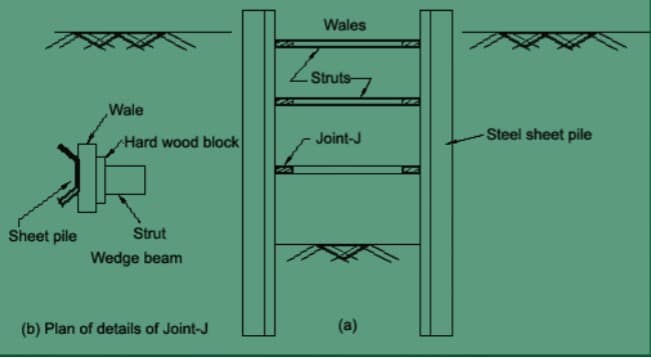
What is Braced Excavation?

Rohan Chaugule
Rohan Chaugule

Rohan Chaugule

  • 12 Questions
  • 11 Answers
  • 1 Best Answer
  • 1,045 Points
View Profile
Rohan Chaugule Expert

What is Braced Excavation?

  1. Kuldeep Singh

    Kuldeep Singh

    • 1 Question
    • 110 Answers
    • 10 Best Answers
    • 652 Points
    View Profile
    Kuldeep Singh Learner
    Added an answer on June 28, 2020 at 10:30 pm
    What is Braced Excavation?

    Braced excavation is a method where deep excavations with straight vertical faces are laterally supported by a sheeting and bracing system until the structure is built. In deep excavations creating a safe slope on the excavation face just for safety is generally not feasible due to high cost, inabunRead more

    Braced excavation is a method where deep excavations with straight vertical faces are laterally supported by a sheeting and bracing system until the structure is built.

    In deep excavations creating a safe slope on the excavation face just for safety is generally not feasible due to high cost, inabundance of space and other structures present nearby. So, the excavation is temperorly supported by sheets/walls and struts, which are removed individually when their requirements cease. Relatively flexible sheets/walls are placed against excavation walls and supported by horizontal struts which in turn resist the earth pressure in compression.

    Some methods are vertical timber sheeting, shoring, steel sheet piling, soldier beams and also tiebacks.

    These structures might not be removed later but they may or may structurallynot be structurally important apart from offering temperorly lateral support. For example, tie backs support excavations and also replace permanent retaining walls.

    See less
    • 2
    • Share
      Share
      • Share on Facebook
      • Share on Twitter
      • Share on LinkedIn
      • Share on WhatsApp
  • 0
  • 3 3 Answers
  • 11,602 Views
  • 0 Followers
Asked: July 19, 2020In: Construction

What is key differences between cable stayed and cable suspension bridge?

Himanshu joshi
Himanshu joshi

Himanshu joshi

  • 11 Questions
  • 27 Answers
  • 0 Best Answers
  • 767 Points
View Profile
Himanshu joshi Learner

What is key differences between cable stayed and cable suspension bridge?

  1. nikeetasharma

    nikeetasharma

    • 23 Questions
    • 303 Answers
    • 0 Best Answers
    • 2,680 Points
    View Profile
    nikeetasharma Guru
    Added an answer on December 17, 2020 at 12:45 pm

    Cable stayed bridges may look similar to suspension bridges. They both have roadways that hang from cables and both have towers. But the two bridges support the load of the roadways in very different ways. The difference lies in how the cables are connected to the towers . In suspension bridges, theRead more

    Cable stayed bridges may look similar to suspension bridges. They both have roadways that hang from cables and both have towers. But the two bridges support the load of the roadways in very different ways. The difference lies in how the cables are connected to the towers . In suspension bridges, the cable ride freely across the towers, transmitting the load to the anchorages at either end. In cable stayed bridges, the cables are attached to the towers, which alone bear the load.

    The cable can be attached to the roadway in a variety of ways. In a radial pattern cables extend from several points on the road to a single point at the top of the tower. In a parallel pattern, cables are attached at different heights along tower running parallel to one another.

    See less
    • 5
    • Share
      Share
      • Share on Facebook
      • Share on Twitter
      • Share on LinkedIn
      • Share on WhatsApp
  • 2
  • 3 3 Answers
  • 16,072 Views
  • 0 Followers
Asked: August 2, 2020In: Transportation

What is the difference between Tar and Bitumen?

vivek gami
vivek gami

vivek gami

  • 54 Questions
  • 16 Answers
  • 5 Best Answers
  • 93 Points
View Profile
vivek gami User

What is the difference between Tar and Bitumen?

  1. Abbas Khan Civil Engineer

    Abbas Khan Civil Engineer

    • 11 Questions
    • 29 Answers
    • 1 Best Answer
    • 925 Points
    View Profile
    Abbas Khan Civil Engineer Learner
    Added an answer on August 10, 2020 at 8:35 am

    Bitumen; BITUMEN is a petroleum product formed by the process of distillation of crude petroleum. It is available both in solid and liquid form. It is providing a good grip to the tyres as compared to the coal tar. Bitumen is available in three types that is; Rapid Setting, Slow Setting and Medium sRead more

    Bitumen;

    BITUMEN is a petroleum product formed by the process of distillation of crude petroleum. It is available both in solid and liquid form. It is providing a good grip to the tyres as compared to the coal tar. Bitumen is available in three types that is; Rapid Setting, Slow Setting and Medium setting. In the modern era, we used bitumen instead of Coal Tar because Coal Tar is Carcinogenic.

    COAL TAR; Coal tar is derived from the coal.It is a black viscous liquid used as a sealing agent in old roads making all over the world. It is not used in the current era, due to the carcinogenic product. It is produced through the process of destructive distillation in the absence of air. Coal Tar not provide enough grip to the tyres of the vehicle and heat up quickly causes wearing out of tyres.

    See less
    • 0
    • Share
      Share
      • Share on Facebook
      • Share on Twitter
      • Share on LinkedIn
      • Share on WhatsApp
  • 1
  • 3 3 Answers
  • 5,819 Views
  • 0 Followers
Asked: July 6, 2020In: Construction

Is it necessary to add a plinth beam between two columns, constructed for installing an iron gate?

Deepak Gautam
Deepak Gautam

Deepak Gautam

  • 2 Questions
  • 0 Answers
  • 0 Best Answers
  • 11 Points
View Profile
Deepak Gautam User

Is it necessary to add a plinth beam between two columns, constructed for installing an iron gate?

  1. aviratdhodare

    aviratdhodare

    • 37 Questions
    • 252 Answers
    • 0 Best Answers
    • 480 Points
    View Profile
    aviratdhodare
    Added an answer on September 8, 2020 at 2:19 pm

    If the columns and their foundations have been designed considering the loads (direct force and moment) from the iron gates then a tie beam at ground level is not necessary. But a tie beam can help in reducing the foundation width in one direction as this beam will help to prevent overturning in oneRead more

    If the columns and their foundations have been designed considering the loads (direct force and moment) from the iron gates then a tie beam at ground level is not necessary.

    But a tie beam can help in reducing the foundation width in one direction as this beam will help to prevent overturning in one direction (if the columns are not joined by plinth beams towards wall boundaries). Another benefit of a tie beam is the extra strength provided in case of impact by a vehicle to the columns.

    See less
    • 34
    • Share
      Share
      • Share on Facebook
      • Share on Twitter
      • Share on LinkedIn
      • Share on WhatsApp
  • 3
  • 3 3 Answers
  • 5,265 Views
  • 0 Followers
Asked: September 19, 2020In: Structural Engineering

What is a convergent beam? Why is it so important?

aviratdhodare
aviratdhodare

aviratdhodare

  • 37 Questions
  • 252 Answers
  • 0 Best Answers
  • 480 Points
View Profile
aviratdhodare

What is a convergent beam? Why is it so important?

  1. Komal Bhandakkar

    Komal Bhandakkar

    • 49 Questions
    • 255 Answers
    • 0 Best Answers
    • 2,050 Points
    View Profile
    Komal Bhandakkar AUTHOR
    Added an answer on November 20, 2020 at 3:46 pm
    This answer was edited.

    A convergent beam of light: Whenever several rays coming from different directions & meet at a single point are nothing but the Light's convergent beam. Thank You.

    A convergent beam of light:

    Whenever several rays coming from different directions & meet at a single point are nothing but the Light’s convergent beam.

    Thank You.

    See less
    • 1
    • Share
      Share
      • Share on Facebook
      • Share on Twitter
      • Share on LinkedIn
      • Share on WhatsApp
  • 30
  • 3 3 Answers
  • 2,102 Views
  • 0 Followers
Asked: July 19, 2020In: Geotechnical Engineering

Why abutment in bridge is designed as earth pressure and rest condition?

Himanshu joshi
Himanshu joshi

Himanshu joshi

  • 11 Questions
  • 27 Answers
  • 0 Best Answers
  • 767 Points
View Profile
Himanshu joshi Learner

Why abutment in bridge is designed as earth pressure and rest condition?

  1. nikeetasharma

    nikeetasharma

    • 23 Questions
    • 303 Answers
    • 0 Best Answers
    • 2,680 Points
    View Profile
    nikeetasharma Guru
    Added an answer on December 17, 2020 at 12:03 pm

    Abutment in bridge is designed as earth pressure and rest condition because abutments support the ends of the bridge and transfer the loads from the superstructure in to the ground. The abutments also support the bearing devices and the backwalls Moreover, bridge abutments connect the deck, or surfaRead more

    Abutment in bridge is designed as earth pressure and rest condition because abutments support the ends of the bridge and transfer the loads from the superstructure in to the ground. The abutments also support the bearing devices and the backwalls Moreover, bridge abutments connect the deck, or surface of the bridge, to the ground and help support its weight both horizontally and vertically. On short bridges, one abutment is placed at either end of the bridge and connected to the embankment, sometimes including a retaining wall.

    See less
    • 0
    • Share
      Share
      • Share on Facebook
      • Share on Twitter
      • Share on LinkedIn
      • Share on WhatsApp
  • 1
  • 3 3 Answers
  • 2,231 Views
  • 0 Followers
Asked: August 17, 2020In: Construction Site Related

Which type of Paint is Best for the Exterior walls of the Building?

[Deleted User]
[Deleted User]

Which type of Paint is Best for the Exterior walls of the Building?

  1. aviratdhodare

    aviratdhodare

    • 37 Questions
    • 252 Answers
    • 0 Best Answers
    • 480 Points
    View Profile
    aviratdhodare
    Added an answer on August 21, 2020 at 12:20 pm

    External walls have to be bear many things like bad weather, stormy winds, temperature variations, etc., So they have to be very tough, impenetrable. So the paint to be applied on that should help the wall do so. For exterior walls paints must have these properties..... UV resistance Water resistancRead more

    External walls have to be bear many things like bad weather, stormy winds, temperature variations, etc., So they have to be very tough, impenetrable.

    So the paint to be applied on that should help the wall do so.

    For exterior walls paints must have these properties…..

    1. UV resistance
    2. Water resistancE
    3. Dirt pickup resistance
    4. Thermal insulation
    5. Anti algae & anti fungal property
    6. Wet scrub resistance

    Apart from these many other properties like good sheen, highly elongation, etc must be in high extent in the paint for best performance.

    Paints good to be applied on the outer walls are

    • Latex based
    • satin and eggshell

    Now the brands

    In the current scenario, given the R & D development most companies like Asian paints, Berger, Nerolac have similar quality paint. Slightly ahead would be Dulux.

    The most important thing is not the paint but the painter

    In the case of Exterior Paints Dulux Weathershield, Nerolac Excel, Asian Paints Ultima Protek, and Apex Ultima pitch in. It is good to choose products that suit your requirements rather than brands while choosing paints for interiors and exteriors of houses.

    See less
    • 35
    • Share
      Share
      • Share on Facebook
      • Share on Twitter
      • Share on LinkedIn
      • Share on WhatsApp
  • 0
  • 3 3 Answers
  • 3,527 Views
  • 0 Followers
Load More Questions

Sidebar

Explore

  • Questions
  • Ask Questions
  • Write for us
  • Artificial Intelligence
  • Sustainability
  • Building
    • Brick Masonry
    • Building Materials
    • Building Tips
    • Formwork/Shuttering
  • Concrete
    • Concrete Admixtures
    • Cement
    • Concrete Cracks
    • Concrete Properties
  • Construction
    • Construction Equipments
    • Construction Management
    • Construction Project
    • Estimating & Costing
  • How To Guide
    • Material Estimation
    • Repair/Protection Guide
    • Material Testing Guide
    • Mix Design Guide
    • Rate Analysis
  • Geotechnical
    • Foundation Engineering
    • Ground Improvement
  • Structural Engineering
    • Strengthening of Structure
    • Structual Inspection
    • Structural Detailing
  • Surveying
  • Tips

Footer

  • Ask Questions
  • Write for us
  • Popular Questions
  • Facebook
  • Instagram
  • Twitter
  • Telegram

© 2009-2021 The Constructor. All Rights Reserved.