

Sign Up

Join TheConstructor to ask questions, answer questions, write articles, and connect with other people. When you join you get additional benefits.

Have an account? Sign In


Have an account? Sign In Now

Sign In

Log in to TheConstructor to ask questions, answer people’s questions, write articles & connect with other people. When you join you get additional benefits.

Sign Up Here

Join for free or log in to continue reading...


Forgot Password?

Don't have account, Sign Up Here

Forgot Password

Lost your password? Please enter your email address. You will receive a link and will create a new password via email.

Have an account? Sign In Now

Sorry, you do not have a permission to ask a question, You must login to ask question. Get the paid membership

Join for free or log in to continue reading...


Forgot Password?

Don't have account, Sign Up Here
Get the paid membership
theconstructor.org Logo theconstructor.org Logo
Log inJoin

theconstructor.org

theconstructor.org Navigation

  • Articles
    • Recent Articles
    • Popular Articles
    • Write for us
  • Community
  • Categories
    • How To Guide
      • Material Testing Guide
    • Concrete
    • Building
      • Brick Masonry
      • Building Materials
      • Building Tips
    • Construction
      • Equipments
      • Management
    • Digital Construction
    • Geotechnical
      • Foundation
  • Case Studies
Search
Ask A Question

Mobile menu

Close
Ask a Question
  • Questions
  • Ask Questions
  • Write for us
  • Artificial Intelligence
  • Sustainability
  • Building
    • Brick Masonry
    • Building Materials
    • Building Tips
    • Formwork/Shuttering
  • Concrete
    • Concrete Admixtures
    • Cement
    • Concrete Cracks
    • Concrete Properties
  • Construction
    • Construction Equipments
    • Construction Management
    • Construction Project
    • Estimating & Costing
  • How To Guide
    • Material Estimation
    • Repair/Protection Guide
    • Material Testing Guide
    • Mix Design Guide
    • Rate Analysis
  • Geotechnical
    • Foundation Engineering
    • Ground Improvement
  • Structural Engineering
    • Strengthening of Structure
    • Structual Inspection
    • Structural Detailing
  • Surveying
  • Tips

What are the type of Soil Stabilization of Highway Embankment?

Home/ Questions/Q 47385
Next
In Process

Do you need to remove the ads? Get the paid membership

Asked: July 29, 20202020-07-29T21:32:17-07:00 2020-07-29T21:32:17-07:00In: Construction Site Related
civl engineer
civl engineer

civl engineer

  • 6 Questions
  • 0 Answers
  • 0 Best Answers
  • 30 Points
View Profile
civl engineer User

What are the type of Soil Stabilization of Highway Embankment?

  • 0
  • 5 5 Answers
  • 1,277 Views
  • 1 Follower
  • 0
  • Share
    Share
    • Share on Facebook
    • Share on Twitter
    • Share on LinkedIn
    • Share on WhatsApp

5 Answers

  • Voted
  • Oldest
  • Recent
  1. CB Sowmya

    CB Sowmya

    • 3 Questions
    • 53 Answers
    • 4 Best Answers
    • 5 Points
    View Profile
    CB Sowmya User
    2020-07-30T22:59:13-07:00Added an answer on July 30, 2020 at 10:59 pm

    There are four types of stabilization

    1. Mechanical
    2. Chemicals
    3. Biological
    4. Using polymers

    Mechanical:

    This includes compacting the soil to physically change the properties of the soil. The compaction can be either vibrating or dynamic.

    Another way to mechanically stabilize the soil is to remove excess water from the soil.

    Chemical:

    The soil is stabilized by adding chemicals to the soil. The chemicals include cement, fly ash, lime, GGBS, bitumen, and pozzolana

    Biological:

    Planting trees will reduce erosion in highways close to rivers and canals. Trees will hold the soil particles together creating optimal soil porosity and retaining water.

    Using Polymers:

    These include using geopolymers, textiles, and other synthetically woven materials that have high strength.

    • 0
    • Share
      Share
      • Share on Facebook
      • Share on Twitter
      • Share on LinkedIn
      • Share on WhatsApp
  2. Amol M.

    Amol M.

    • 0 Questions
    • 8 Answers
    • 0 Best Answers
    • 207 Points
    View Profile
    Amol M. Beginner
    2020-07-30T23:25:21-07:00Added an answer on July 30, 2020 at 11:25 pm

    Soil stabilization of highway embankment

    Soil Stabilization
    • Mechanical stabilization: Improvement of soil properties can be achieved by changing particle gradation. The engineering performance depends
    mainly on grain size distribution and plasticity.
    Significant changes in the properties can be made by the addition or removal of suitable soil fractions.
    Granular fraction imparts strength and hardness. Fine fraction imparts cohesion, water, retention capacity and it acts as filler.
    • Extreme caution is required for adding fine to roadbases and subgrades.
    • The common technique of soil alteration is the addition of sodium montmorillonite (bentonite) to reduce the permeability of the soil. Addition of 10% of bentonite reduces permeability coefficient k. Asphalt
    have been also tried.

    Lime Stabilization :
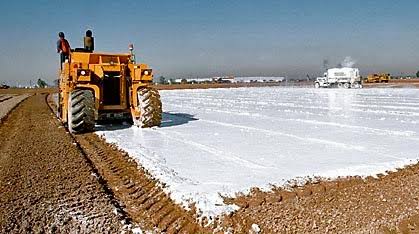
    Hydrated (or slacked) lime is very effective in
    treating heavy plastic clayey soils. Lime may be used alone or in combination with cement, bitumen, or flash. Lime has been mainly used for stabilizing the
    road bases and subgrades.
    • On addition of lime to the soil, two main types of
    chemical reactions occur i) alteration in the nature of the adsorbed layer through base exchange phenomenon and ii) cementing or pozzolanic action.
    Lime reduces P.I. of highly plastic soils making them more friable and easy to be handled and pulverized.
    The P.I. of low plasticity generally increases. There is generally an increase in the O.M.C. and decrease in the compacted density, by strength and durability
    increases.
    • Normally 2 10 8 % of lime may be required for coarse-grained soils and 5 to IO % for plastic soil.

    Cement Stabilization :
    The soil stabilized with cement (Portland) is known as soil cement. The cementing action is believed to be the result of chemical reactions of cement with silicious soil during hydration. The binding action of individual
    particles through cement may be possible only in coarse-grained soils. In cohesive soils, only some of the particles can be excepted to have cement bonds and the rest will be bonded through natural cohesion.

    Bitumen Stabilization :
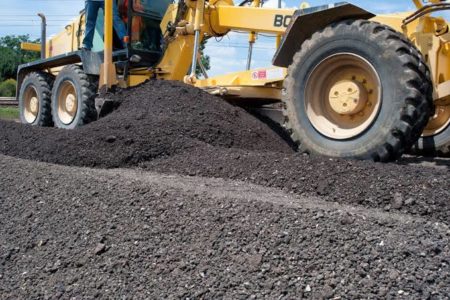
    • Earth roads can be improved by spraying the dry soil surface with a stabilizer such as aspheric and cut back bitumen oil, tars, or emulsions in small quantities. The bituminous materials when added to soil impact cohesion or binding action and reduce water absorption. About 4 to 7 % by weight of
    bitumen is required. Any inorganic soil can be
    stabilized well-graded soils give goods results from 10^3 mm/s to 10^8 mm/s in case of silty sands. Local clays may be used.

    These are the methods of stabilization

    • 0
    • Share
      Share
      • Share on Facebook
      • Share on Twitter
      • Share on LinkedIn
      • Share on WhatsApp
  3. Vivek Patel

    Vivek Patel

    • 39 Questions
    • 80 Answers
    • 1 Best Answer
    • 6 Points
    View Profile
    Vivek Patel User
    2020-07-31T15:25:15-07:00Added an answer on July 31, 2020 at 3:25 pm


    There are two main type

    1. Mechanical method
    2. Chemical method


    Mechanical method

    This includes compacting the soil, for physical change the properties of the soil.

    Another way to mechanically stabilize the soil is to remove excess water from the soil; hence soil consolidation occurs.

    Chemical method

    The soil is stabilized by adding chemicals to the soil. The various chemicals is cement, fly ash, lime, GGBS, bitumen, and pozzolana

    • 0
    • Share
      Share
      • Share on Facebook
      • Share on Twitter
      • Share on LinkedIn
      • Share on WhatsApp
  4. nikeetasharma

    nikeetasharma

    • 23 Questions
    • 303 Answers
    • 0 Best Answers
    • 2,680 Points
    View Profile
    nikeetasharma Guru
    2020-11-29T17:29:54-08:00Added an answer on November 29, 2020 at 5:29 pm

    There are three broad types of soil stabilization, they are;

    1. Biological soil stabilization :- This is achieved through afforestation or planting and its main purpose is erosion control. Root traits such as architectural, morphology, physiological and biotic play an important role in both the physical and chemical development of soils enabling structural stability of soil.

    2. Physical stabilization :- It is the modification of soil particle size distribution and plasticity by the addition or subtraction of different soil fractions in order to modify its physical properties.

    3. Chemical types of soil stabilization :- It can be achieved through use of traditional and non-traditional agents.

    • 0
    • Share
      Share
      • Share on Facebook
      • Share on Twitter
      • Share on LinkedIn
      • Share on WhatsApp
  5. nikeetasharma

    nikeetasharma

    • 23 Questions
    • 303 Answers
    • 0 Best Answers
    • 2,680 Points
    View Profile
    nikeetasharma Guru
    2020-12-21T18:28:53-08:00Added an answer on December 21, 2020 at 6:28 pm

    An embankment refers to a volume of earthen material that is placed and compacted for the purpose of raising the grade of a roadway (or railway) above the level of the existing surrounding ground surface. Highway embankments made of heavy materials are often built over soft ground and this can sometimes leads to settlement and instability of the embankment.

    • 0
    • Share
      Share
      • Share on Facebook
      • Share on Twitter
      • Share on LinkedIn
      • Share on WhatsApp

You must login to add an answer.

Join for free or log in to continue reading...


Forgot Password?

Need An Account, Sign Up Here

Sidebar

Explore

  • Questions
  • Ask Questions
  • Write for us
  • Artificial Intelligence
  • Sustainability
  • Building
    • Brick Masonry
    • Building Materials
    • Building Tips
    • Formwork/Shuttering
  • Concrete
    • Concrete Admixtures
    • Cement
    • Concrete Cracks
    • Concrete Properties
  • Construction
    • Construction Equipments
    • Construction Management
    • Construction Project
    • Estimating & Costing
  • How To Guide
    • Material Estimation
    • Repair/Protection Guide
    • Material Testing Guide
    • Mix Design Guide
    • Rate Analysis
  • Geotechnical
    • Foundation Engineering
    • Ground Improvement
  • Structural Engineering
    • Strengthening of Structure
    • Structual Inspection
    • Structural Detailing
  • Surveying
  • Tips

Footer

  • Ask Questions
  • Write for us
  • Popular Questions
  • Facebook
  • Instagram
  • Twitter
  • Telegram

© 2009-2021 The Constructor. All Rights Reserved.