Sign Up

Join TheConstructor to ask questions, answer questions, write articles, and connect with other people. When you join you get additional benefits.

Have an account? Sign In


Have an account? Sign In Now

Sign In

Log in to TheConstructor to ask questions, answer people’s questions, write articles & connect with other people. When you join you get additional benefits.

Sign Up Here

Join for free or log in to continue reading...


Forgot Password?

Don't have account, Sign Up Here

Forgot Password

Lost your password? Please enter your email address. You will receive a link and will create a new password via email.

Have an account? Sign In Now

Sorry, you do not have a permission to ask a question, You must login to ask question. Get the paid membership

Join for free or log in to continue reading...


Forgot Password?

Don't have account, Sign Up Here
Get the paid membership
theconstructor.org Logo theconstructor.org Logo
Log inJoin

theconstructor.org

theconstructor.org Navigation

  • Articles
    • Recent Articles
    • Popular Articles
    • Write for us
  • Community
  • Categories
    • How To Guide
      • Material Testing Guide
    • Concrete
    • Building
      • Brick Masonry
      • Building Materials
      • Building Tips
    • Construction
      • Equipments
      • Management
    • Digital Construction
    • Geotechnical
      • Foundation
  • Case Studies
Search
Ask A Question

Mobile menu

Close
Ask a Question
  • Questions
  • Ask Questions
  • Write for us
  • Artificial Intelligence
  • Sustainability
  • Building
    • Brick Masonry
    • Building Materials
    • Building Tips
    • Formwork/Shuttering
  • Concrete
    • Concrete Admixtures
    • Cement
    • Concrete Cracks
    • Concrete Properties
  • Construction
    • Construction Equipments
    • Construction Management
    • Construction Project
    • Estimating & Costing
  • How To Guide
    • Material Estimation
    • Repair/Protection Guide
    • Material Testing Guide
    • Mix Design Guide
    • Rate Analysis
  • Geotechnical
    • Foundation Engineering
    • Ground Improvement
  • Structural Engineering
    • Strengthening of Structure
    • Structual Inspection
    • Structural Detailing
  • Surveying
  • Tips

Popular Questions

Home/Popular Questions/Page 29

Do you need to remove the ads? Get the paid membership

Discy Latest Questions

Asked: September 19, 2020In: Concrete

what is the need to design a mix in concrere

Komal Bhandakkar
Komal Bhandakkar

Komal Bhandakkar

  • 49 Questions
  • 255 Answers
  • 0 Best Answers
  • 2,050 Points
View Profile
Komal Bhandakkar AUTHOR

 what is the need to design a mix concrete ?

  1. nikeetasharma

    nikeetasharma

    • 23 Questions
    • 303 Answers
    • 0 Best Answers
    • 2,680 Points
    View Profile
    nikeetasharma Guru
    Added an answer on December 17, 2020 at 4:03 pm

    Good concrete mix design creates the foundation of a sound infrastructure. Concrete mix design involves a process of preparation in which a mix of ingredients creates the required strength and durability for the concrete structure.

    Good concrete mix design creates the foundation of a sound infrastructure. Concrete mix design involves a process of preparation in which a mix of ingredients creates the required strength and durability for the concrete structure.

    See less
    • 0
    • Share
      Share
      • Share on Facebook
      • Share on Twitter
      • Share on LinkedIn
      • Share on WhatsApp
  • 28
  • 3 3 Answers
  • 506 Views
  • 0 Followers
Asked: September 25, 2020In: Concrete

What is the difference between plain and reinforced concrete?

nikeetasharma
nikeetasharma

nikeetasharma

  • 23 Questions
  • 303 Answers
  • 0 Best Answers
  • 2,680 Points
View Profile
nikeetasharma Guru

Differentiate between plain and reinforced concrete. Among these to which one gives more strength?

  1. aviratdhodare

    aviratdhodare

    • 37 Questions
    • 252 Answers
    • 0 Best Answers
    • 480 Points
    View Profile
    aviratdhodare
    Added an answer on October 26, 2020 at 9:47 pm

    Basic differences PCC RCC Plain Cement Concrete R/f Cement Concrete It doesn’t carry ‘Steel’. It carries Steel. PCC is weak in tension loading while strong in compression loading. RCC is strong in both. PCC blasts on excessive loading & in an instant w/t giving any warning. RCC gives you enoughRead more

    Basic differences

    PCC RCC
    Plain Cement Concrete R/f Cement Concrete
    It doesn’t carry ‘Steel’. It carries Steel.
    PCC is weak in tension loading while strong in compression loading. RCC is strong in both.
    PCC blasts on excessive loading & in an instant w/t giving any warning. RCC gives you enough time to vacate the structure before collapse.

    What is PCC DPC and RCC in civil engineering | RCC and PCC

      Plain Cement Concrete R/f Cement Concrete
    Tension Steel tendons

    High tensile steel bars

    Included with tension

    Ordinary Mild Steel Deformed Bars

    No tension included

    Basic materials used Min grade of concrete

    Post-Tensioning → M30

    Pre-Tensioning  → M40

    to resist high stresses


    High strength steel to transfer large prestressing force

    Min grade of concrete → M20

    Steel                           → MS

    Effectiveness of member Entire section carries load Does not carries load
    Crack resistance High

    Cracks don’t occur under working loads

    Less
    Wt & suitability Light

    Heavy loads & longer spans

    Heavy

    Wt is more desired than steel

    Equiments Requires many specialized equiments

    Pulling jack, Post-tensioning pump, Master wedges, Anchhor head & bearing

    Doesn’t involve specialized equiments.
    Quality of steel reqd 1/3rd of RCC

    More strength & less c/s area

    More
    Deflection Very less More
    Load carrying capacity & Durability More Less
    Shock resistance More Less
    Yield As high as 2100 N/mm2 200 – 300 N/mm2
    Testing Testing of steel & concrete can be done while prestressing. No way of testing the steel & concrete.
    Cost Economical for span of 10m – 18m.

    As length of span gets ↑

    Cost % ↑

    C/s area of beam ↓

    Economical for span < 9m.
    See less
    • 12
    • Share
      Share
      • Share on Facebook
      • Share on Twitter
      • Share on LinkedIn
      • Share on WhatsApp
  • 38
  • 3 3 Answers
  • 65,204 Views
  • 0 Followers
Asked: October 15, 2020In: Structural Engineering

Can this type of brick bond be used for bearing walls?

Tengo Alaverdashvili

Tengo Alaverdashvili

  • 1 Question
  • 1 Answer
  • 0 Best Answers
  • 11 Points
View Profile
Tengo Alaverdashvili User

Hi. I am an architect and I’d like to hear your advise. Can this type of brick bond be used for a load bearing wall? I think that this zigzag form makes the wall stronger, but will it be enough? I ...

  1. Komal Bhandakkar

    Komal Bhandakkar

    • 49 Questions
    • 255 Answers
    • 0 Best Answers
    • 2,050 Points
    View Profile
    Komal Bhandakkar AUTHOR
    Added an answer on November 5, 2020 at 8:50 pm
    This answer was edited.

    In masonary work, we used usually 1:4 cement-sand mortar of compressive strength 3.8N/mm2. The compressive strength of one brick of standard size is 11.12N/mm2. The compressive strength of brick masonry is 2.5 N/mm2.  Thanks.  

    In masonary work, we used usually 1:4 cement-sand mortar of compressive strength 3.8N/mm2.


    The compressive strength of one brick of standard size is 11.12N/mm2.


    The compressive strength of brick masonry is 2.5 N/mm2.


     Thanks.  

    See less
    • 0
    • Share
      Share
      • Share on Facebook
      • Share on Twitter
      • Share on LinkedIn
      • Share on WhatsApp
  • 2
  • 3 3 Answers
  • 1,453 Views
  • 0 Followers
Asked: May 20, 2020In: Construction

What are the Advantages AAC Masonry over the Conventional Brick Masonry Work ?

Abhishek Kirave
Abhishek Kirave

Abhishek Kirave

  • 2 Questions
  • 2 Answers
  • 0 Best Answers
  • 67 Points
View Profile
Abhishek Kirave User

What are the Advantages AAC Masonry over the Conventional Brick Masonry Work? Which type of wall shall have more strength?

  1. nikeetasharma

    nikeetasharma

    • 23 Questions
    • 303 Answers
    • 0 Best Answers
    • 2,680 Points
    View Profile
    nikeetasharma Guru
    Added an answer on November 28, 2020 at 11:02 am

    AAC is also known as Autoclaved aerated concrete which is a lightweight, precast, foam concrete building material which is suitable for producing concrete masonry unit like blocks. The advantages of AAC masonry over the conventional brick masonry are as follows :- - AAC bricks are eco-friendly whereRead more

    AAC is also known as Autoclaved aerated concrete which is a lightweight, precast, foam concrete building material which is suitable for producing concrete masonry unit like blocks.

    The advantages of AAC masonry over the conventional brick masonry are as follows :-
    – AAC bricks are eco-friendly whereas conventional bricks are not.
    – On AAC block dead load on the structure is low which reduces the consumption of cement, steel and water whereas using red clay brick there’s a heavy dead load on the structure.
    – AAC blocks emits less heat in the atmosphere due to less use of cement, steel and concrete whereas on the other hand red clay bricks emits high heat to the atmosphere.
    – AAC blocks have less material wastage whereas conventional red clay bricks have high material wastage.
    – Thus, AAC have high sound insulation properties and red bricks have low insulation property.

    See less
    • 0
    • Share
      Share
      • Share on Facebook
      • Share on Twitter
      • Share on LinkedIn
      • Share on WhatsApp
  • 0
  • 3 3 Answers
  • 1,464 Views
  • 0 Followers
Asked: July 15, 2020In: Construction

Explain in detail about closer bricks?

DevilAVRT
DevilAVRT

DevilAVRT

  • 27 Questions
  • 49 Answers
  • 3 Best Answers
  • 207 Points
View Profile
DevilAVRT Beginner

Explain in detail about closer bricks?

  1. AdityaBhandakkar

    AdityaBhandakkar

    • 12 Questions
    • 250 Answers
    • 2 Best Answers
    • 0 Points
    View Profile
    AdityaBhandakkar User
    Added an answer on September 18, 2020 at 6:36 pm
    Explain in detail about closer bricks?

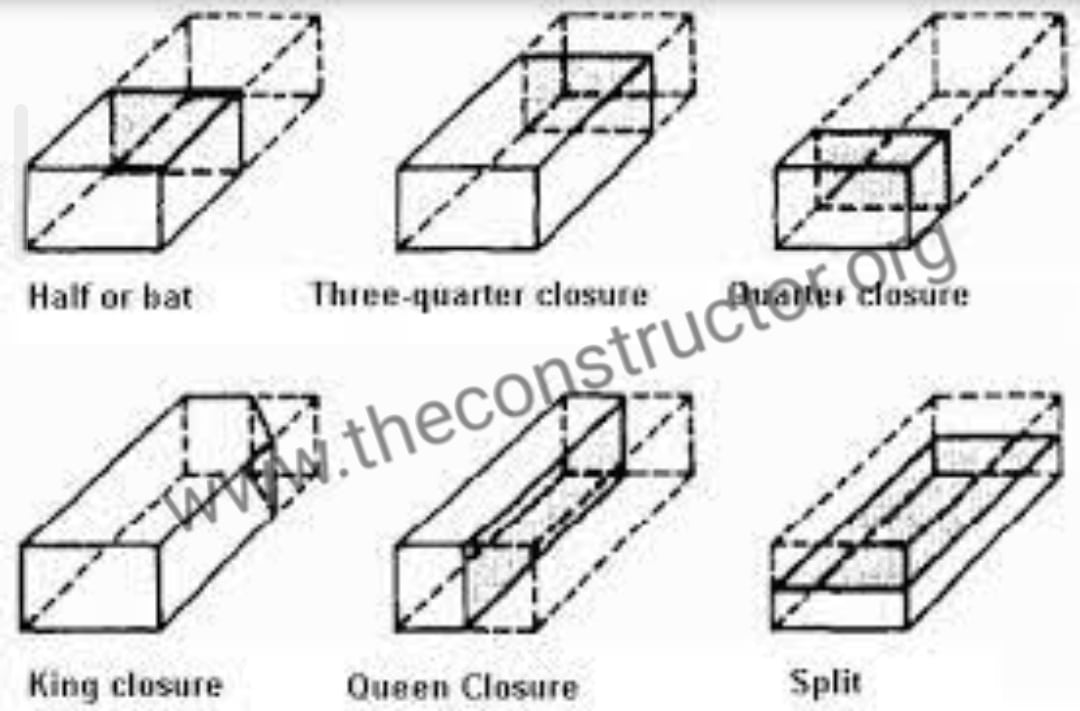
    Closer bricks: the brick is cut in such a way that one portion is kept remains with the break and used another part for closing the gap. Queen closer: the brakes are cut along the length for making two equal parts longitudinally called as Queen closer width of Queen closer brick is half of the origiRead more

    1. Closer bricks: the brick is cut in such a way that one portion is kept remains with the break and used another part for closing the gap.
    2. Queen closer: the brakes are cut along the length for making two equal parts longitudinally called as Queen closer width of Queen closer brick is half of the original brick called as half Queen closer.
    3. King closer: the brick is cut in such a technique that one end of brick width is half of the width of the original brick.
    4. Bevelled closer: in this break, the stretcher face is bevelled in such a way that at one end half-width and on another end, full width is maintained.
    5. Mitred closer: in this break, the one and it is cut in a mitred manner. That is a 45 to 60-degree angle with length. It is shown in the above diagram.
    6. BAT: if along the length, the brick is cut called as a bat.
    7. Half Bat: along the length, bricks are cut into two equal part.
    8. Three-quarter bat: length equal to 3 quarter of the full-length brick.
    9. Bevelled Bat: width is bevelled. As shown in fig.
    See less
    • 50
    • Share
      Share
      • Share on Facebook
      • Share on Twitter
      • Share on LinkedIn
      • Share on WhatsApp
  • 4
  • 3 3 Answers
  • 22,970 Views
  • 0 Followers
Asked: July 17, 2020In: Interview Questions

What is the difference between ductile and malleable property of material?

Himanshu joshi
Himanshu joshi

Himanshu joshi

  • 11 Questions
  • 27 Answers
  • 0 Best Answers
  • 767 Points
View Profile
Himanshu joshi Learner

What is the difference between ductile and malleable property of material?

  1. nikeetasharma

    nikeetasharma

    • 23 Questions
    • 303 Answers
    • 0 Best Answers
    • 2,680 Points
    View Profile
    nikeetasharma Guru
    Added an answer on December 17, 2020 at 1:20 pm

    If we talk about malleability and ductility both are connected or related. A malleable material is one in which a thin sheet can be easily formed by hammering or rolling. In other words, the material has the ability to deform under compressive stress. And here ductility is the ability of the solid mRead more

    If we talk about malleability and ductility both are connected or related. A malleable material is one in which a thin sheet can be easily formed by hammering or rolling. In other words, the material has the ability to deform under compressive stress. And here ductility is the ability of the solid material to deform under tensile stress. Practically, a ductile material is a material that can easily be stretched into a wire when pulled.

    See less
    • 0
    • Share
      Share
      • Share on Facebook
      • Share on Twitter
      • Share on LinkedIn
      • Share on WhatsApp
  • 2
  • 3 3 Answers
  • 1,626 Views
  • 0 Followers
Asked: July 23, 2020In: Concrete

What is meant by Theoretical Thickness in Concrete?

Tips_and_tricks
Tips_and_tricks

Tips_and_tricks

  • 13 Questions
  • 15 Answers
  • 1 Best Answer
  • 685 Points
View Profile
Tips_and_tricks Learner

What is meant by Theoretical Thickness in Concrete?

  1. nikeetasharma

    nikeetasharma

    • 23 Questions
    • 303 Answers
    • 0 Best Answers
    • 2,680 Points
    View Profile
    nikeetasharma Guru
    Added an answer on December 21, 2020 at 1:51 pm

    The thickness of the concrete cover measure is usually part of the concrete quality control in modern construction so as to ensure that the thickness of the concrete cover in conformity with the specifications. The process of measuring the thickness of the concrete cover in structures was noted by tRead more

    The thickness of the concrete cover measure is usually part of the concrete quality control in modern construction so as to ensure that the thickness of the concrete cover in conformity with the specifications. The process of measuring the thickness of the concrete cover in structures was noted by the beginning of the corrosion, as the lack of concrete cover thickness increased the corrosion rate for corrosion as a result of chlorides or carbonation, where it expedited the propagation inside the concrete, causing the speed of steel corrosion as well as the lack of cover helps the propagation of moisture and oxygen, which are form the main basis for the corrosion process.

    See less
    • 0
    • Share
      Share
      • Share on Facebook
      • Share on Twitter
      • Share on LinkedIn
      • Share on WhatsApp
  • 2
  • 3 3 Answers
  • 1,483 Views
  • 0 Followers
Asked: August 2, 2020In: Transportation

What is the ruling radius of a horizontal curve?

AdityaBhandakkar
AdityaBhandakkar

AdityaBhandakkar

  • 12 Questions
  • 250 Answers
  • 2 Best Answers
  • 0 Points
View Profile
AdityaBhandakkar User

What is the ruling radius of a horizontal curve?

  1. aviratdhodare

    aviratdhodare

    • 37 Questions
    • 252 Answers
    • 0 Best Answers
    • 480 Points
    View Profile
    aviratdhodare
    Added an answer on September 7, 2020 at 6:13 pm

    The maximum degree of curve or smallest radius for a railroad is 3 degrees on a new main line track with a maximum grade of 1% compensated at 0.04% per degree of curve; therefore a grade in a 3 degree curve would actually be 0.88%. For a highway it depends on what kind, where, typical traffic, speedRead more

    The maximum degree of curve or smallest radius for a railroad is 3 degrees on a new main line track with a maximum grade of 1% compensated at 0.04% per degree of curve; therefore a grade in a 3 degree curve would actually be 0.88%. For a highway it depends on what kind, where, typical traffic, speed limits, etc.  Degree of curve is the angle between the radii of a curve of a 100 foot chord which is chord definition. Highway departments usually use Degree of Curve as the angle between the radii of a curve of an arc of 100 feet. For curves 3 degrees or under, the difference between the definitions staked on the ground is inconsequential.

    See less
    • 32
    • Share
      Share
      • Share on Facebook
      • Share on Twitter
      • Share on LinkedIn
      • Share on WhatsApp
  • 8
  • 3 3 Answers
  • 1,736 Views
  • 0 Followers
Load More Questions

Sidebar

Explore

  • Questions
  • Ask Questions
  • Write for us
  • Artificial Intelligence
  • Sustainability
  • Building
    • Brick Masonry
    • Building Materials
    • Building Tips
    • Formwork/Shuttering
  • Concrete
    • Concrete Admixtures
    • Cement
    • Concrete Cracks
    • Concrete Properties
  • Construction
    • Construction Equipments
    • Construction Management
    • Construction Project
    • Estimating & Costing
  • How To Guide
    • Material Estimation
    • Repair/Protection Guide
    • Material Testing Guide
    • Mix Design Guide
    • Rate Analysis
  • Geotechnical
    • Foundation Engineering
    • Ground Improvement
  • Structural Engineering
    • Strengthening of Structure
    • Structual Inspection
    • Structural Detailing
  • Surveying
  • Tips

Footer

  • Ask Questions
  • Write for us
  • Popular Questions
  • Facebook
  • Instagram
  • Twitter
  • Telegram

© 2009-2021 The Constructor. All Rights Reserved.