Sign Up

Join TheConstructor to ask questions, answer questions, write articles, and connect with other people. When you join you get additional benefits.

Have an account? Sign In


Have an account? Sign In Now

Sign In

Log in to TheConstructor to ask questions, answer people’s questions, write articles & connect with other people. When you join you get additional benefits.

Sign Up Here

Join for free or log in to continue reading...


Forgot Password?

Don't have account, Sign Up Here

Forgot Password

Lost your password? Please enter your email address. You will receive a link and will create a new password via email.

Have an account? Sign In Now

Sorry, you do not have a permission to ask a question, You must login to ask question. Get the paid membership

Join for free or log in to continue reading...


Forgot Password?

Don't have account, Sign Up Here
Get the paid membership
theconstructor.org Logo theconstructor.org Logo
Log inJoin

theconstructor.org

theconstructor.org Navigation

  • Articles
    • Recent Articles
    • Popular Articles
    • Write for us
  • Community
  • Categories
    • How To Guide
      • Material Testing Guide
    • Concrete
    • Building
      • Brick Masonry
      • Building Materials
      • Building Tips
    • Construction
      • Equipments
      • Management
    • Digital Construction
    • Geotechnical
      • Foundation
  • Case Studies
Search
Ask A Question

Mobile menu

Close
Ask a Question
  • Questions
  • Ask Questions
  • Write for us
  • Artificial Intelligence
  • Sustainability
  • Building
    • Brick Masonry
    • Building Materials
    • Building Tips
    • Formwork/Shuttering
  • Concrete
    • Concrete Admixtures
    • Cement
    • Concrete Cracks
    • Concrete Properties
  • Construction
    • Construction Equipments
    • Construction Management
    • Construction Project
    • Estimating & Costing
  • How To Guide
    • Material Estimation
    • Repair/Protection Guide
    • Material Testing Guide
    • Mix Design Guide
    • Rate Analysis
  • Geotechnical
    • Foundation Engineering
    • Ground Improvement
  • Structural Engineering
    • Strengthening of Structure
    • Structual Inspection
    • Structural Detailing
  • Surveying
  • Tips

Popular Questions

Home/Popular Questions/Page 35

Do you need to remove the ads? Get the paid membership

Discy Latest Questions

Asked: July 16, 2020In: Environmental Engineering

What is Pickup Weir Structure?

vivek gami
vivek gami

vivek gami

  • 54 Questions
  • 16 Answers
  • 5 Best Answers
  • 93 Points
View Profile
vivek gami User

What is Pickup Weir Structure? Why its call pickup? Where it is use?

  1. nikeetasharma

    nikeetasharma

    • 23 Questions
    • 303 Answers
    • 0 Best Answers
    • 2,680 Points
    View Profile
    nikeetasharma Guru
    Added an answer on December 21, 2020 at 3:00 pm

    Weirs are fixed barriers across a river or stream that force water to flow over their tops, where the height of the water above the weir can be used to calculate flow.

    Weirs are fixed barriers across a river or stream that force water to flow over their tops, where the height of the water above the weir can be used to calculate flow.

    See less
    • 0
    • Share
      Share
      • Share on Facebook
      • Share on Twitter
      • Share on LinkedIn
      • Share on WhatsApp
  • 3
  • 3 3 Answers
  • 4,954 Views
  • 0 Followers
Asked: September 22, 2020In: Concrete

Difference between OPC 53 &OPC 43 grade of cement according to the initial and final setting time of cement.

Komal Bhandakkar
Komal Bhandakkar

Komal Bhandakkar

  • 49 Questions
  • 255 Answers
  • 0 Best Answers
  • 2,050 Points
View Profile
Komal Bhandakkar AUTHOR

Difference between OPC 53 &OPC 43 grade of cement according to the initial and final setting time of cement.

  1. nikeetasharma

    nikeetasharma

    • 23 Questions
    • 303 Answers
    • 0 Best Answers
    • 2,680 Points
    View Profile
    nikeetasharma Guru
    Added an answer on November 28, 2020 at 1:15 pm

    OPC 43 :- The 43 grade OPC is the most popular general-purpose cement in the country today. The production of 43 grade OPC is nearly 50% of the total production of cement in the country. This OPC43 continues to gain strength after 28 days. OPC 53 :- The 53 grade OPC is higher strength cement to meetRead more

    OPC 43 :- The 43 grade OPC is the most popular general-purpose cement in the country today. The production of 43 grade OPC is nearly 50% of the total production of cement in the country. This OPC43 continues to gain strength after 28 days.

    OPC 53 :- The 53 grade OPC is higher strength cement to meet the needs of the consumer for higher strength concrete. As per BIS requirements the minimum 28 days compressive strength of 53 grade OPC should not be less than 53 Mpa. Therefore, there is a vast difference in setting time of these cements. It sets very quicker and has low initial setting time. These types of cement can be used where rapid hardening is not needed.

    See less
    • -3
    • Share
      Share
      • Share on Facebook
      • Share on Twitter
      • Share on LinkedIn
      • Share on WhatsApp
  • 34
  • 3 3 Answers
  • 36,186 Views
  • 0 Followers
Asked: September 23, 2020In: Concrete

What is the range of density of Carbon Fibre in Conductive Concrete?

Komal Bhandakkar
Komal Bhandakkar

Komal Bhandakkar

  • 49 Questions
  • 255 Answers
  • 0 Best Answers
  • 2,050 Points
View Profile
Komal Bhandakkar AUTHOR

What is the range of density of Carbon Fibre in Conductive Concrete?

  1. Komal Bhandakkar

    Komal Bhandakkar

    • 49 Questions
    • 255 Answers
    • 0 Best Answers
    • 2,050 Points
    View Profile
    Komal Bhandakkar AUTHOR
    Added an answer on September 28, 2020 at 11:25 pm
    What is the range of density of Carbon Fibre in Conductive Concrete?

    Conductive carbon fiber reinforced concrete is a self-heating material specially used for prevention against ice formation. Following are the specification of Carbon fibre used in conductive concrete; Density-1.81 g/cm 3 Diameter- 7.2 micron Carbon Content-95% Tensile Strength-3800MPa Elastic ModuluRead more

    Conductive carbon fiber reinforced concrete is a self-heating material specially used for prevention against ice formation.


    Following are the specification of Carbon fibre used in conductive concrete;

    1. Density-1.81 g/cm 3
    2. Diameter- 7.2 micron
    3. Carbon Content-95%
    4. Tensile Strength-3800MPa
    5. Elastic Modulus-242GPa
    6. Resistivity-1.52 x 10^3

    See less
    • 35
    • Share
      Share
      • Share on Facebook
      • Share on Twitter
      • Share on LinkedIn
      • Share on WhatsApp
  • 33
  • 3 3 Answers
  • 2,752 Views
  • 0 Followers
Asked: October 8, 2020In: Interview Questions

What is Golden Ratio?

Komal Bhandakkar
Komal Bhandakkar

Komal Bhandakkar

  • 49 Questions
  • 255 Answers
  • 0 Best Answers
  • 2,050 Points
View Profile
Komal Bhandakkar AUTHOR

What is Golden Ratio? How can we find out the Golden Ratio of any rectangular shaped body?

  1. aviratdhodare

    aviratdhodare

    • 37 Questions
    • 252 Answers
    • 0 Best Answers
    • 480 Points
    View Profile
    aviratdhodare
    Added an answer on October 15, 2020 at 9:44 pm

    The Golden Ratio is an irrational number with never-ending infinite numbers of digits, 1.618033988749895..., which are highly confusing and misleading. It is a linear number and represents only two dimensions of the object. Drawing It Here is one way to draw a rectangle with the Golden Ratio: Draw aRead more

    The Golden Ratio is an irrational number with never-ending infinite numbers of digits, 1.618033988749895…, which are highly confusing and misleading. It is a linear number and represents only two dimensions of the object.

    Drawing It

    Here is one way to draw a rectangle with the Golden Ratio:

    • Draw a square (of size “1”)
    • Place a dot half way along one side
    • Draw a line from that point to an opposite corner (it will be √5/2 in length)
    • Turn that line so that it runs along the square’s side

    Then you can extend the square to be a rectangle with the Golden Ratio.

    See less
    • 13
    • Share
      Share
      • Share on Facebook
      • Share on Twitter
      • Share on LinkedIn
      • Share on WhatsApp
  • 16
  • 3 3 Answers
  • 1,943 Views
  • 1 Follower
Asked: November 30, 2017In: Construction

What are the types of slabs and how to design them?

Gopal Mishra
Gopal Mishra

Gopal Mishra

  • 75 Questions
  • 44 Answers
  • 7 Best Answers
  • 577 Points
View Profile
Gopal Mishra

Can you tell me types of slabs? And how can we design them?

  1. aviratdhodare

    aviratdhodare

    • 37 Questions
    • 252 Answers
    • 0 Best Answers
    • 480 Points
    View Profile
    aviratdhodare
    Added an answer on August 17, 2020 at 8:40 am

    Flat slab - Flat slab is minimum 8″ or 0.2m. Slab without drop and column without column head(capital). Slab with drop and column without column head. Slab without drop and column with column head. Slab with drop and column with column head. Conventional slab - conventional slab is 4″ or 10cm. 5″ toRead more

    Flat slab – Flat slab is minimum 8″ or 0.2m.

    1. Slab without drop and column without column head(capital).
    2. Slab with drop and column without column head.
    3. Slab without drop and column with column head.
    4. Slab with drop and column with column head.


    Conventional slab – conventional slab is 4″ or 10cm. 5″ to 6″ inches

    1. One-Way Slab
    2. Two-Way Slab

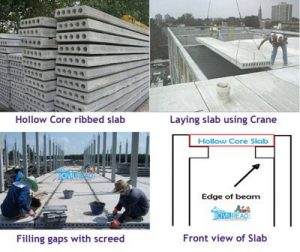
    Hollow core ribbed slab

    hollow core ribbed slab

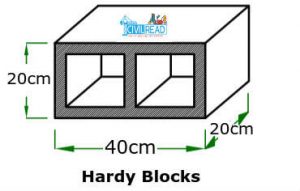
    Hardy slab

    1. One way Hardy Slab
    2. Two way Hardy slab

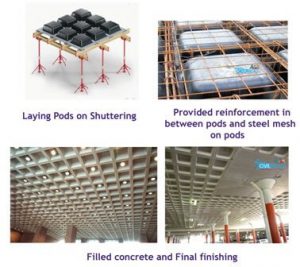
    Waffle slab

    1. Triangular pod system
    2. Square pod system

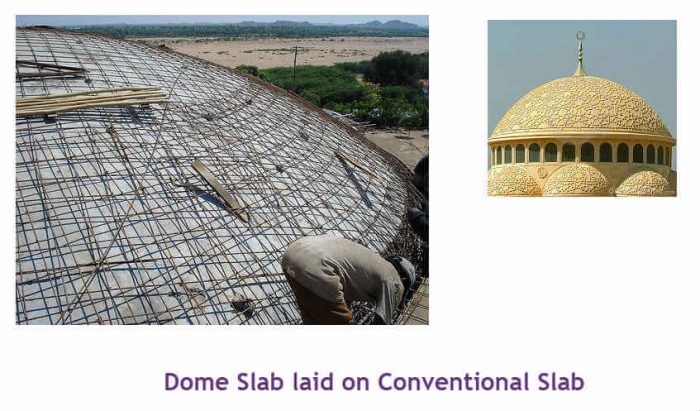
    Dome slab

    dome slab

    Pitch roof slab

    Pitch roof slab

    Slab with arches

    arch slab

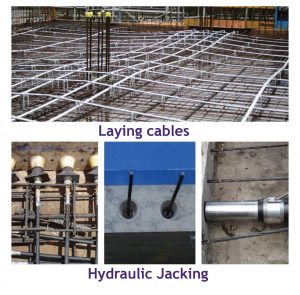
    Post tension slab

    post tension slab

    Pre tension Slab

    Low roof slab

    Projected slab

    projected slab

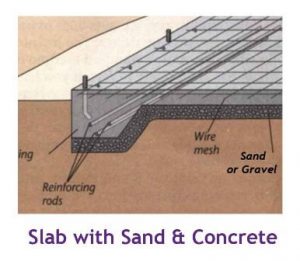
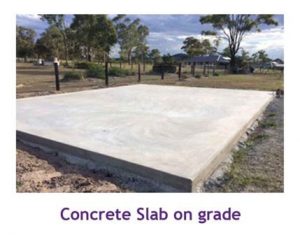
    Grads Slab/ Slab on grade

    slab with sand and concreteconcrete slab

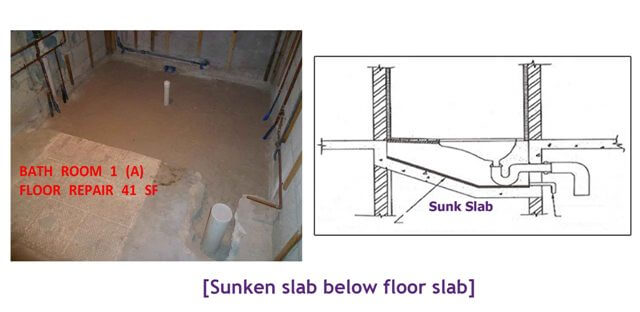
    Sunken Slab

    sunken slab below ground level


    a) Effective span of slab:

    Effective span of slab shall be lesser of the two

    1. L = clear span + d (effective depth )

    2. L = Center to center distance between the support

    b) Depth of slab:

    The depth of slab depends on bending moment and deflection criterion. the trail depth can be obtained using:

    • Effective depth d= Span /((L/d)Basic x modification factor)
    • For obtaining modification factor, the percentage of steel for slab can be assumed from 0.2 to 0.5%.
    • The effective depth d of two way slabs can also be assumed using cl.24.1,IS 456 provided short span is 3.5m and loading class is <3.5KN/m2

    Type of support

    Simply supported

    Fe-250 – L/35

    Fe-415 – L/28

    Continuous support

    Fe-250 – L/40

    Fe-415 – L/32

    Or, the following thumb rules can be used:

    • One way slab d=(L/22) to (L/28).
    • Two way simply supported slab d=(L/20) to (L/30)
    • Two way restrained slab d=(L/30) to (L/32)

    c) Load on slab:

    The load on slab comprises of Dead load, floor finish and live load. The loads are calculated per unit area (load/m2).

    Dead load = D x 25 kN/m2 ( Where D is thickness of slab in m)

    Floor finish (Assumed as)= 1 to 2 kN/m2

    Live load (Assumed as) = 3 to 5 kN/m2 (depending on the occupancy of the building)

    Detailing Requirements of RCC Slab as per IS456: 2000

    a) Nominal Cover:

    For Mild exposure – 20 mm

    For Moderate exposure – 30 mm

    However, if the diameter of bar do not exceed 12 mm, or cover may be reduced by 5 mm. Thus for main reinforcement up to 12 mm diameter bar and for mild exposure, the nominal cover is 15 mm.

    b) Minimum reinforcement: The reinforcement in either direction in slab shall not be less than

    • 0.15% of the total cross sectional area for Fe-250 steel
    • 0.12% of the total cross-sectional area for Fe-415 & Fe-500 steel.

    c) Spacing of bars: The maximum spacing of bars shall not exceed

    • Main Steel – 3d or 300 mm whichever is smaller
    • Distribution steel –5d or 450 mm whichever is smaller Where, ‘d’ is the effective depth of slab. Note: The minimum clear spacing of bars is not kept less than 75 mm (Preferably 100 mm) though code do not recommend any value.

    d) Maximum diameter of bar: The maximum diameter of bar in slab, shall not exceed D/8, where D is the total thickness of slab.


    See less
    • 33
    • Share
      Share
      • Share on Facebook
      • Share on Twitter
      • Share on LinkedIn
      • Share on WhatsApp
  • 2
  • 3 3 Answers
  • 10,678 Views
  • 0 Followers
Asked: July 3, 2020In: Interview Questions

Why gravity dam is called gravity dam ?

Jigar Chaudhari
Jigar Chaudhari

Jigar Chaudhari

  • 2 Questions
  • 1 Answer
  • 0 Best Answers
  • 17 Points
View Profile
Jigar Chaudhari User

Why gravity dam is called a gravity dam? Is there any reason behind the name?  

  1. Kuldeep Singh

    Kuldeep Singh

    • 1 Question
    • 110 Answers
    • 10 Best Answers
    • 652 Points
    View Profile
    Kuldeep Singh Learner
    Added an answer on July 4, 2020 at 5:06 pm

    Gravity dam, as the name suggests, is a dam that resists the water upstream by the use of its weight itself, unlike earthen dams and embankment dams that employ the shear strength of the soil. The dam is designed so that the resultant of the water pressure, earth pressure, and all other forces are aRead more

    Gravity dam, as the name suggests, is a dam that resists the water upstream by the use of its weight itself, unlike earthen dams and embankment dams that employ the shear strength of the soil.

    The dam is designed so that the resultant of the water pressure, earth pressure, and all other forces are aligned and balanced by the weight of the dam itself.

    They are generally made of Roller compacted concrete.

    See less
    • 0
    • Share
      Share
      • Share on Facebook
      • Share on Twitter
      • Share on LinkedIn
      • Share on WhatsApp
  • 1
  • 3 3 Answers
  • 2,145 Views
  • 0 Followers
Asked: September 22, 2020In: Construction

Why the colour of a civil engineer’s cap is only white?

Komal Bhandakkar
Komal Bhandakkar

Komal Bhandakkar

  • 49 Questions
  • 255 Answers
  • 0 Best Answers
  • 2,050 Points
View Profile
Komal Bhandakkar AUTHOR

Why the colour of a civil engineer’s cap is only white? What is the purpose of it?

  1. aviratdhodare

    aviratdhodare

    • 37 Questions
    • 252 Answers
    • 0 Best Answers
    • 480 Points
    View Profile
    aviratdhodare
    Added an answer on September 28, 2020 at 2:03 pm

    It turns out that colors like yellow and red are common indicative colours that appear in nature, and humans, along with many predators have evolved to easily spot such colorations. However yellow is a bright and noticeable colour that doesn't usually appear elsewhere in our modern world, so is easiRead more

    It turns out that colors like yellow and red are common indicative colours that appear in nature, and humans, along with many predators have evolved to easily spot such colorations.

    However yellow is a bright and noticeable colour that doesn’t usually appear elsewhere in our modern world, so is easily noticed.

    See less
    • 31
    • Share
      Share
      • Share on Facebook
      • Share on Twitter
      • Share on LinkedIn
      • Share on WhatsApp
  • 26
  • 3 3 Answers
  • 5,673 Views
  • 0 Followers
Asked: September 25, 2020In: Structural Engineering

How do you calculate twisting moment?

nikeetasharma
nikeetasharma

nikeetasharma

  • 23 Questions
  • 303 Answers
  • 0 Best Answers
  • 2,680 Points
View Profile
nikeetasharma Guru

how to calculate twisting moment?

  1. nikeetasharma

    nikeetasharma

    • 23 Questions
    • 303 Answers
    • 0 Best Answers
    • 2,680 Points
    View Profile
    nikeetasharma Guru
    Added an answer on October 15, 2020 at 10:10 am

    Torsion is the twisting of a beam under the action of a torque (twisting moment). It is systematically applied to screws, nuts, axles, drive shafts etc, and is also generated more randomly under service conditions in car bodies, boat hulls, aircraft fuselages, bridges, springs and many other structuRead more

    Torsion is the twisting of a beam under the action of a torque (twisting moment). It is systematically applied to screws, nuts, axles, drive shafts etc, and is also generated more randomly under service conditions in car bodies, boat hulls, aircraft fuselages, bridges, springs and many other structures and components. A torque, T , has the same units (N m) as a bending moment, M . Both are the product of a force and a distance. In the case of a torque, the force is tangential and the distance is the radial distance between this tangent and the axis of rotation.

    All torsion problems can be solved using the following formula:

    T/J = shear stress/ r = (G * angle)/ L

    where:

    T = torque or twisting moment, [N×m, lb×in]
    J = polar moment of inertia or polar second moment of area about shaft axis, [m4, in4]
    τ = shear stress at outer fibre, [Pa, psi]
    r = radius of the shaft, [m, in]
    G = modulus of rigidity (PanGlobal and Reed’s) or shear modulus (everybody else), [Pa, psi]
    θ = angle of twist, [rad]
    L = length of the shaft, [m, in]

    See less
    • 30
    • Share
      Share
      • Share on Facebook
      • Share on Twitter
      • Share on LinkedIn
      • Share on WhatsApp
  • 34
  • 3 3 Answers
  • 17,794 Views
  • 0 Followers
Load More Questions

Sidebar

Explore

  • Questions
  • Ask Questions
  • Write for us
  • Artificial Intelligence
  • Sustainability
  • Building
    • Brick Masonry
    • Building Materials
    • Building Tips
    • Formwork/Shuttering
  • Concrete
    • Concrete Admixtures
    • Cement
    • Concrete Cracks
    • Concrete Properties
  • Construction
    • Construction Equipments
    • Construction Management
    • Construction Project
    • Estimating & Costing
  • How To Guide
    • Material Estimation
    • Repair/Protection Guide
    • Material Testing Guide
    • Mix Design Guide
    • Rate Analysis
  • Geotechnical
    • Foundation Engineering
    • Ground Improvement
  • Structural Engineering
    • Strengthening of Structure
    • Structual Inspection
    • Structural Detailing
  • Surveying
  • Tips

Footer

  • Ask Questions
  • Write for us
  • Popular Questions
  • Facebook
  • Instagram
  • Twitter
  • Telegram

© 2009-2021 The Constructor. All Rights Reserved.