
Construction Site Related
Home/Construction Site Related/Page 5Do you need to remove the ads? Get the paid membership
Join TheConstructor to ask questions, answer questions, write articles, and connect with other people. When you join you get additional benefits.
Log in to TheConstructor to ask questions, answer people’s questions, write articles & connect with other people. When you join you get additional benefits.
Lost your password? Please enter your email address. You will receive a link and will create a new password via email.
Why vibrators are not used during concreting in piling works?
GK
Piling works have high depths (around 30 m or above) and at such depths vibrators can't be used. At these depths it is advisable not to use vibrators because soil may get collapsed. Concrete used in piling works have high slumps so it can easily flow through reinforcement cage and the mix is designeRead more
- Piling works have high depths (around 30 m or above) and at such depths vibrators can’t be used.
- At these depths it is advisable not to use vibrators because soil may get collapsed.
- Concrete used in piling works have high slumps so it can easily flow through reinforcement cage and the mix is designed to compact itself .
- In some cases vibrators can be used to compact the concrete by vibrating the concreting pipe during pouring.
See lessWhat is deadmen or tell-tales in excavation?
aviratdhodare
When the ground is fairly uniform ‘Deadman” or “Tell-Tales” which shall be left at suitable intervals to determine the average depth of excavation. For uneven or sloping ground, diagonal ‘Tell-Tales’ shall be left. No deduction shall be made for Deadman, Tell-Tales which shall be removed after the mRead more
- When the ground is fairly uniform ‘Deadman” or “Tell-Tales” which shall be left at suitable intervals to determine the average depth of excavation.
- For uneven or sloping ground, diagonal ‘Tell-Tales’ shall be left.
- No deduction shall be made for Deadman, Tell-Tales which shall be removed after the measurements have been taken and checking has been completed.
See lessWhat considerations must be made when building on a site of special scientific interest (SSSI)?
CB Sowmya
The SSSI are sites that are preserved due to its rich flora, fauna, geology and geomorphology. These areas have developed their rich heritage through centuries. Hence they are taken utmost care of. The rules of construction are quite stringent here. Before the construction process, necessary surveysRead more
The SSSI are sites that are preserved due to its rich flora, fauna, geology and geomorphology. These areas have developed their rich heritage through centuries. Hence they are taken utmost care of. The rules of construction are quite stringent here.
- Before the construction process, necessary surveys must be taken to prove that the SSSI wont be affected by the construction process or after it.
- Proper planning and approval is needed.
- Permission from the statutory authority is needed.
See lessWhat are the type of Soil Stabilization of Highway Embankment?
Amol M.
Soil stabilization of highway embankment Soil Stabilization • Mechanical stabilization: Improvement of soil properties can be achieved by changing particle gradation. The engineering performance depends mainly on grain size distribution and plasticity. Significant changes in the properties can be maRead more
Soil stabilization of highway embankment
Soil Stabilization bentonite reduces permeability coefficient k. Asphalt
• Mechanical stabilization: Improvement of soil properties can be achieved by changing particle gradation. The engineering performance depends
mainly on grain size distribution and plasticity.
Significant changes in the properties can be made by the addition or removal of suitable soil fractions.
Granular fraction imparts strength and hardness. Fine fraction imparts cohesion, water, retention capacity and it acts as filler.
• Extreme caution is required for adding fine to roadbases and subgrades.
• The common technique of soil alteration is the addition of sodium montmorillonite (bentonite) to reduce the permeability of the soil. Addition of 10% of
have been also tried.
Lime Stabilization :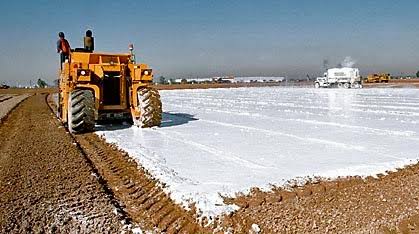
Hydrated (or slacked) lime is very effective in
treating heavy plastic clayey soils. Lime may be used alone or in combination with cement, bitumen, or flash. Lime has been mainly used for stabilizing the
road bases and subgrades.
• On addition of lime to the soil, two main types of
chemical reactions occur i) alteration in the nature of the adsorbed layer through base exchange phenomenon and ii) cementing or pozzolanic action.
Lime reduces P.I. of highly plastic soils making them more friable and easy to be handled and pulverized.
The P.I. of low plasticity generally increases. There is generally an increase in the O.M.C. and decrease in the compacted density, by strength and durability
increases.
• Normally 2 10 8 % of lime may be required for coarse-grained soils and 5 to IO % for plastic soil.
Cement Stabilization :
The soil stabilized with cement (Portland) is known as soil cement. The cementing action is believed to be the result of chemical reactions of cement with silicious soil during hydration. The binding action of individual
particles through cement may be possible only in coarse-grained soils. In cohesive soils, only some of the particles can be excepted to have cement bonds and the rest will be bonded through natural cohesion.
Bitumen Stabilization :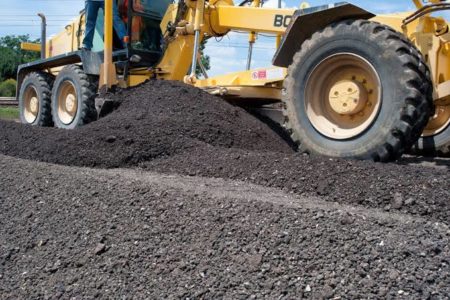
• Earth roads can be improved by spraying the dry soil surface with a stabilizer such as aspheric and cut back bitumen oil, tars, or emulsions in small quantities. The bituminous materials when added to soil impact cohesion or binding action and reduce water absorption. About 4 to 7 % by weight of
bitumen is required. Any inorganic soil can be
stabilized well-graded soils give goods results from 10^3 mm/s to 10^8 mm/s in case of silty sands. Local clays may be used.
These are the methods of stabilization
See lessWhat is Stucco Plaster?
AdityaBhandakkar
Stucco in English refers to coating on outside and plaster refered to internal coating. Stucco plaster are categorised into two types: Traditional Stucco plaster: It is a mixture of lime, sand, and water. Modern stucco plaster: It is a mixture of Portland cement, sand, and water. In modern stucco plRead more
Stucco in English refers to coating on outside and plaster refered to internal coating.
Stucco plaster are categorised into two types:
Traditional Stucco plaster:
It is a mixture of lime, sand, and water.
Modern stucco plaster:
It is a mixture of Portland cement, sand, and water.
In modern stucco plasters, lime is replaced by Portland cement for increasing durability. For many special purposes, Instead of lime plaster, gypsum player use.
To improve structural properties, acrylic and glass fibers are used in modern stucco.
See lessWhat is the moisture content limits in plastered walls before we take up the painting work?
CB Sowmya
The maximum moisture content is limited to 12% in plastered walls before painting or application of any coating.
The maximum moisture content is limited to 12% in plastered walls before painting or application of any coating.
See lessWhat Reinforcements are used in the Process of Prestressing?
Tips_and_tricks
In prestressing, we use strands of steel usually called as tendons. They are made of high strength steel. However, there are other terms in pre stressing based on the size of the tendon. The following are the terms in an increasing order of size. Wire - small wire (single) Strand - 2 or more wires TRead more
In prestressing, we use strands of steel usually called as tendons. They are made of high strength steel. However, there are other terms in pre stressing based on the size of the tendon. The following are the terms in an increasing order of size.
- Wire – small wire (single)
- Strand – 2 or more wires
- Tendon – group of strands
- Cable – Group of tendons
- Bar – single bar – dia of 10 mm or more
See lessWhy should curing not be done by ponding and polythene sheets?
Tips_and_tricks
The disadvantages of ponding: Evaporation is high Constant monitoring Excess water is needed The initial work for ponding must be done However, it is a very simple process and doesn't need skilled labours, thus the disadvantages maybe overruled by that advantage. The disadvantages of polythene sheeRead more
The disadvantages of ponding:
However, it is a very simple process and doesn’t need skilled labours, thus the disadvantages maybe overruled by that advantage.
The disadvantages of polythene sheets:
However, this method if installed properly retains moisture inside the concrete for a longer period of time.
See less