Sign Up

Join TheConstructor to ask questions, answer questions, write articles, and connect with other people. When you join you get additional benefits.

Have an account? Sign In


Have an account? Sign In Now

Sign In

Log in to TheConstructor to ask questions, answer people’s questions, write articles & connect with other people. When you join you get additional benefits.

Sign Up Here

Join for free or log in to continue reading...


Forgot Password?

Don't have account, Sign Up Here

Forgot Password

Lost your password? Please enter your email address. You will receive a link and will create a new password via email.

Have an account? Sign In Now

Sorry, you do not have a permission to ask a question, You must login to ask question. Get the paid membership

Join for free or log in to continue reading...


Forgot Password?

Don't have account, Sign Up Here
Get the paid membership
theconstructor.org Logo theconstructor.org Logo
Log inJoin

theconstructor.org

theconstructor.org Navigation

  • Articles
    • Recent Articles
    • Popular Articles
    • Write for us
  • Community
  • Categories
    • How To Guide
      • Material Testing Guide
    • Concrete
    • Building
      • Brick Masonry
      • Building Materials
      • Building Tips
    • Construction
      • Equipments
      • Management
    • Digital Construction
    • Geotechnical
      • Foundation
  • Case Studies
Search
Ask A Question

Mobile menu

Close
Ask a Question
  • Questions
  • Ask Questions
  • Write for us
  • Artificial Intelligence
  • Sustainability
  • Building
    • Brick Masonry
    • Building Materials
    • Building Tips
    • Formwork/Shuttering
  • Concrete
    • Concrete Admixtures
    • Cement
    • Concrete Cracks
    • Concrete Properties
  • Construction
    • Construction Equipments
    • Construction Management
    • Construction Project
    • Estimating & Costing
  • How To Guide
    • Material Estimation
    • Repair/Protection Guide
    • Material Testing Guide
    • Mix Design Guide
    • Rate Analysis
  • Geotechnical
    • Foundation Engineering
    • Ground Improvement
  • Structural Engineering
    • Strengthening of Structure
    • Structual Inspection
    • Structural Detailing
  • Surveying
  • Tips

Questions

Home/Questions/Page 8

Do you need to remove the ads? Get the paid membership

Discy Latest Questions

Asked: October 12, 2020In: Geotechnical Engineering

What are the Methods of Interpolation of Contours?

ISMAEL PUNGA
ISMAEL PUNGA

ISMAEL PUNGA

  • 1 Question
  • 0 Answers
  • 0 Best Answers
  • 10 Points
View Profile
ISMAEL PUNGA User

What are the Methods of Interpolation of Contours?

  1. nikeetasharma

    nikeetasharma

    • 23 Questions
    • 303 Answers
    • 0 Best Answers
    • 2,680 Points
    View Profile
    nikeetasharma Guru
    Added an answer on October 14, 2020 at 6:36 pm

    Interpolation of the contours is the process of spacing the contours proportionately between the plotted ground points established by indirect methods. The methods of interpolation are based on the assumption that the slope of ground between the two points is uniform. Methods of interpolation of conRead more

    Interpolation of the contours is the process of spacing the contours proportionately between the plotted ground points established by indirect methods. The methods of interpolation are based on the assumption that the slope of ground between the two points is uniform.

    Methods of interpolation of contour are as follows :-

    1. Arithmetic calculation
    2. Graphical calculation
    3. Estimation calculation

    See less
    • 48
    • Share
      Share
      • Share on Facebook
      • Share on Twitter
      • Share on LinkedIn
      • Share on WhatsApp
  • 5
  • 4 4 Answers
  • 37,581 Views
  • 0 Followers
Asked: October 10, 2020In: Construction Site Related

How to pour Concrete in Narrow/Sleak Columns?

Velisiwe Purity
Velisiwe Purity

Velisiwe Purity

  • 1 Question
  • 0 Answers
  • 0 Best Answers
  • 10 Points
View Profile
Velisiwe Purity User

How to pour Concrete in Narrow/Sleak Columns?

  1. Preet Chovatiya

    Preet Chovatiya

    • 11 Questions
    • 81 Answers
    • 5 Best Answers
    • 858 Points
    View Profile
    Preet Chovatiya Learner
    Added an answer on November 28, 2020 at 7:11 pm

    You can use Self Compacted Concrete to use for narrow columns. It also used where the reinforcement is heavy and process of compaction is not available/difficult to compact.

    You can use Self Compacted Concrete to use for narrow columns. It also used where the reinforcement is heavy and process of compaction is not available/difficult to compact.

    See less
    • 1
    • Share
      Share
      • Share on Facebook
      • Share on Twitter
      • Share on LinkedIn
      • Share on WhatsApp
  • 0
  • 3 3 Answers
  • 2,120 Views
  • 0 Followers
Asked: October 8, 2020In: Construction Site Related

What shall be the spacing for core cutter sample for dry density determination for each layer while constructing long embankment?

Muksit Pathan
Muksit Pathan

Muksit Pathan

  • 2 Questions
  • 0 Answers
  • 0 Best Answers
  • 28 Points
View Profile
Muksit Pathan User

While constructing long embankment (appx 4 km) in multiple layers of 300mm depth, what shall be spacing of core cutter samples to ensure adequate dry density measurement.

  1. AdityaBhandakkar

    AdityaBhandakkar

    • 12 Questions
    • 250 Answers
    • 2 Best Answers
    • 0 Points
    View Profile
    AdityaBhandakkar User
    Added an answer on October 16, 2020 at 12:45 pm
    This answer was edited.

    Hi, There are not any specific criteria for the spacing of sample taken, and the decision is purely based upon site civil engineers and various criteria of soils and on observations. if you found soil which is less compacted or even is created then take samples for observation and check the bulk denRead more

    Hi, There are not any specific criteria for the spacing of sample taken, and the decision is purely based upon site civil engineers and various criteria of soils and on observations. if you found soil which is less compacted or even is created then take samples for observation and check the bulk density of soil and moisture content. Please refer to the following article for details about core cutter method and its applications: Link: https://theconstructor.org/geotechnical/dry-density-of-soil-by-core-cutter-method/2680/

    See less
    • 34
    • Share
      Share
      • Share on Facebook
      • Share on Twitter
      • Share on LinkedIn
      • Share on WhatsApp
  • 0
  • 2 2 Answers
  • 1,086 Views
  • 0 Followers
Asked: October 8, 2020In: Interview Questions

What is Golden Ratio?

Komal Bhandakkar
Komal Bhandakkar

Komal Bhandakkar

  • 49 Questions
  • 255 Answers
  • 0 Best Answers
  • 2,050 Points
View Profile
Komal Bhandakkar AUTHOR

What is Golden Ratio? How can we find out the Golden Ratio of any rectangular shaped body?

  1. aviratdhodare

    aviratdhodare

    • 37 Questions
    • 252 Answers
    • 0 Best Answers
    • 480 Points
    View Profile
    aviratdhodare
    Added an answer on October 15, 2020 at 9:44 pm

    The Golden Ratio is an irrational number with never-ending infinite numbers of digits, 1.618033988749895..., which are highly confusing and misleading. It is a linear number and represents only two dimensions of the object. Drawing It Here is one way to draw a rectangle with the Golden Ratio: Draw aRead more

    The Golden Ratio is an irrational number with never-ending infinite numbers of digits, 1.618033988749895…, which are highly confusing and misleading. It is a linear number and represents only two dimensions of the object.

    Drawing It

    Here is one way to draw a rectangle with the Golden Ratio:

    • Draw a square (of size “1”)
    • Place a dot half way along one side
    • Draw a line from that point to an opposite corner (it will be √5/2 in length)
    • Turn that line so that it runs along the square’s side

    Then you can extend the square to be a rectangle with the Golden Ratio.

    See less
    • 13
    • Share
      Share
      • Share on Facebook
      • Share on Twitter
      • Share on LinkedIn
      • Share on WhatsApp
  • 16
  • 3 3 Answers
  • 1,888 Views
  • 1 Follower
Asked: October 5, 2020In: Interview Questions

What is the reason behind the initial setting time of cement should not be less that 30min.?

Komal Bhandakkar
Komal Bhandakkar

Komal Bhandakkar

  • 49 Questions
  • 255 Answers
  • 0 Best Answers
  • 2,050 Points
View Profile
Komal Bhandakkar AUTHOR

What is the reason behind the initial setting time of cement should not be less that 30min.?

  1. Komal Bhandakkar

    Komal Bhandakkar

    • 49 Questions
    • 255 Answers
    • 0 Best Answers
    • 2,050 Points
    View Profile
    Komal Bhandakkar AUTHOR
    Added an answer on October 9, 2020 at 9:20 pm
    This answer was edited.
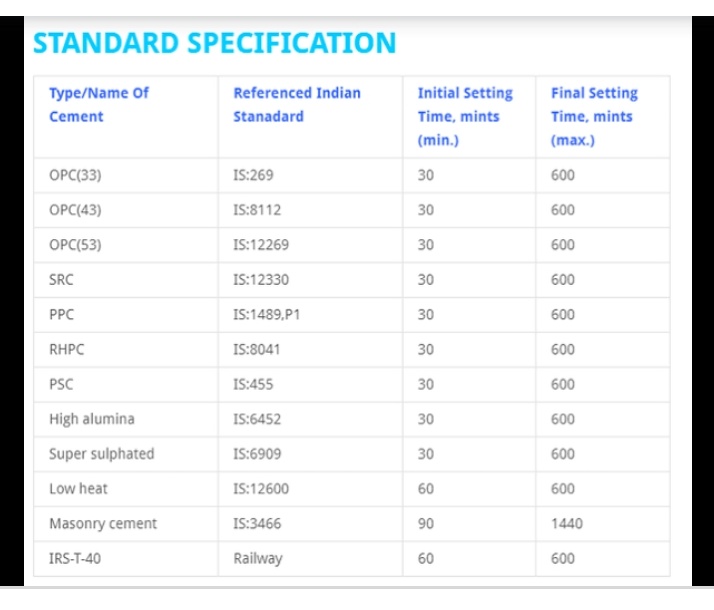
    What is the reason behind the initial setting time of cement should not be less that 30min.?

    Initial setting time of various types of cement: The value of the initial setting time is different for a different type of cement. The initial setting time of Quick setting cement is only 5 minute. The initial setting time of low heat cement is 60 minutes But usually, another type of cement has 30mRead more

    Initial setting time of various types of cement:

    • The value of the initial setting time is different for a different type of cement.

    • The initial setting time of Quick setting cement is only 5 minute.

    • The initial setting time of low heat cement is 60 minutes

    • But usually, another type of cement has 30minutes is the value of initial setting time.

    Please refer the above image for knowing the values of initial setting time and final setting time for various types of cement.


    Thank you.

    See less
    • 30
    • Share
      Share
      • Share on Facebook
      • Share on Twitter
      • Share on LinkedIn
      • Share on WhatsApp
  • 22
  • 5 5 Answers
  • 4,591 Views
  • 0 Followers
Asked: October 5, 2020In: Construction Site Related

Why Back Sight is also called as Plus Sight?

Komal Bhandakkar
Komal Bhandakkar

Komal Bhandakkar

  • 49 Questions
  • 255 Answers
  • 0 Best Answers
  • 2,050 Points
View Profile
Komal Bhandakkar AUTHOR

Why Back Sight is also called as Plus Sight?

  1. Komal Bhandakkar

    Komal Bhandakkar

    • 49 Questions
    • 255 Answers
    • 0 Best Answers
    • 2,050 Points
    View Profile
    Komal Bhandakkar AUTHOR
    Added an answer on November 17, 2020 at 5:50 pm
    This answer was edited.

    Back Sight: Backsight is simply a first reading which is taken after setting up the instrument.  Why the backsight is also called plus sight: Only because the reading is taken of known elevation to continue taking foresight reading.  Thank You.

    Back Sight: Backsight is simply a first reading which is taken after setting up the instrument. 


    Why the backsight is also called plus sight:

    Only because the reading is taken of known elevation to continue taking foresight reading. 


    Thank You.

    See less
    Attachment

    • 0
    • Share
      Share
      • Share on Facebook
      • Share on Twitter
      • Share on LinkedIn
      • Share on WhatsApp
  • 22
  • 5 5 Answers
  • 2,967 Views
  • 0 Followers
Asked: October 5, 2020In: Miscellaneous

What is the difference between Declination and Dip?

Komal Bhandakkar
Komal Bhandakkar

Komal Bhandakkar

  • 49 Questions
  • 255 Answers
  • 0 Best Answers
  • 2,050 Points
View Profile
Komal Bhandakkar AUTHOR

What is the difference between declination and dip?

  1. Komal Bhandakkar

    Komal Bhandakkar

    • 49 Questions
    • 255 Answers
    • 0 Best Answers
    • 2,050 Points
    View Profile
    Komal Bhandakkar AUTHOR
    Added an answer on October 9, 2020 at 9:25 pm
    This answer was edited.
    What is the difference between Declination and Dip?

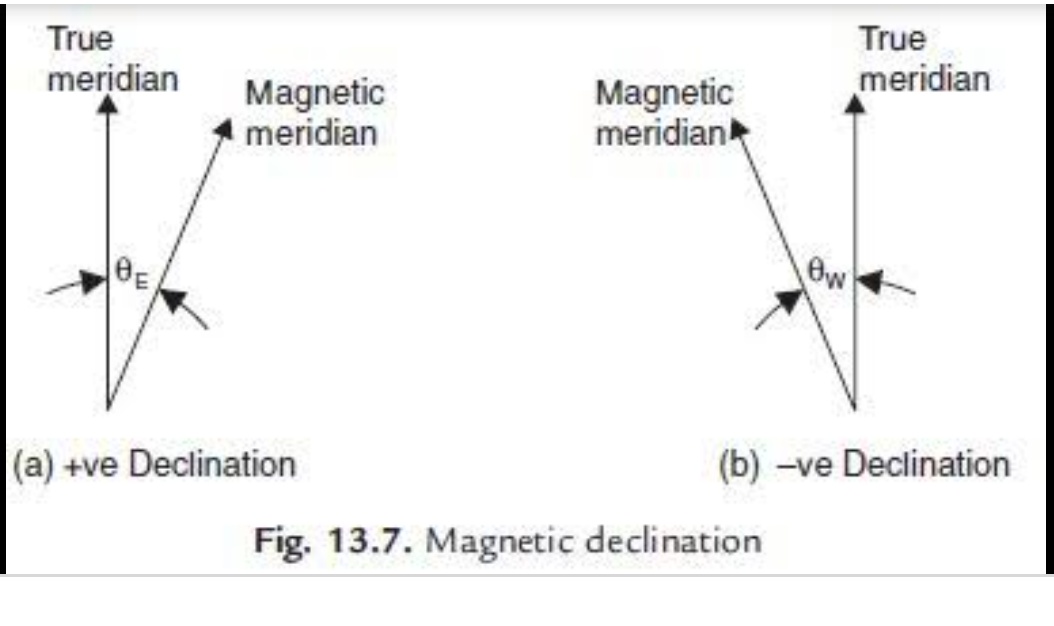
    Declination: I am providing more additional information about the declination, have a look. Here, I Attached a diagram of declination, through that we can clearly understand positive as well as negative declination. Whenever declination is towards the Eastwood direction then that declination is callRead more

    Declination:

    I am providing more additional information about the declination, have a look.

    Here, I Attached a diagram of declination, through that we can clearly understand positive as well as negative declination.


    1. Whenever declination is towards the Eastwood direction then that declination is called positive declination.

    2. When a declination is going towards west word direction then it is called negative declination.

    True bearing is the sum of magnetic bearing plus declination.


    Thank you.

    See less
    • 33
    • Share
      Share
      • Share on Facebook
      • Share on Twitter
      • Share on LinkedIn
      • Share on WhatsApp
  • 25
  • 5 5 Answers
  • 15,144 Views
  • 0 Followers
Asked: October 5, 2020In: Interview Questions

Why correction of curvature is always considered as a negative?

Komal Bhandakkar
Komal Bhandakkar

Komal Bhandakkar

  • 49 Questions
  • 255 Answers
  • 0 Best Answers
  • 2,050 Points
View Profile
Komal Bhandakkar AUTHOR

Why correction of curvature is always considered as a negative?

  1. nikeetasharma

    nikeetasharma

    • 23 Questions
    • 303 Answers
    • 0 Best Answers
    • 2,680 Points
    View Profile
    nikeetasharma Guru
    Added an answer on October 8, 2020 at 8:29 pm

    Here, consider lens or mirror at the origin. Now, all the distances measured in the direction of incident rays are positive and distances measured in the direction opposite to the direction of incident rays are negative. All distances have to be measured from the lens or mirror. For example object dRead more

    Here, consider lens or mirror at the origin. Now, all the distances measured in the direction of incident rays are positive and distances measured in the direction opposite to the direction of incident rays are negative. All distances have to be measured from the lens or mirror. For example object distance measured from lens or mirror is measured in the direction opposite to direction of incident rays hence, in these case object distance u is negative. The paraxial parallel rays are focused on the right hand side of convex lens. See, this distance f is measured in the direction of incident rays . Hence, focal length of convex lens is positive. But, we can see that focal length of concave mirror is negative. It’s radius of curvature is also negative. The radius of curvature of first surface of convex lens is positive, but radius of curvature of it’s second surface is negative. You can see that radius of curvature and focal length of concave mirror are negative.

    See less
    • 33
    • Share
      Share
      • Share on Facebook
      • Share on Twitter
      • Share on LinkedIn
      • Share on WhatsApp
  • 23
  • 2 2 Answers
  • 2,334 Views
  • 0 Followers
Load More Questions

Sidebar

Explore

  • Questions
  • Ask Questions
  • Write for us
  • Artificial Intelligence
  • Sustainability
  • Building
    • Brick Masonry
    • Building Materials
    • Building Tips
    • Formwork/Shuttering
  • Concrete
    • Concrete Admixtures
    • Cement
    • Concrete Cracks
    • Concrete Properties
  • Construction
    • Construction Equipments
    • Construction Management
    • Construction Project
    • Estimating & Costing
  • How To Guide
    • Material Estimation
    • Repair/Protection Guide
    • Material Testing Guide
    • Mix Design Guide
    • Rate Analysis
  • Geotechnical
    • Foundation Engineering
    • Ground Improvement
  • Structural Engineering
    • Strengthening of Structure
    • Structual Inspection
    • Structural Detailing
  • Surveying
  • Tips

Footer

  • Ask Questions
  • Write for us
  • Popular Questions
  • Facebook
  • Instagram
  • Twitter
  • Telegram

© 2009-2021 The Constructor. All Rights Reserved.