Sign Up

Join TheConstructor to ask questions, answer questions, write articles, and connect with other people. When you join you get additional benefits.

Have an account? Sign In


Have an account? Sign In Now

Sign In

Log in to TheConstructor to ask questions, answer people’s questions, write articles & connect with other people. When you join you get additional benefits.

Sign Up Here

Join for free or log in to continue reading...


Forgot Password?

Don't have account, Sign Up Here

Forgot Password

Lost your password? Please enter your email address. You will receive a link and will create a new password via email.

Have an account? Sign In Now

Sorry, you do not have a permission to ask a question, You must login to ask question. Get the paid membership

Join for free or log in to continue reading...


Forgot Password?

Don't have account, Sign Up Here
Get the paid membership
theconstructor.org Logo theconstructor.org Logo
Log inJoin

theconstructor.org

theconstructor.org Navigation

  • Articles
    • Recent Articles
    • Popular Articles
    • Write for us
  • Community
  • Categories
    • How To Guide
      • Material Testing Guide
    • Concrete
    • Building
      • Brick Masonry
      • Building Materials
      • Building Tips
    • Construction
      • Equipments
      • Management
    • Digital Construction
    • Geotechnical
      • Foundation
  • Case Studies
Search
Ask A Question

Mobile menu

Close
Ask a Question
  • Questions
  • Ask Questions
  • Write for us
  • Artificial Intelligence
  • Sustainability
  • Building
    • Brick Masonry
    • Building Materials
    • Building Tips
    • Formwork/Shuttering
  • Concrete
    • Concrete Admixtures
    • Cement
    • Concrete Cracks
    • Concrete Properties
  • Construction
    • Construction Equipments
    • Construction Management
    • Construction Project
    • Estimating & Costing
  • How To Guide
    • Material Estimation
    • Repair/Protection Guide
    • Material Testing Guide
    • Mix Design Guide
    • Rate Analysis
  • Geotechnical
    • Foundation Engineering
    • Ground Improvement
  • Structural Engineering
    • Strengthening of Structure
    • Structual Inspection
    • Structural Detailing
  • Surveying
  • Tips

Construction

Home/Construction/Page 2

Do you need to remove the ads? Get the paid membership

  • Recent Questions
  • Most Answered
  • Answers
  • No Answers
  • Most Visited
  • Most Voted
  • Random

Discy Latest Questions

Asked: July 22, 2020In: Construction

What is difference between site plan and layout plan?

vivek gami
vivek gami

vivek gami

  • 54 Questions
  • 16 Answers
  • 5 Best Answers
  • 93 Points
View Profile
vivek gami User

What is difference between site plan and layout plan?

  1. nikeetasharma

    nikeetasharma

    • 23 Questions
    • 303 Answers
    • 0 Best Answers
    • 2,680 Points
    View Profile
    nikeetasharma Guru
    Added an answer on November 28, 2020 at 8:02 pm

    The site layout is the part of the site plan. The site layout is the part of the construction plan that focuses mainly on the physical space of the construction site and the layout plan includes physical management of the things.

    The site layout is the part of the site plan. The site layout is the part of the construction plan that focuses mainly on the physical space of the construction site and the layout plan includes physical management of the things.

    See less
    • 1
    • Share
      Share
      • Share on Facebook
      • Share on Twitter
      • Share on LinkedIn
      • Share on WhatsApp
  • 3
  • 5 5 Answers
  • 30,593 Views
  • 0 Followers
Asked: July 31, 2020In: Construction

What is the rule for deduction in the measurement of plastering work?

Vivek Patel
Vivek Patel

Vivek Patel

  • 39 Questions
  • 80 Answers
  • 1 Best Answer
  • 6 Points
View Profile
Vivek Patel User

What is the rule for deduction in the measurement of plastering work?

  1. nikeetasharma

    nikeetasharma

    • 23 Questions
    • 303 Answers
    • 0 Best Answers
    • 2,680 Points
    View Profile
    nikeetasharma Guru
    Added an answer on December 18, 2020 at 5:59 pm

    Plastering deductions as per IS code 1200. For opening of size 0.5 m2 to 3 m2 area, deduction is made on one face of the wall. For openings of size above 3 m2, deduction is made on both faces of the wall, but the area of sill, jamb and soffits of the opening is added.

    Plastering deductions as per IS code 1200. For opening of size 0.5 m2 to 3 m2 area, deduction is made on one face of the wall. For openings of size above 3 m2, deduction is made on both faces of the wall, but the area of sill, jamb and soffits of the opening is added.

    See less
    • 4
    • Share
      Share
      • Share on Facebook
      • Share on Twitter
      • Share on LinkedIn
      • Share on WhatsApp
  • 4
  • 4 4 Answers
  • 30,509 Views
  • 0 Followers
Asked: August 17, 2020In: Construction

How to Calculate the Area of formwork required for a Beam?

gAmE pLay
gAmE pLay

gAmE pLay

  • 1 Question
  • 1 Answer
  • 0 Best Answers
  • 22 Points
View Profile
gAmE pLay User

How to Calculate the Area of formwork required for a Beam? Calculate the area of the formwork required for a beam of 2 m span and cross-section dimension of 400 mm x 200 mm?

  1. aviratdhodare

    aviratdhodare

    • 37 Questions
    • 252 Answers
    • 0 Best Answers
    • 480 Points
    View Profile
    aviratdhodare
    Added an answer on August 18, 2020 at 4:10 pm

    Formwork shall be measured in square metres as the actual surfaces in contact with the concrete The formwork or shuttering quantity for the member is measured as per the code of BIS - IS 1200:1982, Part 5- Method of Measurement of Building and Civil Engineering Works. For Column follow the process 1Read more

    Formwork shall be measured in square metres as the actual surfaces in contact with the concrete

    The formwork or shuttering quantity for the member is measured as per the code of BIS – IS 1200:1982, Part 5- Method of Measurement of Building and Civil Engineering Works.

    For Column follow the process

    1. Measure the four sides of column at base or in cross-section.

    2. Calculate the perimeter of column base.

    3. Measure the Colum height.

    4. Multiply the perimeter of base and height of column to give the shuttering area of column.

    Or other way, add all 4 sides and multiply it by height of column.

    For Beam follow the process

    1. Take the cross-section of beam and measure the lengths of the two sides and base of beam.

    2. Sum the three measurements.

    3. Measure the span of the beam

    4. Multiply the span length by sum of the three measurements (beam base two vertical sides) gives the shuttering area of beam.

    The top side in cross-section of beam is not considered as it will be part of beam.

    Or the other way, add the beam height(2 sides) and beam base and multiply it by beam length.

    Other important factors to be considered while picking the shuttering quantities.

    • Where formwork is required to be lined with wall board, hardboard, polythene sheet No deduction shall be made for openings up to 0.4sqm.
    • No deduction shall be made for any opening/cutouts when slip form technique is used.
    • Raking or circular cutting and rounded or moulded edges shall be measured in running meters. Moulded stopping shall be enumerated.
    • Formwork to secondary beam shall be measured up to the sides of main beams, but no deduction shall be made from the formwork of the main beams where the secondary beam intersects it.
    • Formwork to beam shall be measured up to sides of column, but no deduction shall be made from the formwork to stanchion or column casings at intersections of beam.

    Answer:

    Calculation:

    Cross section I terms of metres (400 200 mm) = 0.4  0.2 m

    Width and depth are given in cross section

    Area of the framework = (2 0.4 2) + (20.4  0.2) + (2  0.2)

    = 2.14 

    Result:

    The area of the formwork is = 2.14 .

    See less
    • 33
    • Share
      Share
      • Share on Facebook
      • Share on Twitter
      • Share on LinkedIn
      • Share on WhatsApp
  • 7
  • 4 4 Answers
  • 27,372 Views
  • 0 Followers
Asked: July 23, 2020In: Construction

Which size of aggregate used in RCC structure?

Vivek Patel
Vivek Patel

Vivek Patel

  • 39 Questions
  • 80 Answers
  • 1 Best Answer
  • 6 Points
View Profile
Vivek Patel User

Which size of aggregate used in RCC structure?

  1. nikeetasharma

    nikeetasharma

    • 23 Questions
    • 303 Answers
    • 0 Best Answers
    • 2,680 Points
    View Profile
    nikeetasharma Guru
    Added an answer on October 1, 2020 at 8:18 pm

    Generally the most appropriate size of aggregate used in RCC structure is 20mm. It gives more strength to the structure.

    Generally the most appropriate size of aggregate used in RCC structure is 20mm. It gives more strength to the structure.

    See less
    • 33
    • Share
      Share
      • Share on Facebook
      • Share on Twitter
      • Share on LinkedIn
      • Share on WhatsApp
  • 4
  • 8 8 Answers
  • 24,552 Views
  • 0 Followers
Asked: May 30, 2016In: Construction

How to prepare Construction Quotations and Estimate?

Gopal Mishra
Gopal Mishra

Gopal Mishra

  • 75 Questions
  • 44 Answers
  • 7 Best Answers
  • 577 Points
View Profile
Gopal Mishra

I am really happy to join and I would like to ask what are items to be taken into consideration when preparing quotation for construction works and approximate cost of each item on the post of construction work supervisor. Simply I ...

  1. Gopal Mishra

    Gopal Mishra

    • 75 Questions
    • 44 Answers
    • 7 Best Answers
    • 577 Points
    View Profile
    Gopal Mishra
    Added an answer on October 18, 2017 at 1:57 pm

    Preparation of quotation for construction works depends on the type of work to be carried out. Whenever a quotation is required by the client for particular work, they provide the detailed specification of works to be carried out. For example, if quote for brickwork is required by the client, the deRead more

    Preparation of quotation for construction works depends on the type of work to be carried out. Whenever a quotation is required by the client for particular work, they provide the detailed specification of works to be carried out.

    For example, if quote for brickwork is required by the client, the details about type of work such as brickwork in superstructure or substructure, or at particular height, the mix proportion of cement and sand, etc. are provided. All you have to do is to estimate the unit rate for the brickwork for the given specification of the work and provide the rate to the client.

    For estimating unit rate of brickwork, the cost of materials such as bricks, cement, sand and water, the labor required for unit work done, cost / rent of tools and equipment, contractor’s profit, contingencies etc. need to be calculated and summed up.

    Thus to estimate the cost of unit quantity of particular work, the cost of materials, tools, equipment, labor, transportation, profit, contingencies etc. shall be considered for the calculation.

    See less
    • 0
    • Share
      Share
      • Share on Facebook
      • Share on Twitter
      • Share on LinkedIn
      • Share on WhatsApp
  • 6
  • 1 1 Answer
  • 23,330 Views
  • 0 Followers
Asked: September 19, 2020In: Construction

How to calculate strength of concrete in rebound hammer test

Revansidda B Hagargi

Revansidda B Hagargi

  • 1 Question
  • 0 Answers
  • 0 Best Answers
  • 5 Points
View Profile
Revansidda B Hagargi User


  1. aviratdhodare

    aviratdhodare

    • 37 Questions
    • 252 Answers
    • 0 Best Answers
    • 480 Points
    View Profile
    aviratdhodare
    Added an answer on September 22, 2020 at 1:50 pm

    The rebound hammer test is a non-destructive test for the strength of concrete for field testing of concrete. As per the Indian code IS: 13311(2)-1992, the rebound hammer test has the following objectives: To determine the compressive strength of the concrete by relating the rebound index and the coRead more

    The rebound hammer test is a non-destructive test for the strength of concrete for field testing of concrete.

    As per the Indian code IS: 13311(2)-1992, the rebound hammer test has the following objectives:

    1. To determine the compressive strength of the concrete by relating the rebound index and the compressive strength
    2. To assess the uniformity of the concrete
    3. To assess the quality of the concrete based on the standard specifications
    4. To relate one concrete element with other in terms of quality

    The instrument can be used on both horizontal and vertical surfaces. The main point to be noted is that the graph had to be read appropriately. These days, the hammer is equipped with a digital scale to make life easier.

    The IS: 13311(2)-1992 elaborates the procedure in a more detailed manner, making it easier for even beginners to understand the concept.

    The point of impact should be at least 20 mm away from any edge or shape discontinuity. For taking a measurement, the rebound hammer should be held at right angles to the surface of the concrete member.

    The apparatus is placed on the spot where the test is desired. The hammer is allowed to drop freely. After it strikes the concrete surface it rebounds back. The raise of the rebound is recorded. This test is repeated at different locations and the rebound value is recorded.

    The compressive value of concrete is obtained by doing a cube test of the test cube of the batch of concrete on which the rebound test is conducted. The value of rebound and compressive strength of concrete is compared and the value of compression is adjudged from the values of compression test and rebound values.

    Around each point of observation, six readings of rebound indices are taken 2nd average of these readings after deleting outliers as per IS 8900: 1978 becomes the rebound index for the point of observation. ( This outlaying is a calculation based method, can be discussed on one’s interest).

    Now, we will calculate comp. Strength from rebound number. There are three positions of taking reading

    1. Vertical Downward:- Weight of Hammer is increasing stress on spring of hammer
    2. Vertical Upward:- Weight of hammer is decreasing the stress on spring of hammer
    3. Horizontally :- Weight of hammer have no effect on spring.

    This is why, there are three graphs in Rebound Number-Compressive Strength graph of Rebound Hammer.

    You will have to calculate the strength from the graph as per position of Rebound Hammer.

    For Example,

    For Vertical Upward position of Hammer

    If 15 Rebound number readings are

    48,42,43,43,44,44,45,45,45,45,46,47,48,50

    , as per IS:8900, Clause 5.1.1(TESTS FOR TWO OR MORE OUTLIERS , AT LEAST ONE OUTLIER AT EACH END), 42 and 50 are Outlaying values.

    Removing those, Average Rebound number is 45.27

    From the graph( fro Vertical Upward) , Compressive Strength Will be 40.54 Mpa

    See less
    • 38
    • Share
      Share
      • Share on Facebook
      • Share on Twitter
      • Share on LinkedIn
      • Share on WhatsApp
  • 0
  • 1 1 Answer
  • 23,079 Views
  • 0 Followers
Asked: July 15, 2020In: Construction

Explain in detail about closer bricks?

DevilAVRT
DevilAVRT

DevilAVRT

  • 27 Questions
  • 49 Answers
  • 3 Best Answers
  • 207 Points
View Profile
DevilAVRT Beginner

Explain in detail about closer bricks?

  1. AdityaBhandakkar

    AdityaBhandakkar

    • 12 Questions
    • 250 Answers
    • 2 Best Answers
    • 0 Points
    View Profile
    AdityaBhandakkar User
    Added an answer on September 18, 2020 at 6:36 pm
    Explain in detail about closer bricks?

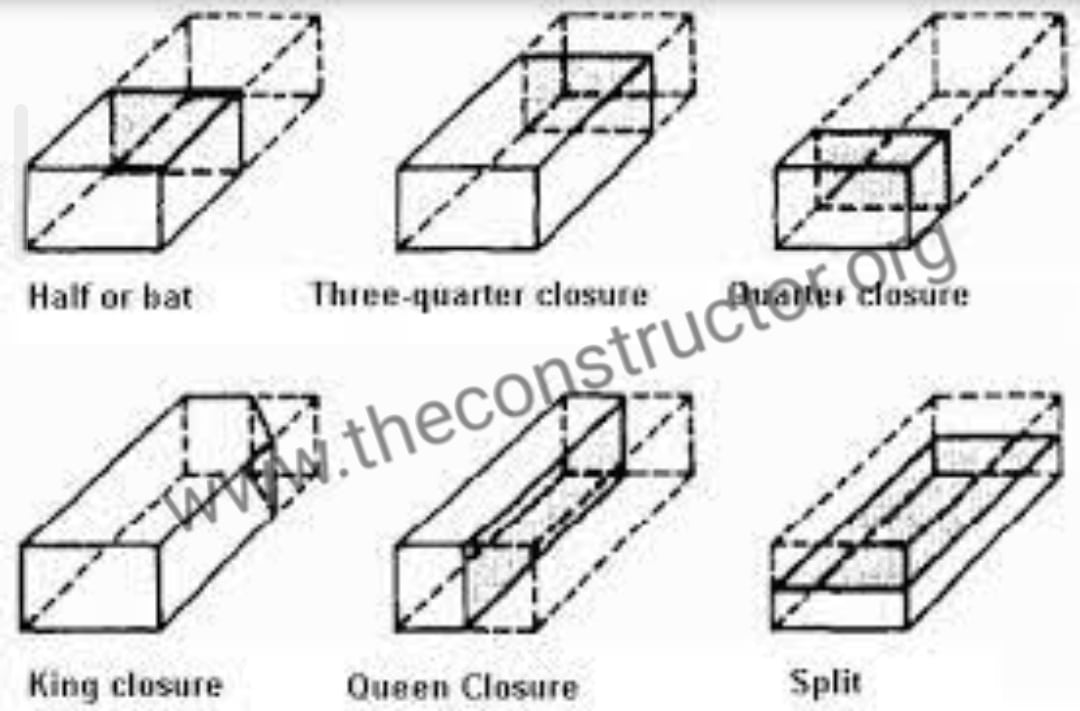
    Closer bricks: the brick is cut in such a way that one portion is kept remains with the break and used another part for closing the gap. Queen closer: the brakes are cut along the length for making two equal parts longitudinally called as Queen closer width of Queen closer brick is half of the origiRead more

    1. Closer bricks: the brick is cut in such a way that one portion is kept remains with the break and used another part for closing the gap.
    2. Queen closer: the brakes are cut along the length for making two equal parts longitudinally called as Queen closer width of Queen closer brick is half of the original brick called as half Queen closer.
    3. King closer: the brick is cut in such a technique that one end of brick width is half of the width of the original brick.
    4. Bevelled closer: in this break, the stretcher face is bevelled in such a way that at one end half-width and on another end, full width is maintained.
    5. Mitred closer: in this break, the one and it is cut in a mitred manner. That is a 45 to 60-degree angle with length. It is shown in the above diagram.
    6. BAT: if along the length, the brick is cut called as a bat.
    7. Half Bat: along the length, bricks are cut into two equal part.
    8. Three-quarter bat: length equal to 3 quarter of the full-length brick.
    9. Bevelled Bat: width is bevelled. As shown in fig.
    See less
    • 50
    • Share
      Share
      • Share on Facebook
      • Share on Twitter
      • Share on LinkedIn
      • Share on WhatsApp
  • 4
  • 3 3 Answers
  • 22,992 Views
  • 0 Followers
Asked: July 7, 2020In: Construction

What is the difference between Arch and Lintel?

DevilAVRT
DevilAVRT

DevilAVRT

  • 27 Questions
  • 49 Answers
  • 3 Best Answers
  • 207 Points
View Profile
DevilAVRT Beginner

What is the difference between Arch and Lintel?

  1. aviratdhodare

    aviratdhodare

    • 37 Questions
    • 252 Answers
    • 0 Best Answers
    • 480 Points
    View Profile
    aviratdhodare
    Added an answer on September 11, 2020 at 12:00 am

    As far as what they do there is no difference, and both support weight loading above them. Shape wise a lintel is usually flat compared to the curved shape of an arch. Strength wise the arch is far superior and only compresses more the greater the loading, compared with a lintel that has limitationsRead more

    As far as what they do there is no difference, and both support weight loading above them. Shape wise a lintel is usually flat compared to the curved shape of an arch. Strength wise the arch is far superior and only compresses more the greater the loading, compared with a lintel that has limitations to what it will hold before failing due to compression.

    Having said that most lintels carry very little weight anyway as it is spread out through the interlocking of stone, block, or brick and the only weight it actually carries can be measured by drawing a line at 45° from each end of the lintel until they cross in the centre above it and what its actual loading is. Beyond that, the wall supports its own weight and that above it providing something supports the interlocking material and how the Victorians managed to support mass weight purely on timber lintels only 3 inches thick. With lintels, span becomes an issue very quickly much less so with an arch

    See less
    • 34
    • Share
      Share
      • Share on Facebook
      • Share on Twitter
      • Share on LinkedIn
      • Share on WhatsApp
  • 4
  • 4 4 Answers
  • 20,301 Views
  • 0 Followers
Load More Questions

Sidebar

Explore

  • Questions
  • Ask Questions
  • Write for us
  • Artificial Intelligence
  • Sustainability
  • Building
    • Brick Masonry
    • Building Materials
    • Building Tips
    • Formwork/Shuttering
  • Concrete
    • Concrete Admixtures
    • Cement
    • Concrete Cracks
    • Concrete Properties
  • Construction
    • Construction Equipments
    • Construction Management
    • Construction Project
    • Estimating & Costing
  • How To Guide
    • Material Estimation
    • Repair/Protection Guide
    • Material Testing Guide
    • Mix Design Guide
    • Rate Analysis
  • Geotechnical
    • Foundation Engineering
    • Ground Improvement
  • Structural Engineering
    • Strengthening of Structure
    • Structual Inspection
    • Structural Detailing
  • Surveying
  • Tips

Footer

  • Ask Questions
  • Write for us
  • Popular Questions
  • Facebook
  • Instagram
  • Twitter
  • Telegram

© 2009-2021 The Constructor. All Rights Reserved.