Sign Up

Join TheConstructor to ask questions, answer questions, write articles, and connect with other people. When you join you get additional benefits.

Have an account? Sign In


Have an account? Sign In Now

Sign In

Log in to TheConstructor to ask questions, answer people’s questions, write articles & connect with other people. When you join you get additional benefits.

Sign Up Here

Join for free or log in to continue reading...


Forgot Password?

Don't have account, Sign Up Here

Forgot Password

Lost your password? Please enter your email address. You will receive a link and will create a new password via email.

Have an account? Sign In Now

Sorry, you do not have a permission to ask a question, You must login to ask question. Get the paid membership

Join for free or log in to continue reading...


Forgot Password?

Don't have account, Sign Up Here
Get the paid membership
theconstructor.org Logo theconstructor.org Logo
Log inJoin

theconstructor.org

theconstructor.org Navigation

  • Articles
    • Recent Articles
    • Popular Articles
    • Write for us
  • Community
  • Categories
    • How To Guide
      • Material Testing Guide
    • Concrete
    • Building
      • Brick Masonry
      • Building Materials
      • Building Tips
    • Construction
      • Equipments
      • Management
    • Digital Construction
    • Geotechnical
      • Foundation
  • Case Studies
Search
Ask A Question

Mobile menu

Close
Ask a Question
  • Questions
  • Ask Questions
  • Write for us
  • Artificial Intelligence
  • Sustainability
  • Building
    • Brick Masonry
    • Building Materials
    • Building Tips
    • Formwork/Shuttering
  • Concrete
    • Concrete Admixtures
    • Cement
    • Concrete Cracks
    • Concrete Properties
  • Construction
    • Construction Equipments
    • Construction Management
    • Construction Project
    • Estimating & Costing
  • How To Guide
    • Material Estimation
    • Repair/Protection Guide
    • Material Testing Guide
    • Mix Design Guide
    • Rate Analysis
  • Geotechnical
    • Foundation Engineering
    • Ground Improvement
  • Structural Engineering
    • Strengthening of Structure
    • Structual Inspection
    • Structural Detailing
  • Surveying
  • Tips

Geotechnical Engineering

Home/Geotechnical Engineering/Page 2

Do you need to remove the ads? Get the paid membership

  • Recent Questions
  • Most Answered
  • Answers
  • No Answers
  • Most Visited
  • Most Voted
  • Random

Discy Latest Questions

Asked: September 19, 2020In: Geotechnical Engineering

drained and undarined shear strength

mukh159
mukh159

mukh159

  • 1 Question
  • 0 Answers
  • 0 Best Answers
  • 5 Points
View Profile
mukh159 User

what are the difference between drained and undrained shear strength? under what condition drained or undrained shear strength should be used

  1. aviratdhodare

    aviratdhodare

    • 37 Questions
    • 252 Answers
    • 0 Best Answers
    • 480 Points
    View Profile
    aviratdhodare
    Added an answer on October 18, 2020 at 10:37 am

    One very imp decision on the selection of soil strength for design is whether the soil is behaving under drained or undrained loading conditions. Why, bcoz each gives diff strength values and the selection of the wrong trength could lead to disaster. Any soil can experience either condition dependinRead more

    One very imp decision on the selection of soil strength for design is whether the soil is behaving under drained or undrained loading conditions. Why, bcoz each gives diff strength values and the selection of the wrong trength could lead to disaster. Any soil can experience either condition depending on the rate of loading and the permeability of the soil.

    In general, we normally treat coarse-grained soils such as sands and gravels as drained materials bcoz their permeability is high and therefore water can flow freely through the large and continuous void spaces. Fine-grained soils such as silts and clay’s however have much smaller void spaces and often these aren’t continuous so there is no direct route for water to flow freely. You can consider water flow in fine-grained soils is a little like a game of snakes and ladders whether water advances to a certain pt but then as to backtrack as the void spaces come to an abrupt end.

    Thus, the porous nature of soil has a direct influence on soil strength. We can illustrate this by again calling on Mohr circle for 2D stress as many practical problems can be treated by analysis in 2D. Imagine we have a submerged coarse grain material, this means the soil void space is saturated and that we’re going to construct a raft foundation at ground level. Consider a representative element within the bulb of soil influenced by the rafts floating. Before the raft is constructed, the soil element will experience the following vertical & horizontal normal stresses. The Mohr circle for these stresses looks like so,

    Mohr circle diagram with the Mohr-Coulomb-Griffith failure-criterion... |  Download Scientific Diagram

    Diag not exact, only for reference

    notice that the circle is well away from the failure line and this is known as the K0 are at rest condition

    K0 = σ3 / σ1

    If the raft is now constructed, we see that the Mohr circle shifts to the right & increases in diameter. This is bcoz the raft loading increases both the horizontal and vertical normal stresses.

    These increases take place in unison as the load is transferred directly into greater intergranular stresses. Any tendency for the pore water pressure to increase doesn’t materialize as the permeability of the soil permits the water to flow rapidly out of the void space. So the grain settled into a denser & stronger configuration & this is ∴ referred to as the drained or eff stress condition. The eff vertical stress on the soil element changes from the at-rest condn to the follow’g

    σ1 = γsat . z – γw . z

    σ1‘= (γsat . z + ∆σ) – γw . z
    Note again that the Mohr circle at the end of construction remains well away from the line defining failure. Its dist away being a measure of the foundations FOS.

    Now let’s take the exact same scenario but this time for a fine-grained soil. The K0 or in-situ stresses remain essentially the same as before. This time however that the foundation load is applied, the Mohr circle will again shift to the right but its dia remains constant. This occurs bcoz water is incompressible & it takes the additional load from the raft as the low permeability soil prevents the water in the void space from escaping quickly enough. Hence the soil grains are prevented from reconfiguring into a denser stronger structure. The consequence of such behavior can be seen if we test three specimens that are fully saturated have the same moisture content & a similar soil structure. Then the application of an increasing confining pressure in each test will simply mean that the pore water pressure in each specimen is increased by the same amount. No change in eff stress occurs as the pore water carries the additional load & the shear strength measured Cu will be the same irrespective of the confining pressure this gives a ϕu = 0° failure line. Also note that the characteristics of all three specimens in terms of eff stress is represented by the same circle. This is a consequence of the pore water pressure and failure then -‘ed from the initial confining stress for each test.

    This is an imp concept to understand. It’s not that the soil has changed in any way but rather, the loading conditions are such that in the short term. The soil is not free draining & hence its strength is limited by its initial eff stress. In the long term of course, the elevated pore water pressures will dissipate & the stress once carried by the pore water will be transferred into the soil skeleton.

    The lesson here is under undrained loading, saturated fine-grained soils will have a strength limited by their eff stress prior to loading. But in time, assuming the soil has not failed under the loading its strength will increase with transfer of load from the pore water to the soil grains.

    In temperate climates throughout the world. Soils are essentially saturated at foundation level so engineers practicing in such regions would do well to remember this jekyll-and-hyde behavior of fine grained soils. Finally we mentioned earlier that as soil is loaded the strength increases as its grains move into a denser tighter configuration. The price we pay for this closing of void space is settlement or the movement of foundations.

    See less
    • 11
    • Share
      Share
      • Share on Facebook
      • Share on Twitter
      • Share on LinkedIn
      • Share on WhatsApp
  • 0
  • 5 5 Answers
  • 16,168 Views
  • 0 Followers
Asked: September 22, 2020In: Geotechnical Engineering

How can we differentiate clay and silt apart from its sizes?

Komal Bhandakkar
Komal Bhandakkar

Komal Bhandakkar

  • 49 Questions
  • 255 Answers
  • 0 Best Answers
  • 2,050 Points
View Profile
Komal Bhandakkar AUTHOR

How can we differentiate clay and silt apart from its sizes?

  1. nikeetasharma

    nikeetasharma

    • 23 Questions
    • 303 Answers
    • 0 Best Answers
    • 2,680 Points
    View Profile
    nikeetasharma Guru
    Added an answer on October 9, 2020 at 9:45 am

    Here, from a geotechnical perspective you can’t differentiate silt and clay on the basis of grain size because it can be irrelevant to material behaviour. Silt and clay are both the result of the physical and chemical breakdown of the minerals in rocks. They main difference is in chemical compositioRead more

    Here, from a geotechnical perspective you can’t differentiate silt and clay on the basis of grain size because it can be irrelevant to material behaviour.

    Silt and clay are both the result of the physical and chemical breakdown of the minerals in rocks. They main difference is in chemical composition and particle size.

    Silt is composed of silicate minerals, or those containing silicon and oxygen.

    Clay is composed of metal silicates, or silicates with metals like magnesium or aluminum associated with it.

    But in terms of handling the two as part of an experiment, the main discernible difference is particle size. Sand particles are larger than silt particles which are in turn larger than clay particles. Silt particles are about 0.05 to 0.002 millimeters in size. Clay particles are smaller than micrometer in size. So silt particles are too small to really be felt with your fingers like grains of sand. But wet silt will feel very smooth like finely ground baking flour. Clay particles are so small that they will simply feel sticky. You won’t be able to move them around your fingers like silt particles. This stickiness will be the main difference between the two in terms of touch.

    See less
    • 36
    • Share
      Share
      • Share on Facebook
      • Share on Twitter
      • Share on LinkedIn
      • Share on WhatsApp
  • 31
  • 3 3 Answers
  • 13,629 Views
  • 0 Followers
Asked: July 20, 2020In: Geotechnical Engineering

What are the method for finding Bearing capacity of soil?

Himanshu joshi
Himanshu joshi

Himanshu joshi

  • 11 Questions
  • 27 Answers
  • 0 Best Answers
  • 767 Points
View Profile
Himanshu joshi Learner

What are the method for finding Bearing capacity of soil?

  1. nikeetasharma

    nikeetasharma

    • 23 Questions
    • 303 Answers
    • 0 Best Answers
    • 2,680 Points
    View Profile
    nikeetasharma Guru
    Added an answer on December 15, 2020 at 7:03 pm

    The different methods for finding bearing capacity of soil are as follows :- 1. Presumptive analysis 2. Analytical method 3. Plate bearing test 4. Penetration test 5. Modern testing method 6. Centrifuge test

    The different methods for finding bearing capacity of soil are as follows :-

    1. Presumptive analysis
    2. Analytical method
    3. Plate bearing test
    4. Penetration test
    5. Modern testing method
    6. Centrifuge test

    See less
    • 0
    • Share
      Share
      • Share on Facebook
      • Share on Twitter
      • Share on LinkedIn
      • Share on WhatsApp
  • 0
  • 4 4 Answers
  • 12,007 Views
  • 0 Followers
Asked: July 29, 2020In: Geotechnical Engineering

What is the Average Density of Soil?

AdityaBhandakkar
AdityaBhandakkar

AdityaBhandakkar

  • 12 Questions
  • 250 Answers
  • 2 Best Answers
  • 0 Points
View Profile
AdityaBhandakkar User

What is the Average Density of Soil?

  1. nikeetasharma

    nikeetasharma

    • 23 Questions
    • 303 Answers
    • 0 Best Answers
    • 2,680 Points
    View Profile
    nikeetasharma Guru
    Added an answer on October 8, 2020 at 9:29 am

    As we know, Density = Mass / Volume Here, Soil density is defined in two well accepted concepts as particle density and bulk density. In the metric system, particle density can be expressed in terms of mega grams per cubic meter (Mg/m3). Thus if 1 m3 of soil solids weighs 2.6 Mg, the particle densitRead more

    As we know,
    Density = Mass / Volume

    Here, Soil density is defined in two well accepted concepts as particle density and bulk density. In the metric system, particle density can be expressed in terms of mega grams per cubic meter (Mg/m3). Thus if 1 m3 of soil solids weighs 2.6 Mg, the particle density is 2.6 Mg / m3 (since 1 Mg =1 million grams and 1 m3 =1 million cubic centimeters) thus particle density can also be expressed as 2.6 g / cm3.

    Particle Density :-

    The weight per unit volume of the solid portion of soil is called particle density. Generally particle density of normal soils is 2.65 grams per cubic centimeter. The particle density is higher if large amount of heavy minerals such as magnetite; limonite and hematite are present in the soil. With increase in organic matter of the soil the particle density decreases. Particle density is also termed as true density.

    Bulk Density :-

    The oven dry weight of a unit volume of soil inclusive of pore spaces is called bulk density. The bulk density of a soil is always smaller than its particle density. The bulk density of sandy soil is about 1.6 g / cm3, whereas that of organic matter is about 0.5. Bulk density normally decreases, as mineral soils become finer in texture. The bulk density varies indirectly with the total pore space present in the soil and gives a good estimate of the porosity of the soil. Bulk density is of greater importance than particle density in understanding the physical behavior of the soil. Generally soils with low bulk densities have favorable physical conditions.

    See less
    • 33
    • Share
      Share
      • Share on Facebook
      • Share on Twitter
      • Share on LinkedIn
      • Share on WhatsApp
  • 7
  • 6 6 Answers
  • 11,704 Views
  • 1 Follower
Asked: June 24, 2020In: Geotechnical Engineering

What is Braced Excavation?

Rohan Chaugule
Rohan Chaugule

Rohan Chaugule

  • 12 Questions
  • 11 Answers
  • 1 Best Answer
  • 1,045 Points
View Profile
Rohan Chaugule Expert

What is Braced Excavation?

  1. Kuldeep Singh

    Kuldeep Singh

    • 1 Question
    • 110 Answers
    • 10 Best Answers
    • 652 Points
    View Profile
    Kuldeep Singh Learner
    Added an answer on June 28, 2020 at 10:30 pm
    What is Braced Excavation?

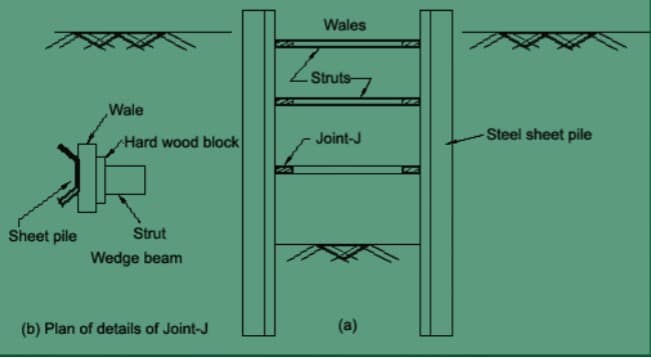
    Braced excavation is a method where deep excavations with straight vertical faces are laterally supported by a sheeting and bracing system until the structure is built. In deep excavations creating a safe slope on the excavation face just for safety is generally not feasible due to high cost, inabunRead more

    Braced excavation is a method where deep excavations with straight vertical faces are laterally supported by a sheeting and bracing system until the structure is built.

    In deep excavations creating a safe slope on the excavation face just for safety is generally not feasible due to high cost, inabundance of space and other structures present nearby. So, the excavation is temperorly supported by sheets/walls and struts, which are removed individually when their requirements cease. Relatively flexible sheets/walls are placed against excavation walls and supported by horizontal struts which in turn resist the earth pressure in compression.

    Some methods are vertical timber sheeting, shoring, steel sheet piling, soldier beams and also tiebacks.

    These structures might not be removed later but they may or may structurallynot be structurally important apart from offering temperorly lateral support. For example, tie backs support excavations and also replace permanent retaining walls.

    See less
    • 2
    • Share
      Share
      • Share on Facebook
      • Share on Twitter
      • Share on LinkedIn
      • Share on WhatsApp
  • 0
  • 3 3 Answers
  • 11,563 Views
  • 0 Followers
Asked: June 24, 2020In: Geotechnical Engineering

What is Submerged Density and Degree of Shrinkage?

Manas Ranjan Patra
Manas Ranjan Patra

Manas Ranjan Patra

  • 1 Question
  • 0 Answers
  • 0 Best Answers
  • 5 Points
View Profile
Manas Ranjan Patra User

  What is the submerged density and degree of shrinkage?

  1. Kuldeep Singh

    Kuldeep Singh

    • 1 Question
    • 110 Answers
    • 10 Best Answers
    • 652 Points
    View Profile
    Best Answer
    Kuldeep Singh Learner
    Added an answer on June 28, 2020 at 10:30 pm

    Submerged density or bouyant density is the density of a mass of soil as observed under water in a saturated condition of course. Suppose you are calculating the density when the soil mass and you yourself are submerged. It is calculated as the difference of the soil density in air and the density oRead more

    Submerged density or bouyant density is the density of a mass of soil as observed under water in a saturated condition of course. Suppose you are calculating the density when the soil mass and you yourself are submerged. It is calculated as the difference of the soil density in air and the density of water, divided by the density of water.

    SD = (density of soil – density of water) / density of water

    or

    SD = density of soil in air – 1

    It is also defined as the mass of soil minus the mass of water displaced by it upon submergence, divided by the volume.

    This concept is particularly useful in determining the bouyancy of submerged soils and is crucial in equations of sediment transport in rivers. If the bouyant density equals 1, the soil just floats. If it gets negative, soil will rise in water.

    Degree of shrinkage is another concept. It is the amount of water content reduction needed to bring the soil to its shrinkage limit, expressed as percent of the original water content.

    See less
    • 4
    • Share
      Share
      • Share on Facebook
      • Share on Twitter
      • Share on LinkedIn
      • Share on WhatsApp
  • 3
  • 4 4 Answers
  • 8,994 Views
  • 0 Followers
Asked: July 15, 2020In: Geotechnical Engineering

What is Relative Compaction?

vivek gami
vivek gami

vivek gami

  • 54 Questions
  • 16 Answers
  • 5 Best Answers
  • 93 Points
View Profile
vivek gami User

What is Relative Compaction? How it is used on-site?

  1. Vivek Patel

    Vivek Patel

    • 39 Questions
    • 80 Answers
    • 1 Best Answer
    • 6 Points
    View Profile
    Vivek Patel User
    Added an answer on July 16, 2020 at 2:40 pm

    Relative compaction is a ration of the density of soil at site to the maximum dry density of soil. like we have maximum dry density of soil have 1800 kg/m3 which determine in lab now on site we can archive 1700 kg/m3 by compaction of dumped soil so relative density of that soil on site is =1700/1800Read more

    Relative compaction is a ration of the density of soil at site to the maximum dry density of soil.

    like we have maximum dry density of soil have 1800 kg/m3 which determine in lab

    now on site we can archive 1700 kg/m3 by compaction of dumped soil

    so relative density of that soil on site is =1700/1800=0.9444 = 94.44%

    it is use for

    1. to know how much density we archive compare to design in lab
    2. sometime in specification minimum criteria of relative density are given, ex- minimum relative density at whole site should be 90%.
    3. from relative density we can calculate actual movement of soil, which is very important in tall building and structural durability calculation
    See less
    • 8
    • Share
      Share
      • Share on Facebook
      • Share on Twitter
      • Share on LinkedIn
      • Share on WhatsApp
  • 6
  • 1 1 Answer
  • 7,988 Views
  • 0 Followers
Asked: July 31, 2020In: Geotechnical Engineering

What are the properties and significance of Fire Clay?

Vivek Patel
Vivek Patel

Vivek Patel

  • 39 Questions
  • 80 Answers
  • 1 Best Answer
  • 6 Points
View Profile
Vivek Patel User

What are the properties and significance of Fire Clay?

  1. nikeetasharma

    nikeetasharma

    • 23 Questions
    • 303 Answers
    • 0 Best Answers
    • 2,680 Points
    View Profile
    nikeetasharma Guru
    Added an answer on October 8, 2020 at 7:31 pm

    Fire clay :- Fire clay is a range of refractory clays used in the manufacture of ceramics, especially fire brick. The United States Environmental Protection Agency defines fire clay very generally as a "mineral aggregate composed of hydrous silicates of aluminium (Al2O3·2SiO2·2H2O) with or without fRead more

    Fire clay :-

    Fire clay is a range of refractory clays used in the manufacture of ceramics, especially fire brick. The United States Environmental Protection Agency defines fire clay very generally as a “mineral aggregate composed of hydrous silicates of aluminium (Al2O3·2SiO2·2H2O) with or without free silica.”

    Properties of fire clay :-

    Fire clay is resistant to high temperatures, having fusion points higher than 1,600 °C (2,910 °F); therefore it is suitable for lining furnaces, as fire brick, and for manufacture of utensils used in the metalworking industries, such as crucibles, saggars, retorts and glassware. Because of its stability during firing in the kiln, it can be used to make complex items of pottery such as pipes and sanitary ware.

    See less
    • 33
    • Share
      Share
      • Share on Facebook
      • Share on Twitter
      • Share on LinkedIn
      • Share on WhatsApp
  • 0
  • 5 5 Answers
  • 7,010 Views
  • 0 Followers
Load More Questions

Sidebar

Explore

  • Questions
  • Ask Questions
  • Write for us
  • Artificial Intelligence
  • Sustainability
  • Building
    • Brick Masonry
    • Building Materials
    • Building Tips
    • Formwork/Shuttering
  • Concrete
    • Concrete Admixtures
    • Cement
    • Concrete Cracks
    • Concrete Properties
  • Construction
    • Construction Equipments
    • Construction Management
    • Construction Project
    • Estimating & Costing
  • How To Guide
    • Material Estimation
    • Repair/Protection Guide
    • Material Testing Guide
    • Mix Design Guide
    • Rate Analysis
  • Geotechnical
    • Foundation Engineering
    • Ground Improvement
  • Structural Engineering
    • Strengthening of Structure
    • Structual Inspection
    • Structural Detailing
  • Surveying
  • Tips

Footer

  • Ask Questions
  • Write for us
  • Popular Questions
  • Facebook
  • Instagram
  • Twitter
  • Telegram

© 2009-2021 The Constructor. All Rights Reserved.