Sign Up

Join TheConstructor to ask questions, answer questions, write articles, and connect with other people. When you join you get additional benefits.

Have an account? Sign In


Have an account? Sign In Now

Sign In

Log in to TheConstructor to ask questions, answer people’s questions, write articles & connect with other people. When you join you get additional benefits.

Sign Up Here

Join for free or log in to continue reading...


Forgot Password?

Don't have account, Sign Up Here

Forgot Password

Lost your password? Please enter your email address. You will receive a link and will create a new password via email.

Have an account? Sign In Now

Sorry, you do not have a permission to ask a question, You must login to ask question. Get the paid membership

Join for free or log in to continue reading...


Forgot Password?

Don't have account, Sign Up Here
Get the paid membership
theconstructor.org Logo theconstructor.org Logo
Log inJoin

theconstructor.org

theconstructor.org Navigation

  • Articles
    • Recent Articles
    • Popular Articles
    • Write for us
  • Community
  • Categories
    • How To Guide
      • Material Testing Guide
    • Concrete
    • Building
      • Brick Masonry
      • Building Materials
      • Building Tips
    • Construction
      • Equipments
      • Management
    • Digital Construction
    • Geotechnical
      • Foundation
  • Case Studies
Search
Ask A Question

Mobile menu

Close
Ask a Question
  • Questions
  • Ask Questions
  • Write for us
  • Artificial Intelligence
  • Sustainability
  • Building
    • Brick Masonry
    • Building Materials
    • Building Tips
    • Formwork/Shuttering
  • Concrete
    • Concrete Admixtures
    • Cement
    • Concrete Cracks
    • Concrete Properties
  • Construction
    • Construction Equipments
    • Construction Management
    • Construction Project
    • Estimating & Costing
  • How To Guide
    • Material Estimation
    • Repair/Protection Guide
    • Material Testing Guide
    • Mix Design Guide
    • Rate Analysis
  • Geotechnical
    • Foundation Engineering
    • Ground Improvement
  • Structural Engineering
    • Strengthening of Structure
    • Structual Inspection
    • Structural Detailing
  • Surveying
  • Tips

Geotechnical Engineering

Home/Geotechnical Engineering

Do you need to remove the ads? Get the paid membership

  • Recent Questions
  • Most Answered
  • Answers
  • No Answers
  • Most Visited
  • Most Voted
  • Random

Discy Latest Questions

Asked: August 2, 2020In: Geotechnical Engineering

What is disturbed and undisturbed soil sample?

vivek gami
vivek gami

vivek gami

  • 54 Questions
  • 16 Answers
  • 5 Best Answers
  • 93 Points
View Profile
vivek gami User

What is disturbed and undisturbed soil sample?

  1. nikeetasharma

    nikeetasharma

    • 23 Questions
    • 303 Answers
    • 0 Best Answers
    • 2,680 Points
    View Profile
    nikeetasharma Guru
    Added an answer on December 21, 2020 at 9:25 am

    Disturbed soil sample is one in which the structure of the soil has been changed sufficiently that tests of the structural properties of the soil will not be representatives of in-situ conditions, and only properties of soil grains can be accurately determined. Undisturbed soil sample is one where tRead more

    Disturbed soil sample is one in which the structure of the soil has been changed sufficiently that tests of the structural properties of the soil will not be representatives of in-situ conditions, and only properties of soil grains can be accurately determined.

    Undisturbed soil sample is one where the condition of the soil in the sample is close enough to the conditions of the soil in in-situ to allow tests of structural properties of the soil to be used to approximate the properties of the soil in-situ.

    See less
    • 5
    • Share
      Share
      • Share on Facebook
      • Share on Twitter
      • Share on LinkedIn
      • Share on WhatsApp
  • 5
  • 6 6 Answers
  • 54,438 Views
  • 0 Followers
Asked: July 24, 2020In: Geotechnical Engineering

What is zero air void line in soil?

Vivek Patel
Vivek Patel

Vivek Patel

  • 39 Questions
  • 80 Answers
  • 1 Best Answer
  • 6 Points
View Profile
Vivek Patel User

What is zero air void line in soil?

  1. Abbas Khan Civil Engineer

    Abbas Khan Civil Engineer

    • 11 Questions
    • 29 Answers
    • 1 Best Answer
    • 925 Points
    View Profile
    Abbas Khan Civil Engineer Learner
    Added an answer on July 27, 2020 at 3:17 pm

    The zero Air Void line is obtained when there is no presence of the air in the pores of a soil mass and totally filled with the water and soil mass get saturated. It is determined by the compaction test of a soil. Draw the graph between Dry Density VS water content, calculate the dry density from thRead more

    The zero Air Void line is obtained when there is no presence of the air in the pores of a soil mass and totally filled with the water and soil mass get saturated. It is determined by the compaction test of a soil. Draw the graph between Dry Density VS water content, calculate the dry density from the compaction test results, and Zero Air void line is drawn on the graph.
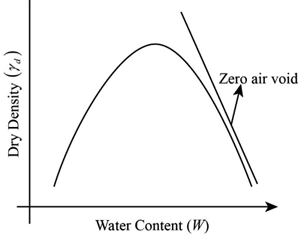
     

    Graph A

    See less
    • 19
    • Share
      Share
      • Share on Facebook
      • Share on Twitter
      • Share on LinkedIn
      • Share on WhatsApp
  • 3
  • 4 4 Answers
  • 38,586 Views
  • 0 Followers
Asked: October 12, 2020In: Geotechnical Engineering

What are the Methods of Interpolation of Contours?

ISMAEL PUNGA
ISMAEL PUNGA

ISMAEL PUNGA

  • 1 Question
  • 0 Answers
  • 0 Best Answers
  • 10 Points
View Profile
ISMAEL PUNGA User

What are the Methods of Interpolation of Contours?

  1. nikeetasharma

    nikeetasharma

    • 23 Questions
    • 303 Answers
    • 0 Best Answers
    • 2,680 Points
    View Profile
    nikeetasharma Guru
    Added an answer on October 14, 2020 at 6:36 pm

    Interpolation of the contours is the process of spacing the contours proportionately between the plotted ground points established by indirect methods. The methods of interpolation are based on the assumption that the slope of ground between the two points is uniform. Methods of interpolation of conRead more

    Interpolation of the contours is the process of spacing the contours proportionately between the plotted ground points established by indirect methods. The methods of interpolation are based on the assumption that the slope of ground between the two points is uniform.

    Methods of interpolation of contour are as follows :-

    1. Arithmetic calculation
    2. Graphical calculation
    3. Estimation calculation

    See less
    • 48
    • Share
      Share
      • Share on Facebook
      • Share on Twitter
      • Share on LinkedIn
      • Share on WhatsApp
  • 5
  • 4 4 Answers
  • 37,629 Views
  • 0 Followers
Asked: July 16, 2020In: Geotechnical Engineering

Explain the construction & use of New Mark’s influence chart?

DevilAVRT
DevilAVRT

DevilAVRT

  • 27 Questions
  • 49 Answers
  • 3 Best Answers
  • 207 Points
View Profile
DevilAVRT Beginner

Explain the construction & use of New Mark’s influence chart?

  1. Suyogmuralkar

    Suyogmuralkar

    • 1 Question
    • 11 Answers
    • 0 Best Answers
    • 303 Points
    View Profile
    Suyogmuralkar Beginner
    Added an answer on August 21, 2020 at 1:30 pm

    Hi devilart, This method is used to compute the vertical and horizontal stresses of any shape ,irregular geometry below any point outside or inside The chart as shown in the above figure essentially consists of n no. of radial lines and m no. of concentric circles.   To find out vertical stressRead more

    Hi devilart, This method is used to compute the vertical and horizontal stresses of any shape ,irregular geometry below any point outside or inside

    The chart as shown in the above figure essentially consists of n no. of radial lines and m no. of concentric circles.


    To find out vertical stress at any point below or outside the loaded area, Plan of the loaded area is drawn such that depth Z at which stress is being computed equals the length AB as shown on

    N = No. of blocks. Bina Nusantara.

    Further, the plan is placed over influence chart such that the point below which stress is required coincides with the center of chart Then count the number of influence area (N) covered by the plan

    See less
    • 4
    • Share
      Share
      • Share on Facebook
      • Share on Twitter
      • Share on LinkedIn
      • Share on WhatsApp
  • 9
  • 2 2 Answers
  • 26,968 Views
  • 0 Followers
Asked: July 16, 2020In: Geotechnical Engineering

Which best material for backfill of retaining wall?

Vivek Patel
Vivek Patel

Vivek Patel

  • 39 Questions
  • 80 Answers
  • 1 Best Answer
  • 6 Points
View Profile
Vivek Patel User

Which best material for backfill of retaining wall?

  1. nikeetasharma

    nikeetasharma

    • 23 Questions
    • 303 Answers
    • 0 Best Answers
    • 2,680 Points
    View Profile
    nikeetasharma Guru
    Added an answer on October 1, 2020 at 7:28 pm

    Thus when it comes to backfill, it refers to the dirt behind the wall. In order to provide proper drainage, atleast 12 inches of granular backfill (gravel or a similar aggregate) should be installed directly behind the wall. Compacted native soil can be used to backfill the rest of the space behindRead more

    Thus when it comes to backfill, it refers to the dirt behind the wall. In order to provide proper drainage, atleast 12 inches of granular backfill (gravel or a similar aggregate) should be installed directly behind the wall. Compacted native soil can be used to backfill the rest of the space behind the wall.

    See less
    • 35
    • Share
      Share
      • Share on Facebook
      • Share on Twitter
      • Share on LinkedIn
      • Share on WhatsApp
  • 2
  • 6 6 Answers
  • 25,603 Views
  • 0 Followers
Asked: September 19, 2020In: Geotechnical Engineering

What is the equation of A-line in the plasticity chart?

aviratdhodare
aviratdhodare

aviratdhodare

  • 37 Questions
  • 252 Answers
  • 0 Best Answers
  • 480 Points
View Profile
aviratdhodare

What is the equation of A-line in the plasticity chart?

  1. nikeetasharma

    nikeetasharma

    • 23 Questions
    • 303 Answers
    • 0 Best Answers
    • 2,680 Points
    View Profile
    nikeetasharma Guru
    Added an answer on November 26, 2020 at 12:09 pm

    Fine grained soils are classified based on the plasticity chart. The equation of A line is ; Ip=0.73(liquid limit -20) Ip=plasticity index

    Fine grained soils are classified based on the plasticity chart. The equation of A line is ;

    Ip=0.73(liquid limit -20)

    Ip=plasticity index

    See less
    • 1
    • Share
      Share
      • Share on Facebook
      • Share on Twitter
      • Share on LinkedIn
      • Share on WhatsApp
  • 31
  • 6 6 Answers
  • 21,573 Views
  • 0 Followers
Asked: September 5, 2020In: Geotechnical Engineering

What is negative pore water pressure in soil?

aviratdhodare
aviratdhodare

aviratdhodare

  • 37 Questions
  • 252 Answers
  • 0 Best Answers
  • 480 Points
View Profile
aviratdhodare

What is negative pore water pressure in soil?

  1. sanjaypakad

    sanjaypakad

    • 0 Questions
    • 9 Answers
    • 0 Best Answers
    • 232 Points
    View Profile
    sanjaypakad Beginner
    Added an answer on October 8, 2020 at 5:36 pm

    The pressure is zero when the soil voids are filled with air, and is negative when the voids are partly filled with water (in which case surface-tension forces operate to achieve a suction effect and the shear strength of the soil is increased).

    The pressure is zero when the soil voids are filled with air, and is negative when the voids are partly filled with water (in which case surface-tension forces operate to achieve a suction effect and the shear strength of the soil is increased).

    See less
    • 1
    • Share
      Share
      • Share on Facebook
      • Share on Twitter
      • Share on LinkedIn
      • Share on WhatsApp
  • 37
  • 9 9 Answers
  • 20,175 Views
  • 0 Followers
Asked: May 20, 2021In: Geotechnical Engineering

What is the Safe Bearing Capacity values for Different Soils?

Gopal Mishra
Gopal Mishra

Gopal Mishra

  • 75 Questions
  • 44 Answers
  • 7 Best Answers
  • 577 Points
View Profile
Gopal Mishra

In the absence of test data for calculating SBC of soil. What are the assumed safe bearing capacity values for different soils?

  1. Fasi Ur Rahman

    Fasi Ur Rahman

    • 4 Questions
    • 36 Answers
    • 1 Best Answer
    • 1,323 Points
    View Profile
    Fasi Ur Rahman
    Added an answer on May 20, 2021 at 5:40 am

    The capacity of the soil to allow the loads coming from the foundation is called the bearing capacity of the soil. It is essential to know the bearing capacity of the soil before designing the foundation. Different field tests can determine it. However, standard safe bearing capacity values are avaiRead more

    The capacity of the soil to allow the loads coming from the foundation is called the bearing capacity of the soil.
    It is essential to know the bearing capacity of the soil before designing the foundation. Different field tests can determine it. However, standard safe bearing capacity values are available for different soil types, and these values can be assumed where test data is limited or speedy construction is required.

    S.No Type of Soil Safe Bearing Capacity ( kN/m2)
    Cohesive Soils
    1. Soft shale, hard or stiff clay in a deep bed, dry state 440
    2. Medium clay readily indented with a thumbnail 245
    3. Moist clay and Sand clay mixture, which can be indented by thumb pressure 150
    4. Black cotton soil/expansive clay ( 50% saturated) in the dry state 130 to 160
    5. Soft clay indented with moderate thumb pressure 100
    6. Very soft clay which can be penetrated with the thump up to few centimeters 50
    Cohesionless Soil
    7. Compact gravel/sand and gravel mixture with good resistance against penetration of tools 440
    8. Compact and dry coarse sand 440
    9. Compact and dry medium sand 245
    10. Loose gravel or sandy gravel mixture, dry state 245
    11. Fine sand and silt ( consists of dry lumps) 150
    12. Loose and dry fine sand 100
    Rocks
    13. Hard rocks such as granite trap, diorite, etc. 3240
    14. Laminated rocks such as sandstone, limestone, etc. 1620
    15. Residual deposits of shattered and broken bedrock and hard shale cemented material 880
    16. Soft rocks 440
    See less
    • 48
    • Share
      Share
      • Share on Facebook
      • Share on Twitter
      • Share on LinkedIn
      • Share on WhatsApp
  • 11
  • 1 1 Answer
  • 18,667 Views
  • 0 Followers
Load More Questions

Sidebar

Explore

  • Questions
  • Ask Questions
  • Write for us
  • Artificial Intelligence
  • Sustainability
  • Building
    • Brick Masonry
    • Building Materials
    • Building Tips
    • Formwork/Shuttering
  • Concrete
    • Concrete Admixtures
    • Cement
    • Concrete Cracks
    • Concrete Properties
  • Construction
    • Construction Equipments
    • Construction Management
    • Construction Project
    • Estimating & Costing
  • How To Guide
    • Material Estimation
    • Repair/Protection Guide
    • Material Testing Guide
    • Mix Design Guide
    • Rate Analysis
  • Geotechnical
    • Foundation Engineering
    • Ground Improvement
  • Structural Engineering
    • Strengthening of Structure
    • Structual Inspection
    • Structural Detailing
  • Surveying
  • Tips

Footer

  • Ask Questions
  • Write for us
  • Popular Questions
  • Facebook
  • Instagram
  • Twitter
  • Telegram

© 2009-2021 The Constructor. All Rights Reserved.