
Sign Up

Join TheConstructor to ask questions, answer questions, write articles, and connect with other people. When you join you get additional benefits.

Have an account? Sign In


Have an account? Sign In Now

Sign In

Log in to TheConstructor to ask questions, answer people’s questions, write articles & connect with other people. When you join you get additional benefits.

Sign Up Here

Join for free or log in to continue reading...


Forgot Password?

Don't have account, Sign Up Here

Forgot Password

Lost your password? Please enter your email address. You will receive a link and will create a new password via email.

Have an account? Sign In Now

Sorry, you do not have a permission to ask a question, You must login to ask question. Get the paid membership

Join for free or log in to continue reading...


Forgot Password?

Don't have account, Sign Up Here
Get the paid membership
theconstructor.org Logo theconstructor.org Logo
Log inJoin

theconstructor.org

theconstructor.org Navigation

  • Articles
    • Recent Articles
    • Popular Articles
    • Write for us
  • Community
  • Categories
    • How To Guide
      • Material Testing Guide
    • Concrete
    • Building
      • Brick Masonry
      • Building Materials
      • Building Tips
    • Construction
      • Equipments
      • Management
    • Digital Construction
    • Geotechnical
      • Foundation
  • Case Studies
Search
Ask A Question

Mobile menu

Close
Ask a Question
  • Questions
  • Ask Questions
  • Write for us
  • Artificial Intelligence
  • Sustainability
  • Building
    • Brick Masonry
    • Building Materials
    • Building Tips
    • Formwork/Shuttering
  • Concrete
    • Concrete Admixtures
    • Cement
    • Concrete Cracks
    • Concrete Properties
  • Construction
    • Construction Equipments
    • Construction Management
    • Construction Project
    • Estimating & Costing
  • How To Guide
    • Material Estimation
    • Repair/Protection Guide
    • Material Testing Guide
    • Mix Design Guide
    • Rate Analysis
  • Geotechnical
    • Foundation Engineering
    • Ground Improvement
  • Structural Engineering
    • Strengthening of Structure
    • Structual Inspection
    • Structural Detailing
  • Surveying
  • Tips

Geotechnical Engineering

Home/Geotechnical Engineering/Page 3

Do you need to remove the ads? Get the paid membership

  • Recent Questions
  • Most Answered
  • Answers
  • No Answers
  • Most Visited
  • Most Voted
  • Random
  1. Asked: July 31, 2020In: Geotechnical Engineering

    What are the properties and significance of Fire Clay?

    CB Sowmya

    CB Sowmya

    • 3 Questions
    • 53 Answers
    • 4 Best Answers
    • 5 Points
    View Profile
    CB Sowmya User
    Added an answer on August 2, 2020 at 9:26 am

    Properties and significance: It can withstand a temperature of at least 1515 °C. It is made up of 65% siliceous materials and 22% argillaceous materials. It has high alumina content and kaolinite. It is plastic in nature and have high iron impurities. It is ideal for lining surfaces exposed to highRead more

    Properties and significance:

    1. It can withstand a temperature of at least 1515 °C.
    2. It is made up of 65% siliceous materials and 22% argillaceous materials.
    3. It has high alumina content and kaolinite.
    4. It is plastic in nature and have high iron impurities.
    5. It is ideal for lining surfaces exposed to high temperature.
    6. It is used in furnaces, kilns, in manufacture of crucibles, fire bricks, saggars and glassware.
    See less
    • 1
    • Share
      Share
      • Share on Facebook
      • Share on Twitter
      • Share on LinkedIn
      • Share on WhatsApp
  2. Asked: July 13, 2020In: Geotechnical Engineering

    What is different between Prandtal mixing length and Boundarylayer ?

    Vivek Patel

    Vivek Patel

    • 39 Questions
    • 80 Answers
    • 1 Best Answer
    • 6 Points
    View Profile
    Vivek Patel User
    Added an answer on July 31, 2020 at 3:20 pm

    Prandtl mixing line theory is the phenomenon of momentum remaining constant in fluid flow where the boundary layer is a theory of variations of velocity perpendicular to the floor and velocity value change from 0 to infinite. Prandtl mixing theory is used for the study of momentum in fluid flow. BouRead more

    Prandtl mixing line theory is the phenomenon of momentum remaining constant in fluid flow where the boundary layer is a theory of variations of velocity perpendicular to the floor and velocity value change from 0 to infinite.

    Prandtl mixing theory is used for the study of momentum in fluid flow.

    Boundary layer theory is used for the study of velocity distributions in fluid flow.

    See less
    • 0
    • Share
      Share
      • Share on Facebook
      • Share on Twitter
      • Share on LinkedIn
      • Share on WhatsApp
  3. Asked: July 29, 2020In: Geotechnical Engineering

    What is the Average Density of Soil?

    INDER KUMAR YADAV

    INDER KUMAR YADAV

    • 0 Questions
    • 14 Answers
    • 1 Best Answer
    • 562 Points
    View Profile
    INDER KUMAR YADAV Learner
    Added an answer on July 30, 2020 at 11:28 pm

    Soil density is defined in two different terms. particle density bulk density In terms of particle density the density of soil is  2.65 gram per cubic centimeter. in terms of bulk density, the density of soil is 1.6 gram per cubic centimeter. Image shows below that how the density of soil is measureRead more

    Soil density is defined in two different terms.

    1. particle density
    2. bulk density

    In terms of particle density the density of soil is  2.65 gram per cubic centimeter.

    in terms of bulk density, the density of soil is 1.6 gram per cubic centimeter.

    Image shows below that how the density of soil is measured

    Bulk Density - Measurement | Fact Sheets | soilquality.org.au

    See less
    • 2
    • Share
      Share
      • Share on Facebook
      • Share on Twitter
      • Share on LinkedIn
      • Share on WhatsApp
  4. Asked: July 27, 2020In: Geotechnical Engineering

    What is the bearing capacity of soil? How can we calculate it?

    Vivek Patel

    Vivek Patel

    • 39 Questions
    • 80 Answers
    • 1 Best Answer
    • 6 Points
    View Profile
    Vivek Patel User
    Added an answer on July 28, 2020 at 10:45 pm

    The bearing capacity means the soil can transfer the load safely from the foundation to the soil strata without excessive settlement and without any type of failure. Soil bearing capacity can be identify by some test: Dynamic cone penitration test Static cone penitration test Plate load test CBR tesRead more

    The bearing capacity means the soil can transfer the load safely from the foundation to the soil strata without excessive settlement and without any type of failure.

    Soil bearing capacity can be identify by some test:

    • Dynamic cone penitration test
    • Static cone penitration test
    • Plate load test
    • CBR test

    Those all test are conducted at site to identify soil bearing capacity.

    Two criteria majorly accounted for foundation failure

    1. Excessive settlement and relative settlement
    2. Shear failure of soil (punching failure, local shear failure and general shear failure)
    See less
    • 0
    • Share
      Share
      • Share on Facebook
      • Share on Twitter
      • Share on LinkedIn
      • Share on WhatsApp
  5. Asked: July 24, 2020In: Geotechnical Engineering

    What is zero air void line in soil?

    Abbas Khan Civil Engineer

    Abbas Khan Civil Engineer

    • 11 Questions
    • 29 Answers
    • 1 Best Answer
    • 925 Points
    View Profile
    Abbas Khan Civil Engineer Learner
    Added an answer on July 27, 2020 at 3:17 pm

    The zero Air Void line is obtained when there is no presence of the air in the pores of a soil mass and totally filled with the water and soil mass get saturated. It is determined by the compaction test of a soil. Draw the graph between Dry Density VS water content, calculate the dry density from thRead more

    The zero Air Void line is obtained when there is no presence of the air in the pores of a soil mass and totally filled with the water and soil mass get saturated. It is determined by the compaction test of a soil. Draw the graph between Dry Density VS water content, calculate the dry density from the compaction test results, and Zero Air void line is drawn on the graph.
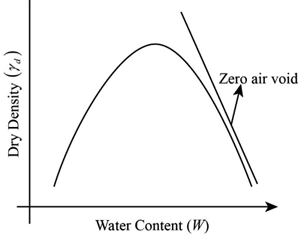
     

    Graph A

    See less
    • 19
    • Share
      Share
      • Share on Facebook
      • Share on Twitter
      • Share on LinkedIn
      • Share on WhatsApp
  6. Asked: July 20, 2020In: Geotechnical Engineering

    What are the method for finding Bearing capacity of soil?

    Preet Chovatiya

    Preet Chovatiya

    • 11 Questions
    • 81 Answers
    • 5 Best Answers
    • 858 Points
    View Profile
    Preet Chovatiya Learner
    Added an answer on July 22, 2020 at 12:12 am

    Soil bearing capacity can be determined by below methods:- Penetration test Centrifuge test Analytical method Plate bearing test Modern testing method Presumptive analysis

    Soil bearing capacity can be determined by below methods:-

    1. Penetration test
    2. Centrifuge test
    3. Analytical method
    4. Plate bearing test
    5. Modern testing method
    6. Presumptive analysis
    See less
    • 3
    • Share
      Share
      • Share on Facebook
      • Share on Twitter
      • Share on LinkedIn
      • Share on WhatsApp
  7. Asked: July 20, 2020In: Geotechnical Engineering

    What is the meaning of shear strength in soil?

    Vivek Patel

    Vivek Patel

    • 39 Questions
    • 80 Answers
    • 1 Best Answer
    • 6 Points
    View Profile
    Vivek Patel User
    Added an answer on July 20, 2020 at 9:00 pm

    Shear strength of soil is resistance against shear come from the footing of structure. Shear strength gives soil bearing capacity of structure footing without excessive settlement.   Shear strength of soil is given by coulomb. Shear strength = c +φ tan ∅ Where c= cohesion φ= normal stress ∅ = aRead more

    Shear strength of soil is resistance against shear come from the footing of structure.

    Shear strength gives soil bearing capacity of structure footing without excessive settlement.


    Shear strength of soil is given by coulomb.

    Shear strength = c +φ tan ∅

    Where c= cohesion

    φ= normal stress

    ∅ = angle of internal friction of soil


    In clay angle of internal friction is very less and in sandy soil, cohesion is very less.

    Some of the test is use for finding out shear strength of soil like

    • Ven shear test
    • Triaxial test
    • Plate load bearing test
    • Box test etc


    See less
    • 1
    • Share
      Share
      • Share on Facebook
      • Share on Twitter
      • Share on LinkedIn
      • Share on WhatsApp
  8. Asked: July 19, 2020In: Geotechnical Engineering

    Why abutment in bridge is designed as earth pressure and rest condition?

    Kuldeep Singh

    Kuldeep Singh

    • 1 Question
    • 110 Answers
    • 10 Best Answers
    • 652 Points
    View Profile
    Kuldeep Singh Learner
    Added an answer on July 20, 2020 at 10:48 am

    Earth pressure at rest is used for the design of underground structures, be abutments, etc. because it is expected that there would be no lateral displacement in the soil mass after construction is complete and during the life of the structure. Also, if you test the earth pressure in the field arounRead more

    Earth pressure at rest is used for the design of underground structures, be abutments, etc. because it is expected that there would be no lateral displacement in the soil mass after construction is complete and during the life of the structure.

    Also, if you test the earth pressure in the field around these structures, it matches very well with the calculated earth pressure at rest for normally consolidated soils.

    See less
    • 1
    • Share
      Share
      • Share on Facebook
      • Share on Twitter
      • Share on LinkedIn
      • Share on WhatsApp
Load More Answers

Sidebar

Explore

  • Questions
  • Ask Questions
  • Write for us
  • Artificial Intelligence
  • Sustainability
  • Building
    • Brick Masonry
    • Building Materials
    • Building Tips
    • Formwork/Shuttering
  • Concrete
    • Concrete Admixtures
    • Cement
    • Concrete Cracks
    • Concrete Properties
  • Construction
    • Construction Equipments
    • Construction Management
    • Construction Project
    • Estimating & Costing
  • How To Guide
    • Material Estimation
    • Repair/Protection Guide
    • Material Testing Guide
    • Mix Design Guide
    • Rate Analysis
  • Geotechnical
    • Foundation Engineering
    • Ground Improvement
  • Structural Engineering
    • Strengthening of Structure
    • Structual Inspection
    • Structural Detailing
  • Surveying
  • Tips

Footer

  • Ask Questions
  • Write for us
  • Popular Questions
  • Facebook
  • Instagram
  • Twitter
  • Telegram

© 2009-2021 The Constructor. All Rights Reserved.