Sign Up

Join TheConstructor to ask questions, answer questions, write articles, and connect with other people. When you join you get additional benefits.

Have an account? Sign In


Have an account? Sign In Now

Sign In

Log in to TheConstructor to ask questions, answer people’s questions, write articles & connect with other people. When you join you get additional benefits.

Sign Up Here

Join for free or log in to continue reading...


Forgot Password?

Don't have account, Sign Up Here

Forgot Password

Lost your password? Please enter your email address. You will receive a link and will create a new password via email.

Have an account? Sign In Now

Sorry, you do not have a permission to ask a question, You must login to ask question. Get the paid membership

Join for free or log in to continue reading...


Forgot Password?

Don't have account, Sign Up Here
Get the paid membership
theconstructor.org Logo theconstructor.org Logo
Log inJoin

theconstructor.org

theconstructor.org Navigation

  • Articles
    • Recent Articles
    • Popular Articles
    • Write for us
  • Community
  • Categories
    • How To Guide
      • Material Testing Guide
    • Concrete
    • Building
      • Brick Masonry
      • Building Materials
      • Building Tips
    • Construction
      • Equipments
      • Management
    • Digital Construction
    • Geotechnical
      • Foundation
  • Case Studies
Search
Ask A Question

Mobile menu

Close
Ask a Question
  • Questions
  • Ask Questions
  • Write for us
  • Artificial Intelligence
  • Sustainability
  • Building
    • Brick Masonry
    • Building Materials
    • Building Tips
    • Formwork/Shuttering
  • Concrete
    • Concrete Admixtures
    • Cement
    • Concrete Cracks
    • Concrete Properties
  • Construction
    • Construction Equipments
    • Construction Management
    • Construction Project
    • Estimating & Costing
  • How To Guide
    • Material Estimation
    • Repair/Protection Guide
    • Material Testing Guide
    • Mix Design Guide
    • Rate Analysis
  • Geotechnical
    • Foundation Engineering
    • Ground Improvement
  • Structural Engineering
    • Strengthening of Structure
    • Structual Inspection
    • Structural Detailing
  • Surveying
  • Tips

Structural Engineering

Home/Structural Engineering/Page 2

Do you need to remove the ads? Get the paid membership

  • Recent Questions
  • Most Answered
  • Answers
  • No Answers
  • Most Visited
  • Most Voted
  • Random

Discy Latest Questions

Asked: August 15, 2020In: Structural Engineering

Which is the most economical way of roofing for rural areas?

AdityaBhandakkar
AdityaBhandakkar

AdityaBhandakkar

  • 12 Questions
  • 250 Answers
  • 2 Best Answers
  • 0 Points
View Profile
AdityaBhandakkar User

Which is the most economical way of roofing for rural areas?

  1. nikeetasharma

    nikeetasharma

    • 23 Questions
    • 303 Answers
    • 0 Best Answers
    • 2,680 Points
    View Profile
    nikeetasharma Guru
    Added an answer on November 23, 2020 at 11:41 am

    The following are the most economical way of roofing for rural areas :- 1. Partial roofs 2. Slate roofs 3. Porches 4. Stone roofs 5. Galvanized roofs 6. Tile stone coated roofs

    The following are the most economical way of roofing for rural areas :-
    1. Partial roofs
    2. Slate roofs
    3. Porches
    4. Stone roofs
    5. Galvanized roofs
    6. Tile stone coated roofs

    See less
    • 0
    • Share
      Share
      • Share on Facebook
      • Share on Twitter
      • Share on LinkedIn
      • Share on WhatsApp
  • 8
  • 4 4 Answers
  • 2,595 Views
  • 0 Followers
Asked: July 22, 2020In: Structural Engineering

What is the diffrence between lap length and development length?

Vivek Patel
Vivek Patel

Vivek Patel

  • 39 Questions
  • 80 Answers
  • 1 Best Answer
  • 6 Points
View Profile
Vivek Patel User

What is the diffrence between lap length and development length?

  1. nikeetasharma

    nikeetasharma

    • 23 Questions
    • 303 Answers
    • 0 Best Answers
    • 2,680 Points
    View Profile
    nikeetasharma Guru
    Added an answer on September 30, 2020 at 5:44 pm

    lap length is required when bars placed short of their required length (due to nonavailability of longer bars) need to be extended. lap length is to be provided to safely transfer the load. Development length is provided to transfer the load from steel to concrete. It is also known as anchorage lengRead more

    lap length is required when bars placed short of their required length (due to nonavailability of longer bars) need to be extended. lap length is to be provided to safely transfer the load.

    Development length is provided to transfer the load from steel to concrete. It is also known as anchorage length.

    See less
    • 41
    • Share
      Share
      • Share on Facebook
      • Share on Twitter
      • Share on LinkedIn
      • Share on WhatsApp
  • 5
  • 7 7 Answers
  • 27,595 Views
  • 0 Followers
Asked: July 23, 2020In: Structural Engineering

What is the function of stirrup in beam?

vivek gami
vivek gami

vivek gami

  • 54 Questions
  • 16 Answers
  • 5 Best Answers
  • 93 Points
View Profile
vivek gami User

What is the function of stirrup in beam?

  1. Preet Chovatiya

    Preet Chovatiya

    • 11 Questions
    • 81 Answers
    • 5 Best Answers
    • 858 Points
    View Profile
    Best Answer
    Preet Chovatiya Learner
    Added an answer on July 24, 2020 at 6:07 pm

    Stirrups are mainly provided for holding the main reinforcement of beam. It prevents the buckling of beam and also protect the RCC structure during seismic activity. Stirrups providing protection against flexural and shear failure as shown in figure.

    Stirrups are mainly provided for holding the main reinforcement of beam. It prevents the buckling of beam and also protect the RCC structure during seismic activity. Stirrups providing protection against flexural and shear failure as shown in figure.

    See less
    • 14
    • Share
      Share
      • Share on Facebook
      • Share on Twitter
      • Share on LinkedIn
      • Share on WhatsApp
  • 5
  • 5 5 Answers
  • 16,450 Views
  • 0 Followers
Asked: July 16, 2020In: Structural Engineering

What is diffrence between retaining wall and breast wall?

Vivek Patel
Vivek Patel

Vivek Patel

  • 39 Questions
  • 80 Answers
  • 1 Best Answer
  • 6 Points
View Profile
Vivek Patel User

What is diffrence between retaining wall and breast wall?

  1. vivek gami

    vivek gami

    • 54 Questions
    • 16 Answers
    • 5 Best Answers
    • 93 Points
    View Profile
    Best Answer
    vivek gami User
    Added an answer on July 19, 2020 at 9:34 pm

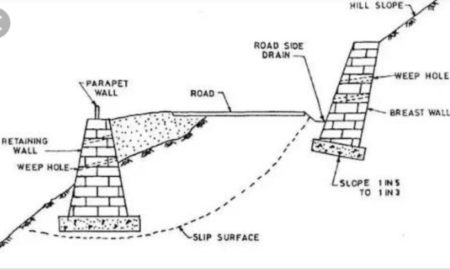
    Basic difference is retaining wall is designed to resist backfill earth pressure and breast wall is resist for natural earthen slope of hilly area In hill. When road is construct, at that time we need to cut-off some portion of hill and basically we construct two wall one is breast wall which is onRead more

    Basic difference is retaining wall is designed to resist backfill earth pressure and breast wall is resist for natural earthen slope of hilly area

    In hill. When road is construct, at that time we need to cut-off some portion of hill and basically we construct two wall one is breast wall which is on hill side of the road to give stability of hill slop and another one is retaining wall which is construct on valley side of road which wall have backfill pressure plus road pressure on backfill so we need to design retaining wall for that backfill & surcharge .

    See figure for different between retaining wall and breast wall.

    See less
    • 30
    • Share
      Share
      • Share on Facebook
      • Share on Twitter
      • Share on LinkedIn
      • Share on WhatsApp
  • 5
  • 6 6 Answers
  • 43,327 Views
  • 0 Followers
Asked: April 27, 2019In: Structural Engineering

How to Calculate Reinforcement Steel Overlap Length?

onejohi
onejohi

onejohi

  • 1 Question
  • 0 Answers
  • 0 Best Answers
  • 20 Points
View Profile
onejohi User

How to calculate length of overlap for reinforcement steel?

  1. Gopal Mishra

    Gopal Mishra

    • 75 Questions
    • 44 Answers
    • 7 Best Answers
    • 577 Points
    View Profile
    Best Answer
    Gopal Mishra
    Added an answer on April 27, 2019 at 6:50 pm

    Lapping of reinforcement is usually done where minimum bending stress is required. In general, lap length is 50d which means 50 times the bar diameter is provided if both bars are of same diameter. Lap length in tension: The lap length including anchorage value of hooks shall be For flexural tensionRead more

    Lapping of reinforcement is usually done where minimum bending stress is required. In general, lap length is 50d which means 50 times the bar diameter is provided if both bars are of same diameter.

    Lap length in tension:
    The lap length including anchorage value of hooks shall be

    For flexural tension – Ld or 30d whichever is greater is considered.
    For direct tension – 2Ld or 30d whichever is greater is considered.
    The straight length of lapping of bars shall not be less than 15d or 20cm.

    Lap Length in Compression:
    The lap length is equal to the development length calculated in compression but not less than 24d.

    For Different Diameter Bars:
    When the bars of different diameters are to be spliced, the lap length is calculated considering the smaller diameter bar.

    See less
    • 6
    • Share
      Share
      • Share on Facebook
      • Share on Twitter
      • Share on LinkedIn
      • Share on WhatsApp
  • 5
  • 3 3 Answers
  • 32,355 Views
  • 0 Followers
Asked: July 15, 2020In: Structural Engineering

What is substitute frame method in structural design?

vivek gami
vivek gami

vivek gami

  • 54 Questions
  • 16 Answers
  • 5 Best Answers
  • 93 Points
View Profile
vivek gami User

What is the substitute frame method in structural design?

  1. AdityaBhandakkar

    AdityaBhandakkar

    • 12 Questions
    • 250 Answers
    • 2 Best Answers
    • 0 Points
    View Profile
    AdityaBhandakkar User
    Added an answer on September 7, 2020 at 6:13 pm

    Hi, Substitute frame method is used for the analysis of complex structure I.e multi-storeyed building because analysis of multi-story building is very complicated and long calculations needed. Substitute frame method used for sudden analysis and gives approximate values. The moment distribution methRead more

    Hi,

    Substitute frame method is used for the analysis of complex structure I.e multi-storeyed building because analysis of multi-story building is very complicated and long calculations needed. Substitute frame method used for sudden analysis and gives approximate values.

    The moment distribution method is used for the analysis of applied loads on the structure in the substitute frame method. This method is generally used to determine the vertical loads and horizontal loads. Vertical load is a combination of live load and dead loads

    This method is applied only or vertical loads.

    Dead loads include self-weight of slab column and beams which is analysed in substitute frame method.

    In this method, the beams which are at floor level as well as the columns above the floor and below which are situated at the fixed far end will be e analysed. In some cases the bending moment is not distributed over the far end, thus the moment is computed independently at each floor and retained on that floor for further analysis.

    See less
    • 44
    • Share
      Share
      • Share on Facebook
      • Share on Twitter
      • Share on LinkedIn
      • Share on WhatsApp
  • 4
  • 2 2 Answers
  • 5,624 Views
  • 0 Followers
Asked: July 17, 2020In: Structural Engineering

Which pressure us higher in retaining wall, water or soil?

vivek gami
vivek gami

vivek gami

  • 54 Questions
  • 16 Answers
  • 5 Best Answers
  • 93 Points
View Profile
vivek gami User

Which pressure us higher in retaining wall, water or soil?

  1. AdityaBhandakkar

    AdityaBhandakkar

    • 12 Questions
    • 250 Answers
    • 2 Best Answers
    • 0 Points
    View Profile
    AdityaBhandakkar User
    Added an answer on September 7, 2020 at 6:12 pm

    In technical terms, Above the Water table, Pressure exerted by water on retaining wall = 0.5 K.H^2 K = coefficient of earth pressure H= vertical height of wall. Total stress = effective stress + pore water pressure. Earth pressure due to soil: Total stress = effective stress.  

    In technical terms,

    Above the Water table,

    Pressure exerted by water on retaining wall = 0.5 K.H^2

    K = coefficient of earth pressure

    H= vertical height of wall.

    Total stress = effective stress + pore water pressure.

    Earth pressure due to soil:

    Total stress = effective stress.


    See less
    • 42
    • Share
      Share
      • Share on Facebook
      • Share on Twitter
      • Share on LinkedIn
      • Share on WhatsApp
  • 4
  • 2 2 Answers
  • 2,399 Views
  • 0 Followers
Asked: July 17, 2020In: Structural Engineering

What is effect of steel and aluminium, if we use it as reinforcement in structure?

Himanshu joshi
Himanshu joshi

Himanshu joshi

  • 11 Questions
  • 27 Answers
  • 0 Best Answers
  • 767 Points
View Profile
Himanshu joshi Learner

What is the effect of steel and aluminum, if we use it as reinforcement in structure?

  1. vivek gami

    vivek gami

    • 54 Questions
    • 16 Answers
    • 5 Best Answers
    • 93 Points
    View Profile
    Best Answer
    vivek gami User
    Added an answer on July 18, 2020 at 2:47 pm

    Both have different properties & a separate cost which describes below. steel As compared aluminium,steel have less corrosion resistance Steel are chiper than aluminium Steel give lesser malleability and elastic properties than aluminium In weight steel have higher weight Steel is tough & haRead more

    Both have different properties & a separate cost which describes below.

    steel

    • As compared aluminium,steel have less corrosion resistance
    • Steel are chiper than aluminium
    • Steel give lesser malleability and elastic properties than aluminium
    • In weight steel have higher weight
    • Steel is tough & harder than alluminium
    • Generally we use steel as a reinforced member in concrete structures
    • Esay to weld with other structural components.

    Aluminum

    • Higher corrosion resistance
    • Higher cost
    • Higher
    • malleability and elastic properties
    • Lesser weight
    • Generally we not use in concrete
    • Difficult to weld
    • Aluminum is soft metal compare to steel.


    We are generally use steel as a reinforcement.

    We doesn’t use aluminium because of soft metal property

    See less
    • 1
    • Share
      Share
      • Share on Facebook
      • Share on Twitter
      • Share on LinkedIn
      • Share on WhatsApp
  • 4
  • 5 5 Answers
  • 2,978 Views
  • 0 Followers
Load More Questions

Sidebar

Explore

  • Questions
  • Ask Questions
  • Write for us
  • Artificial Intelligence
  • Sustainability
  • Building
    • Brick Masonry
    • Building Materials
    • Building Tips
    • Formwork/Shuttering
  • Concrete
    • Concrete Admixtures
    • Cement
    • Concrete Cracks
    • Concrete Properties
  • Construction
    • Construction Equipments
    • Construction Management
    • Construction Project
    • Estimating & Costing
  • How To Guide
    • Material Estimation
    • Repair/Protection Guide
    • Material Testing Guide
    • Mix Design Guide
    • Rate Analysis
  • Geotechnical
    • Foundation Engineering
    • Ground Improvement
  • Structural Engineering
    • Strengthening of Structure
    • Structual Inspection
    • Structural Detailing
  • Surveying
  • Tips

Footer

  • Ask Questions
  • Write for us
  • Popular Questions
  • Facebook
  • Instagram
  • Twitter
  • Telegram

© 2009-2021 The Constructor. All Rights Reserved.