Sign Up

Join TheConstructor to ask questions, answer questions, write articles, and connect with other people. When you join you get additional benefits.

Have an account? Sign In


Have an account? Sign In Now

Sign In

Log in to TheConstructor to ask questions, answer people’s questions, write articles & connect with other people. When you join you get additional benefits.

Sign Up Here

Join for free or log in to continue reading...


Forgot Password?

Don't have account, Sign Up Here

Forgot Password

Lost your password? Please enter your email address. You will receive a link and will create a new password via email.

Have an account? Sign In Now

Sorry, you do not have a permission to ask a question, You must login to ask question. Get the paid membership

Join for free or log in to continue reading...


Forgot Password?

Don't have account, Sign Up Here
Get the paid membership
theconstructor.org Logo theconstructor.org Logo
Log inJoin

theconstructor.org

theconstructor.org Navigation

  • Articles
    • Recent Articles
    • Popular Articles
    • Write for us
  • Community
  • Categories
    • How To Guide
      • Material Testing Guide
    • Concrete
    • Building
      • Brick Masonry
      • Building Materials
      • Building Tips
    • Construction
      • Equipments
      • Management
    • Digital Construction
    • Geotechnical
      • Foundation
  • Case Studies
Search
Ask A Question

Mobile menu

Close
Ask a Question
  • Questions
  • Ask Questions
  • Write for us
  • Artificial Intelligence
  • Sustainability
  • Building
    • Brick Masonry
    • Building Materials
    • Building Tips
    • Formwork/Shuttering
  • Concrete
    • Concrete Admixtures
    • Cement
    • Concrete Cracks
    • Concrete Properties
  • Construction
    • Construction Equipments
    • Construction Management
    • Construction Project
    • Estimating & Costing
  • How To Guide
    • Material Estimation
    • Repair/Protection Guide
    • Material Testing Guide
    • Mix Design Guide
    • Rate Analysis
  • Geotechnical
    • Foundation Engineering
    • Ground Improvement
  • Structural Engineering
    • Strengthening of Structure
    • Structual Inspection
    • Structural Detailing
  • Surveying
  • Tips

Structural Engineering

Home/Structural Engineering/Page 4

Do you need to remove the ads? Get the paid membership

  • Recent Questions
  • Most Answered
  • Answers
  • No Answers
  • Most Visited
  • Most Voted
  • Random

Discy Latest Questions

Asked: June 18, 2020In: Structural Engineering

What are the Primary and secondary load-bearing structures of high-rise concrete buildings?

civil sons
civil sons

civil sons

  • 2 Questions
  • 0 Answers
  • 0 Best Answers
  • 10 Points
View Profile
civil sons User

What are the Primary and secondary load-bearing structures of high-rise concrete buildings? Bracing against the lateral load of wind and earthquake


  1. aviratdhodare

    aviratdhodare

    • 37 Questions
    • 252 Answers
    • 0 Best Answers
    • 480 Points
    View Profile
    aviratdhodare
    Added an answer on August 21, 2020 at 1:23 pm

    Walls, beams, columns, foundations etc can be called as primary or main load bearing components of a concrete building. Examples of secondary load bearing structures would be the lintels in masonry walls, the shelf angles that support finishes when they span over a window or other opening and there Read more

    Walls, beams, columns, foundations etc can be called as primary or main load bearing components of a concrete building.

    Examples of secondary load bearing structures would be the lintels in masonry walls, the shelf angles that support finishes when they span over a window or other opening and there are other odd and ends that provide support or stabilization such as cross bracing in steel bar joist or structural elements used during the construction of the building.

    See less
    • 34
    • Share
      Share
      • Share on Facebook
      • Share on Twitter
      • Share on LinkedIn
      • Share on WhatsApp
  • 0
  • 2 2 Answers
  • 4,594 Views
  • 0 Followers
Asked: June 29, 2020In: Structural Engineering

What are the Different Types of Steel Stacks?

Maulik vavaliya
Maulik vavaliya

Maulik vavaliya

  • 3 Questions
  • 1 Answer
  • 0 Best Answers
  • 43 Points
View Profile
Maulik vavaliya User

What are the different types of steel stacks?

  1. Preet Chovatiya

    Preet Chovatiya

    • 11 Questions
    • 81 Answers
    • 5 Best Answers
    • 858 Points
    View Profile
    Best Answer
    Preet Chovatiya Learner
    Added an answer on June 30, 2020 at 6:46 pm

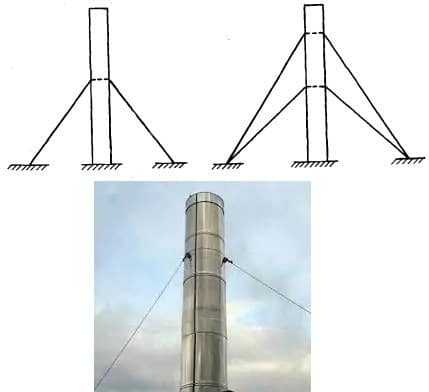
    There are four types of steel stack that generally used in steel stack are as below: Freestanding (Self-supported) steel stack (fig.1) The base support and guyed steel stack (fig.2) The base support and braced steel stack Multi flue stack (fig.3) [caption id="attachment_45199" align="alignnone" widtRead more

    There are four types of steel stack that generally used in steel stack are as below:

    1. Freestanding (Self-supported) steel stack (fig.1)
    2. The base support and guyed steel stack (fig.2)
    3. The base support and braced steel stack
    4. Multi flue stack (fig.3)

    fig.1

    fig.2

    fig.3

    See less
    • 1
    • Share
      Share
      • Share on Facebook
      • Share on Twitter
      • Share on LinkedIn
      • Share on WhatsApp
  • 2
  • 1 1 Answer
  • 4,331 Views
  • 1 Follower
Asked: July 24, 2020In: Structural Engineering

Why helical reinforcement gives better strength than ordinary columns?

Vivek Patel
Vivek Patel

Vivek Patel

  • 39 Questions
  • 80 Answers
  • 1 Best Answer
  • 6 Points
View Profile
Vivek Patel User

Why helical reinforcement gives better strength than ordinary columns?

  1. nikeetasharma

    nikeetasharma

    • 23 Questions
    • 303 Answers
    • 0 Best Answers
    • 2,680 Points
    View Profile
    nikeetasharma Guru
    Added an answer on December 21, 2020 at 4:08 pm

    The small dia reinforcement wrapped around the main or longitudinal reinforcement of columns, restraining the lateral expansion of the concrete under compression and thus strengthening the column. Columns with one helical reinforcement take more load than that of tied column due to additional strengRead more

    The small dia reinforcement wrapped around the main or longitudinal reinforcement of columns, restraining the lateral expansion of the concrete under compression and thus strengthening the column. Columns with one helical reinforcement take more load than that of tied column due to additional strength of spiral.

    Helical reinforcement can protect columns/piles against seismic loads.

    See less
    • 0
    • Share
      Share
      • Share on Facebook
      • Share on Twitter
      • Share on LinkedIn
      • Share on WhatsApp
  • 3
  • 4 4 Answers
  • 4,286 Views
  • 0 Followers
Asked: July 7, 2020In: Structural Engineering

How to design Formwork?

Aswany Sreejith
Aswany Sreejith

Aswany Sreejith

  • 1 Question
  • 0 Answers
  • 0 Best Answers
  • 5 Points
View Profile
Aswany Sreejith User

What is the procedure of designing the formwork?

  1. nikeetasharma

    nikeetasharma

    • 23 Questions
    • 303 Answers
    • 0 Best Answers
    • 2,680 Points
    View Profile
    nikeetasharma Guru
    Added an answer on October 15, 2020 at 4:25 pm

    Formwork is the term used for the process of creating a temporary mould into which concrete is poured and formed. Traditional formwork is fabricated using timber, but it can also be constructed from steel, glass fibre reinforced plastics and other materials. There are three types of formwork :- -BeaRead more

    Formwork is the term used for the process of creating a temporary mould into which concrete is poured and formed. Traditional formwork is fabricated using timber, but it can also be constructed from steel, glass fibre reinforced plastics and other materials.

    There are three types of formwork :-

    -Beam formwork :-
    Formwork for beams takes the form of a three-sided box which is supported and propped in the correct position and to the desired level. The removal time for the formwork will vary with air temperature, humidity and consequent curing rate. Typical striking times are as follows (using air temperature of 7-16 ºC):

    i) Beam sides: 9-12 hours.
    ii) Beam soffits: 8-14 days.
    iii) Beam props: 15-21 days.

    -Column formwork :-
    This consists of a vertical mould of the desired shape and size of the column to be poured. As a means of keeping the formwork material thickness to a minimum, horizontal steel or timber clamps (or yokes) are used at equal centres for batch filling and at varying centres for filling that is completed in one pour.

    The head of the column formwork can be used to provide support for the beam formwork, but while this gives good top lateral restraint it can make the formwork complex. Alternatively, the column can be cast to the underside of the beams. Later on, a collar of formwork can be clamped around the cast column to complete the casting and support the incoming beam formwork.

    -Plastic formwork :-
    Re-usable plastic formwork is generally used for quick pours of concrete. The formwork is assembled either from interlocking panels or from a modular system and is used for relatively simple concrete structures. It is not as versatile as timber formwork due to the prefabrication requirements and is best suited for lost-cost, repetitive structures such as mass housing schemes.

    Stay-in-place structural formwork is generally assembled on site using prefabricated fibre-reinforced plastic. It is used for concrete columns and piers and stays in place, acting as permanent axial and shear reinforcement for the structural member. It also provides resistance to environmental damage for both the concrete and reinforcing bars.

    Proprietary systems are used to support vertical formwork while concrete cures, consisting of a series of tubes and ties.

    See less
    • 27
    • Share
      Share
      • Share on Facebook
      • Share on Twitter
      • Share on LinkedIn
      • Share on WhatsApp
  • 0
  • 4 4 Answers
  • 4,243 Views
  • 0 Followers
Asked: July 20, 2020In: Structural Engineering

What is Castellated Beam?

vivek gami
vivek gami

vivek gami

  • 54 Questions
  • 16 Answers
  • 5 Best Answers
  • 93 Points
View Profile
vivek gami User

What is Castellated Beam? Why we provide it?

  1. Vivek Patel

    Vivek Patel

    • 39 Questions
    • 80 Answers
    • 1 Best Answer
    • 6 Points
    View Profile
    Best Answer
    Vivek Patel User
    Added an answer on July 23, 2020 at 1:20 pm

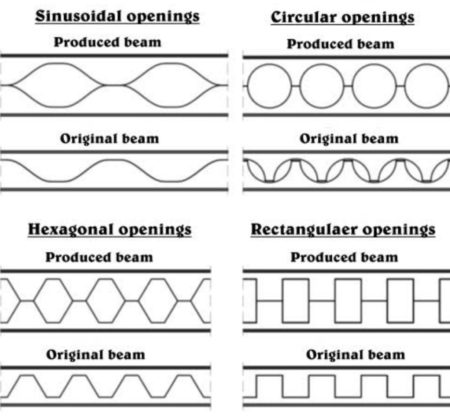
    The castellated beam is a modified steel beam. In which the beam is cut in the central web portion were no great force is present. Cut near to neutral axis of the beam where we required less amount of material mass to resist various force. The opening shape may be hexagonal, rectangular, circular, eRead more

    The castellated beam is a modified steel beam. In which the beam is cut in the central web portion were no great force is present.

    Cut near to neutral axis of the beam where we required less amount of material mass to resist various force.

    The opening shape may be hexagonal, rectangular, circular, etc.

    Due to opening in web we get some benifit

    • Saving in material
    • Lighter weight
    • Due to increased depth allowed, we get more strengthen beam
    • Good aesthetic view
    • Esay handle with roof febrication work.
    See less
    • 1
    • Share
      Share
      • Share on Facebook
      • Share on Twitter
      • Share on LinkedIn
      • Share on WhatsApp
  • 3
  • 3 3 Answers
  • 3,719 Views
  • 0 Followers
Asked: July 20, 2020In: Structural Engineering

What is the compressive strength of Fe500 rebars?

CB Sowmya
CB Sowmya

CB Sowmya

  • 3 Questions
  • 53 Answers
  • 4 Best Answers
  • 5 Points
View Profile
CB Sowmya User

What is the compressive strength of Fe500 rebars?

  1. Kuldeep Singh

    Kuldeep Singh

    • 1 Question
    • 110 Answers
    • 10 Best Answers
    • 652 Points
    View Profile
    Best Answer
    Kuldeep Singh Learner
    Added an answer on July 21, 2020 at 10:30 pm

    It is generally assumed to be 250 MPa.

    It is generally assumed to be 250 MPa.

    See less
    • 2
    • Share
      Share
      • Share on Facebook
      • Share on Twitter
      • Share on LinkedIn
      • Share on WhatsApp
  • 3
  • 3 3 Answers
  • 3,342 Views
  • 0 Followers
Asked: July 2, 2020In: Structural Engineering

What is Web Crippling in Steel ?

Mangala Karunarathne

Mangala Karunarathne

  • 4 Questions
  • 4 Answers
  • 0 Best Answers
  • 123 Points
View Profile
Mangala Karunarathne Beginner

What is Web Crippling in Steel?

  1. Ancy Joby

    Ancy Joby

    • 20 Questions
    • 11 Answers
    • 1 Best Answer
    • 580 Points
    View Profile
    Ancy Joby Learner
    Added an answer on July 3, 2020 at 4:54 pm

    Webs of rolled section are subjected to large amount of stresses just below concentrated loads and above reactions from support. Stress concentration occurs at junction of web and flange. As a result, large bearing stresses are developed below concentrated load. Consequently, the web near portion ofRead more

    Webs of rolled section are subjected to large amount of stresses just below concentrated loads and above reactions from support. Stress concentration occurs at junction of web and flange. As a result, large bearing stresses are developed below concentrated load. Consequently, the web near portion of stress concentration tends to fold over flange. This type of local buckling phenomenon is called crippling or crippling of web.

    See less
    • 1
    • Share
      Share
      • Share on Facebook
      • Share on Twitter
      • Share on LinkedIn
      • Share on WhatsApp
  • 1
  • 1 1 Answer
  • 3,266 Views
  • 0 Followers
Asked: May 15, 2020In: Structural Engineering

What are quickest method to find deflection and slope in beams?

Ankita Pal
Ankita Pal

Ankita Pal

  • 1 Question
  • 0 Answers
  • 0 Best Answers
  • 5 Points
View Profile
Ankita Pal User

During GATE, IES exam it is difficult to follow any traditional method to follow from start to end solution. What are the conceptual shortcuts to find slope and deflection of the beam which can be used to find a solution ...

  1. Kuldeep Singh

    Kuldeep Singh

    • 1 Question
    • 110 Answers
    • 10 Best Answers
    • 652 Points
    View Profile
    Kuldeep Singh Learner
    Added an answer on July 5, 2020 at 5:25 pm

    Well, if you're analyzing a beam, then the quickest and easiest way is hands down, the moment - area method. Students often overlook it and delve into complex methods while the problem may be solved a lot easily. Other than this, there are often other quick methods depending on the question. For exaRead more

    Well, if you’re analyzing a beam, then the quickest and easiest way is hands down, the moment – area method. Students often overlook it and delve into complex methods while the problem may be solved a lot easily.

    Other than this, there are often other quick methods depending on the question. For example sometimes the conjugate beam method is not such a bad choice. If you can write the moment curvature equation and are quick at differentiation, you can use that.

    I for one, never get into slope deflection method unless it is strictly needed. I stick to moment area, conjugate beam and the 4th order differential equation.

    Also, a friendly tip : just have a look at the options especially in the IES paper. They never push you into long calculations. You could sense that some options just have to be wrong and are nowhere close to be correct. In GATE, this approach doesn’t fare well though.

    Hope it helps.

    See less
    • 2
    • Share
      Share
      • Share on Facebook
      • Share on Twitter
      • Share on LinkedIn
      • Share on WhatsApp
  • 1
  • 2 2 Answers
  • 3,193 Views
  • 0 Followers
Load More Questions

Sidebar

Explore

  • Questions
  • Ask Questions
  • Write for us
  • Artificial Intelligence
  • Sustainability
  • Building
    • Brick Masonry
    • Building Materials
    • Building Tips
    • Formwork/Shuttering
  • Concrete
    • Concrete Admixtures
    • Cement
    • Concrete Cracks
    • Concrete Properties
  • Construction
    • Construction Equipments
    • Construction Management
    • Construction Project
    • Estimating & Costing
  • How To Guide
    • Material Estimation
    • Repair/Protection Guide
    • Material Testing Guide
    • Mix Design Guide
    • Rate Analysis
  • Geotechnical
    • Foundation Engineering
    • Ground Improvement
  • Structural Engineering
    • Strengthening of Structure
    • Structual Inspection
    • Structural Detailing
  • Surveying
  • Tips

Footer

  • Ask Questions
  • Write for us
  • Popular Questions
  • Facebook
  • Instagram
  • Twitter
  • Telegram

© 2009-2021 The Constructor. All Rights Reserved.