Sign Up

Join TheConstructor to ask questions, answer questions, write articles, and connect with other people. When you join you get additional benefits.

Have an account? Sign In


Have an account? Sign In Now

Sign In

Log in to TheConstructor to ask questions, answer people’s questions, write articles & connect with other people. When you join you get additional benefits.

Sign Up Here

Join for free or log in to continue reading...


Forgot Password?

Don't have account, Sign Up Here

Forgot Password

Lost your password? Please enter your email address. You will receive a link and will create a new password via email.

Have an account? Sign In Now

Sorry, you do not have a permission to ask a question, You must login to ask question. Get the paid membership

Join for free or log in to continue reading...


Forgot Password?

Don't have account, Sign Up Here
Get the paid membership
theconstructor.org Logo theconstructor.org Logo
Log inJoin

theconstructor.org

theconstructor.org Navigation

  • Articles
    • Recent Articles
    • Popular Articles
    • Write for us
  • Community
  • Categories
    • How To Guide
      • Material Testing Guide
    • Concrete
    • Building
      • Brick Masonry
      • Building Materials
      • Building Tips
    • Construction
      • Equipments
      • Management
    • Digital Construction
    • Geotechnical
      • Foundation
  • Case Studies
Search
Ask A Question

Mobile menu

Close
Ask a Question
  • Questions
  • Ask Questions
  • Write for us
  • Artificial Intelligence
  • Sustainability
  • Building
    • Brick Masonry
    • Building Materials
    • Building Tips
    • Formwork/Shuttering
  • Concrete
    • Concrete Admixtures
    • Cement
    • Concrete Cracks
    • Concrete Properties
  • Construction
    • Construction Equipments
    • Construction Management
    • Construction Project
    • Estimating & Costing
  • How To Guide
    • Material Estimation
    • Repair/Protection Guide
    • Material Testing Guide
    • Mix Design Guide
    • Rate Analysis
  • Geotechnical
    • Foundation Engineering
    • Ground Improvement
  • Structural Engineering
    • Strengthening of Structure
    • Structual Inspection
    • Structural Detailing
  • Surveying
  • Tips

Structural Engineering

Home/Structural Engineering/Page 9

Do you need to remove the ads? Get the paid membership

  • Recent Questions
  • Most Answered
  • Answers
  • No Answers
  • Most Visited
  • Most Voted
  • Random

Discy Latest Questions

Asked: February 6, 2020In: Structural Engineering

repairing a concrete horizontal beam

alain7053
alain7053

alain7053

  • 1 Question
  • 0 Answers
  • 0 Best Answers
  • 0 Points
View Profile
alain7053 User

beam failing , how to fix or remedial solution

  1. Madeh Izat Hamakareem

    Madeh Izat Hamakareem

    • 0 Questions
    • 40 Answers
    • 3 Best Answers
    • 1,229 Points
    View Profile
    Madeh Izat Hamakareem
    Added an answer on March 9, 2020 at 8:34 pm
    This answer was edited.

    The beam should be analyzed to find out the cause of deflection, then decide on the repair technique. one solution could be increasing the size of the beam and adding extra reinforcement in order load carrying capacity of the beam, and increase flexural resistance to reduce deflection. Before applicRead more

    The beam should be analyzed to find out the cause of deflection, then decide on the repair technique. one solution could be increasing the size of the beam and adding extra reinforcement in order load carrying capacity of the beam, and increase flexural resistance to reduce deflection. Before application of this repair technique, the beam should be released from certain amount of loads through the provision of jacks for the secondary beams. The new cross section with the added reinforcement ratio should be analyzed for compute its load carrying capacity.

    See less
    • 1
    • Share
      Share
      • Share on Facebook
      • Share on Twitter
      • Share on LinkedIn
      • Share on WhatsApp
  • 1
  • 2 2 Answers
  • 1,119 Views
  • 0 Followers
Asked: May 21, 2020In: Structural Engineering

What are different structural shapes used in steel structures amd its Importance and Function?

Abbas Khan Civil Engineer

Abbas Khan Civil Engineer

  • 11 Questions
  • 29 Answers
  • 1 Best Answer
  • 925 Points
View Profile
Abbas Khan Civil Engineer Learner

What are the different structural shapes used in steel structures? Kindly named it and explain the importance and function of these structural shapes?

  1. [Deleted User]
    Added an answer on August 16, 2020 at 8:46 am
    This answer was edited.
    What are different structural shapes used in steel structures amd its Importance and Function?

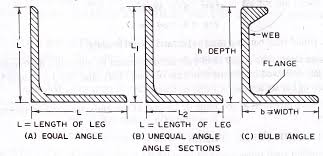
    ANGLE SECTION - use for both compression and tension member. it is also used for a build-up beam. equal angle unequal angle bulb angle - mostly use for ship and storage tank construction CHANNEL SECTION - mostly used for the build-up column. also, use for tension members. I-SECTION - this kind of seRead more

    • ANGLE SECTION – use for both compression and tension member. it is also used for a build-up beam.
    1. equal angle
    2. unequal angle
    3. bulb angle – mostly use for ship and storage tank construction
    • CHANNEL SECTION – mostly used for the build-up column. also, use for tension members.
    • I-SECTION – this kind of section widely use for beam construction due to its better stiffness.
    See less
    Attachment

    • 0
    • Share
      Share
      • Share on Facebook
      • Share on Twitter
      • Share on LinkedIn
      • Share on WhatsApp
  • 0
  • 1 1 Answer
  • 1,088 Views
  • 0 Followers
Asked: May 22, 2020In: Structural Engineering

Why a Continuous RCC beam should be designed as a Tee beam for Span moments and as a Rectangular Beam for Support Moments?

Raghvendra_Rai
Raghvendra_Rai

Raghvendra_Rai

  • 2 Questions
  • 2 Answers
  • 0 Best Answers
  • 1,041 Points
View Profile
Raghvendra_Rai Expert

Why a Continuous RCC beam should be designed as a Tee beam for Span moments and as a Rectangular Beam for Support Moments?

  1. Madeh Izat Hamakareem

    Madeh Izat Hamakareem

    • 0 Questions
    • 40 Answers
    • 3 Best Answers
    • 1,229 Points
    View Profile
    Best Answer
    Madeh Izat Hamakareem
    Added an answer on May 23, 2020 at 5:48 pm

    In the regions of a positive moment, a portion of the slab works with the beam (both under compression force), so that part should be included in the beam design. However, negative moments develop cracks at the upper part of the beam. So, the cracked part of the concrete section is neglected in theRead more

    In the regions of a positive moment, a portion of the slab works with the beam (both under compression force), so that part should be included in the beam design. However, negative moments develop cracks at the upper part of the beam. So, the cracked part of the concrete section is neglected in the design, and the lower portion is in compression which is rectangular.

    See less
    • 1
    • Share
      Share
      • Share on Facebook
      • Share on Twitter
      • Share on LinkedIn
      • Share on WhatsApp
  • 1
  • 2 2 Answers
  • 993 Views
  • 0 Followers
Asked: September 19, 2020In: Structural Engineering

What happens when the thrust line coincides with the bottom Vern axis of beam? (Prestressed concrete)

aviratdhodare
aviratdhodare

aviratdhodare

  • 37 Questions
  • 252 Answers
  • 0 Best Answers
  • 480 Points
View Profile
aviratdhodare

What happens when the thrust line coincides with the bottom Vern axis of beam? (Prestressed concrete)

  1. nikeetasharma

    nikeetasharma

    • 23 Questions
    • 303 Answers
    • 0 Best Answers
    • 2,680 Points
    View Profile
    nikeetasharma Guru
    Added an answer on November 26, 2020 at 1:24 pm
    This answer was edited.

    Basically, shear force is the combination of flexural compression which result as C and tends to form an inclined thrust line known as arch. For example consider a simple strut and tie model. Here it may be technically expected that the shear force is supported by the longitudinal resultant.   NαVcoRead more

    Basically, shear force is the combination of flexural compression which result as C and tends to form an inclined thrust line known as arch. For example consider a simple strut and tie model. Here it may be technically expected that the shear force is supported by the longitudinal resultant.  

    NαVcotθNa=αVcotθ

    Shear force is the product of shear stress and area. Thrust line can also affect the stability. 

    See less
    • 0
    • Share
      Share
      • Share on Facebook
      • Share on Twitter
      • Share on LinkedIn
      • Share on WhatsApp
  • 30
  • 3 3 Answers
  • 962 Views
  • 0 Followers
Asked: July 19, 2020In: Structural Engineering

At which structure (place) retaining wall resist passive earth pressure?

Vivek Patel
Vivek Patel

Vivek Patel

  • 39 Questions
  • 80 Answers
  • 1 Best Answer
  • 6 Points
View Profile
Vivek Patel User

At which structure (place) retaining wall resist passive earth pressure?

  1. AdityaBhandakkar

    AdityaBhandakkar

    • 12 Questions
    • 250 Answers
    • 2 Best Answers
    • 0 Points
    View Profile
    AdityaBhandakkar User
    Added an answer on September 7, 2020 at 6:12 pm
    At which structure (place) retaining wall resist passive earth pressure?

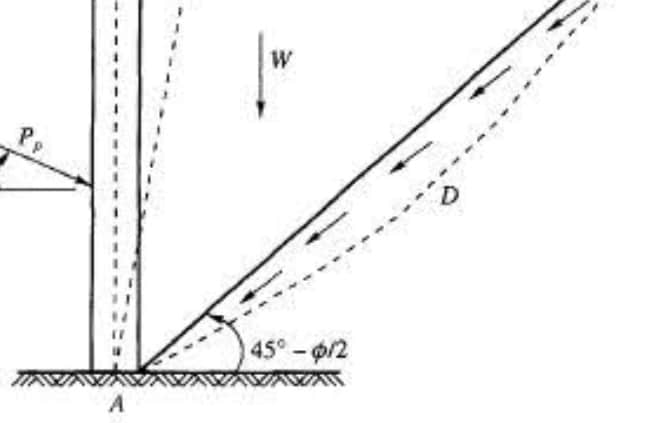
    The moment of the wall towards the backfill, in this case, the lateral earth pressure called a passive earth pressure. In the case of passive earth pressure, Major principal stress = lateral pressure Minor principal stress = vertical pressure In this case, soil exerts a pull on a retaining wall wherRead more

    The moment of the wall towards the backfill, in this case, the lateral earth pressure called a passive earth pressure.

    In the case of passive earth pressure,

    Major principal stress = lateral pressure

    Minor principal stress = vertical pressure

    In this case, soil exerts a pull on a retaining wall where the inner rupture plane called as a failure plane makes at (45- fi/2) angle with horizontal.

    At depth=0 , Rankines passive force= 0

    If q is a surcharge load acting on backfill, then lateral pressure = K.q applied throughout the depth of retaining wall.

    See less
    • 43
    • Share
      Share
      • Share on Facebook
      • Share on Twitter
      • Share on LinkedIn
      • Share on WhatsApp
  • 2
  • 2 2 Answers
  • 953 Views
  • 0 Followers
Asked: May 8, 2020In: Structural Engineering

General Details for Poured Walls Construction

fhsappleton
fhsappleton

fhsappleton

  • 1 Question
  • 0 Answers
  • 0 Best Answers
  • 6 Points
View Profile
fhsappleton VVIP

Sectional details through walls, joint connections, corners, windows, and door openings.

  1. Gopal Mishra

    Gopal Mishra

    • 75 Questions
    • 44 Answers
    • 7 Best Answers
    • 577 Points
    View Profile
    Best Answer
    Gopal Mishra
    Added an answer on May 14, 2020 at 6:08 pm

    The design and detailing details of wall construction depend on many factors such as its purpose, type and amount of load on it, its support conditions, types of soils, etc. Unless these details are known, the sectional details can not be accurate or as required.

    The design and detailing details of wall construction depend on many factors such as its purpose, type and amount of load on it, its support conditions, types of soils, etc. Unless these details are known, the sectional details can not be accurate or as required.

    See less
    • 1
    • Share
      Share
      • Share on Facebook
      • Share on Twitter
      • Share on LinkedIn
      • Share on WhatsApp
  • 1
  • 1 1 Answer
  • 951 Views
  • 0 Followers
Asked: July 7, 2020In: Structural Engineering

How to treat the under design poured concrete on shearwall?

lei
lei

lei

  • 2 Questions
  • 0 Answers
  • 0 Best Answers
  • 30 Points
View Profile
lei User

How to treat the under design poured concrete on shearwall? example: the designed strength of concrete (f’c) must be 7000 psi however it was poured by only f’c=5000psi?  

  1. Komal Bhandakkar

    Komal Bhandakkar

    • 49 Questions
    • 255 Answers
    • 0 Best Answers
    • 2,050 Points
    View Profile
    Komal Bhandakkar AUTHOR
    Added an answer on September 5, 2020 at 8:25 am
    How to treat the under design poured concrete on shearwall?

    Design of poured concrete on the shear wall: When the final f'c extrapolated from a break of 3 days then an additional break of 5 days (it is usually 3, 7 & 28 days), it is directly indicated that the first cylinder itself was defective. When the f'c of 5000psi was one of the 28th day (i.e. finaRead more

    Design of poured concrete on the shear wall:

    • When the final f’c extrapolated from a break of 3 days then an additional break of 5 days (it is usually 3, 7 & 28 days), it is directly indicated that the first cylinder itself was defective.
    • When the f’c of 5000psi was one of the 28th day (i.e. final) result, then it clearly indicates that it’s necessary to return the design engineer who is specified f’c 7000.
    • It is really possible that he or she can review their previous calculations and determine lower compression that will still satisfy their own design.
    • If it is not so then it will clearly requirement of other physical attributes like load, span, etc. it will have to be adjusted.
    • Practically on a job, I was inspecting probably 3-day break spec, 5-day break, confirmed below fake spec.
    • Usually, the contractor decided to tear the wall out and repour, but later on, it was determined to be a mechanical failure at the batch plant where only half the cement was batched.
    • In case of another multi-storey hotel, it wasn’t the compression, it was the lack of adequate reconsolidation including vibration.
    • When the forms where is stripped from a large, significance and poured in place shear wall, there were a large number of voids -some the size of a basketball.
    • It was ultimately referred to the engineer, who specified filling a large number of voids with a simple compound.
    • I personally didn’t feel particularly warm and fuzzy about the fix, but the engineer seemed more satisfied.

    • One example of which I know is that a cantilevered deck at an officer’s club, on a military base.

    But after all, the testing fell short of the design, the general contractor, and batch plant manager approach to the officer in charge (Airforce colonel which is assigned to oversee the project) to propose one of the serious field testings to demonstrate that the cantilever would work.

    Finally, he decided to redo it.

    See less
    • 39
    • Share
      Share
      • Share on Facebook
      • Share on Twitter
      • Share on LinkedIn
      • Share on WhatsApp
  • 1
  • 1 1 Answer
  • 936 Views
  • 0 Followers
Asked: May 31, 2020In: Structural Engineering

Which are the different Types of Welding Process?

Abbas Khan Civil Engineer

Abbas Khan Civil Engineer

  • 11 Questions
  • 29 Answers
  • 1 Best Answer
  • 925 Points
View Profile
Abbas Khan Civil Engineer Learner

Which are the different types of welding processes in steel structures and which one is the most common and affordable?

  1. RaghavArora

    RaghavArora

    • 4 Questions
    • 5 Answers
    • 1 Best Answer
    • 847 Points
    View Profile
    RaghavArora Learner
    Added an answer on June 12, 2020 at 6:29 pm

    The most commonly used and Affordable welding is Stud Welding because it is cost-efficient. The different types of Welding processes in steel structures are as follows:- 1. Stud Welding:- It involves the electric process of welding a fastener on a metal base by heating both the components with an arRead more

    The most commonly used and Affordable welding is Stud Welding because it is cost-efficient.

    The different types of Welding processes in steel structures are as follows:-

    1. Stud Welding:- It involves the electric process of welding a fastener on a metal base by heating both the components with an arc.

    2. Flux Core Welding:- this involves a consumable tubular electrode containing a flux and a constant voltage welding power supply. It’s A portable and fast welding process, and less-skilled workers can easily undergo this.

    3. Shield metal arc welding (SMAW):- it involves a consumable fixed-length electrode covered with a flux, and an electric power source is used to weld two metals together. After the completion of this process, mineral coating flux Of electrode disintegrates and releases a gas Commonly known as Shielding gas, which saves joint from unfavorable atmospheric conditions.

    See less
    • 1
    • Share
      Share
      • Share on Facebook
      • Share on Twitter
      • Share on LinkedIn
      • Share on WhatsApp
  • 1
  • 1 1 Answer
  • 864 Views
  • 0 Followers
Load More Questions

Sidebar

Explore

  • Questions
  • Ask Questions
  • Write for us
  • Artificial Intelligence
  • Sustainability
  • Building
    • Brick Masonry
    • Building Materials
    • Building Tips
    • Formwork/Shuttering
  • Concrete
    • Concrete Admixtures
    • Cement
    • Concrete Cracks
    • Concrete Properties
  • Construction
    • Construction Equipments
    • Construction Management
    • Construction Project
    • Estimating & Costing
  • How To Guide
    • Material Estimation
    • Repair/Protection Guide
    • Material Testing Guide
    • Mix Design Guide
    • Rate Analysis
  • Geotechnical
    • Foundation Engineering
    • Ground Improvement
  • Structural Engineering
    • Strengthening of Structure
    • Structual Inspection
    • Structural Detailing
  • Surveying
  • Tips

Footer

  • Ask Questions
  • Write for us
  • Popular Questions
  • Facebook
  • Instagram
  • Twitter
  • Telegram

© 2009-2021 The Constructor. All Rights Reserved.