
Sign Up

Join TheConstructor to ask questions, answer questions, write articles, and connect with other people. When you join you get additional benefits.

Have an account? Sign In


Have an account? Sign In Now

Sign In

Log in to TheConstructor to ask questions, answer people’s questions, write articles & connect with other people. When you join you get additional benefits.

Sign Up Here

Join for free or log in to continue reading...


Forgot Password?

Don't have account, Sign Up Here

Forgot Password

Lost your password? Please enter your email address. You will receive a link and will create a new password via email.

Have an account? Sign In Now

Sorry, you do not have a permission to ask a question, You must login to ask question. Get the paid membership

Join for free or log in to continue reading...


Forgot Password?

Don't have account, Sign Up Here
Get the paid membership
theconstructor.org Logo theconstructor.org Logo
Log inJoin

theconstructor.org

theconstructor.org Navigation

  • Articles
    • Recent Articles
    • Popular Articles
    • Write for us
  • Community
  • Categories
    • How To Guide
      • Material Testing Guide
    • Concrete
    • Building
      • Brick Masonry
      • Building Materials
      • Building Tips
    • Construction
      • Equipments
      • Management
    • Digital Construction
    • Geotechnical
      • Foundation
  • Case Studies
Search
Ask A Question

Mobile menu

Close
Ask a Question
  • Questions
  • Ask Questions
  • Write for us
  • Artificial Intelligence
  • Sustainability
  • Building
    • Brick Masonry
    • Building Materials
    • Building Tips
    • Formwork/Shuttering
  • Concrete
    • Concrete Admixtures
    • Cement
    • Concrete Cracks
    • Concrete Properties
  • Construction
    • Construction Equipments
    • Construction Management
    • Construction Project
    • Estimating & Costing
  • How To Guide
    • Material Estimation
    • Repair/Protection Guide
    • Material Testing Guide
    • Mix Design Guide
    • Rate Analysis
  • Geotechnical
    • Foundation Engineering
    • Ground Improvement
  • Structural Engineering
    • Strengthening of Structure
    • Structual Inspection
    • Structural Detailing
  • Surveying
  • Tips

What are Mac-Arthur Piles?

Home/ Questions/Q 47382
Next
In Process

Do you need to remove the ads? Get the paid membership

Asked: July 29, 20202020-07-29T21:33:08-07:00 2020-07-29T21:33:08-07:00In: Construction
Dhanya
Dhanya

Dhanya

  • 2 Questions
  • 14 Answers
  • 0 Best Answers
  • 367 Points
View Profile
Dhanya Beginner

What are Mac-Arthur Piles?

  • 0
  • 7 7 Answers
  • 3,747 Views
  • 0 Followers
  • 0
  • Share
    Share
    • Share on Facebook
    • Share on Twitter
    • Share on LinkedIn
    • Share on WhatsApp

7 Answers

  • Voted
  • Oldest
  • Recent
  1. Komal Bhandakkar

    Komal Bhandakkar

    • 49 Questions
    • 255 Answers
    • 0 Best Answers
    • 2,050 Points
    View Profile
    Komal Bhandakkar AUTHOR
    2020-09-10T23:59:26-07:00Added an answer on September 10, 2020 at 11:59 pm
    What are Mac-Arthur Piles?

    MacArthur pile :

    Definition :

    • It is a patented pile.
    • It is formed by driving a steel shell into the ground to the required depth.

    Basic information of MacArthur pile:

    • It is placed in small quantities of concrete and having them down.
    • The purpose is to force the concrete into the earth beyond the point of the shell.
    • Its an advantage is that the bearing area is increases as same as pedestal pile
    • Then the Shell is withdrawn because the hole is made is filled with concrete

    (See figure for better understanding of the concept.)

    Thank you.

    • 46
    • Share
      Share
      • Share on Facebook
      • Share on Twitter
      • Share on LinkedIn
      • Share on WhatsApp
  2. AdityaBhandakkar

    AdityaBhandakkar

    • 12 Questions
    • 250 Answers
    • 2 Best Answers
    • 0 Points
    View Profile
    AdityaBhandakkar User
    2020-07-30T22:10:33-07:00Added an answer on July 30, 2020 at 10:10 pm

    The pile has uniform diameter throughout its length and made from corrugated steel called Mac Arthur pile.

    It is used in place of the Raymond pile.

    Procedure:

    1)Heavy steel casing with the dense core is driven into the ground.

    2)After reaching a suitable height, only the core will remove.

    3) Concrete is poured into these steel casing and compacted. Then steel casing also remove.

    This is one of the types of pile foundations used in the present scenario.

    • 36
    • Share
      Share
      • Share on Facebook
      • Share on Twitter
      • Share on LinkedIn
      • Share on WhatsApp
  3. nikeetasharma

    nikeetasharma

    • 23 Questions
    • 303 Answers
    • 0 Best Answers
    • 2,680 Points
    View Profile
    nikeetasharma Guru
    2020-10-15T21:50:15-07:00Added an answer on October 15, 2020 at 9:50 pm

    A patented pile formed by driving a steel shell into the ground to the required depth, putting in small quantities of concrete, and hammering them down so as to force the concrete into the earth beyond the point of the shell; thus enlarging the end and greatly increasing the bearing area, is called mac-arthur piles. The shell is afterward withdrawn gradually, as the hole that it made is filled with concrete. If the shell were left in, the method would be far more satisfactory; as the shaft of the pile is liable to be seriously imperfect. Same as pedestal pile.

    Such pilings, of course can only be driven into mud, sand or clay bottoms. The author suggests the pile would be more effective, were the steel casing to be left in place – which suggests that this sort of pile would only be used where the cost of supplying enough casings for all the piles would be higher than the additional labour involved in extracting the casins.

    • 25
    • Share
      Share
      • Share on Facebook
      • Share on Twitter
      • Share on LinkedIn
      • Share on WhatsApp
  4. Preet Chovatiya

    Preet Chovatiya

    • 11 Questions
    • 81 Answers
    • 5 Best Answers
    • 858 Points
    View Profile
    Preet Chovatiya Learner
    2020-07-30T22:07:33-07:00Added an answer on July 30, 2020 at 10:07 pm

    Mac-Arthur pile is a pile of uniform diameter and made of from using corrugated sheet shell which remains in place as Raymond pile.

    Procedure:-

    1. First of all heavy corrugated steel shell is driven with the core.

    2. After reaching desired depth the core is withdrawn from that sheet pile.

    3. Concreting is done after the withdrawal of the core.

    • 0
    • Share
      Share
      • Share on Facebook
      • Share on Twitter
      • Share on LinkedIn
      • Share on WhatsApp
  5. CB Sowmya

    CB Sowmya

    • 3 Questions
    • 53 Answers
    • 4 Best Answers
    • 5 Points
    View Profile
    CB Sowmya User
    2020-07-30T23:20:32-07:00Added an answer on July 30, 2020 at 11:20 pm

    Mac Arthur pile is a cast In-Situ pile of uniform diameter.
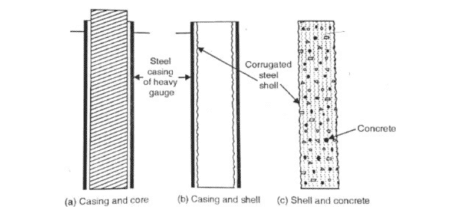
    1. A shell casing is driven into the ground with the help of a driving core.
    2. After the desired depth is reached, the core is removed.
    3. Now a corrugates steel shell is inserted again into the casing.
    4. The concrete is poured into the corrugated steel shell and simultaneously the outer casing is removed.
    5. If the outer casing is left inside, the structure would be even more safe but it is not economical.
    • 0
    • Share
      Share
      • Share on Facebook
      • Share on Twitter
      • Share on LinkedIn
      • Share on WhatsApp
  6. Vivek Patel

    Vivek Patel

    • 39 Questions
    • 80 Answers
    • 1 Best Answer
    • 6 Points
    View Profile
    Vivek Patel User
    2020-07-31T15:25:19-07:00Added an answer on July 31, 2020 at 3:25 pm

    Mac-Arthur pile is a pile of uniform diameter pile. made of from using corrugated permanent sheet shell.

    Procedure:-

    1. heavy corrugated steel shell is driven.
    2. After reaching desired depth the core is withdrawn from that sheet pile.
    3. Reinforcement placed before concreting.
    4. Concreting is done after sheet pile withdraw.

    • 0
    • Share
      Share
      • Share on Facebook
      • Share on Twitter
      • Share on LinkedIn
      • Share on WhatsApp
  7. nikeetasharma

    nikeetasharma

    • 23 Questions
    • 303 Answers
    • 0 Best Answers
    • 2,680 Points
    View Profile
    nikeetasharma Guru
    2020-12-21T09:17:11-08:00Added an answer on December 21, 2020 at 9:17 am

    Mac-arthur piles are the heavy steel casing with a core is driven into ground. When the desired depth is reached, the core is withdrawn and a corrugated steel shell is placed in the casing. The last operation consists in filling and gradually compacting the concrete and withdrawing the casing.

    • 0
    • Share
      Share
      • Share on Facebook
      • Share on Twitter
      • Share on LinkedIn
      • Share on WhatsApp

You must login to add an answer.

Join for free or log in to continue reading...


Forgot Password?

Need An Account, Sign Up Here

Sidebar

Explore

  • Questions
  • Ask Questions
  • Write for us
  • Artificial Intelligence
  • Sustainability
  • Building
    • Brick Masonry
    • Building Materials
    • Building Tips
    • Formwork/Shuttering
  • Concrete
    • Concrete Admixtures
    • Cement
    • Concrete Cracks
    • Concrete Properties
  • Construction
    • Construction Equipments
    • Construction Management
    • Construction Project
    • Estimating & Costing
  • How To Guide
    • Material Estimation
    • Repair/Protection Guide
    • Material Testing Guide
    • Mix Design Guide
    • Rate Analysis
  • Geotechnical
    • Foundation Engineering
    • Ground Improvement
  • Structural Engineering
    • Strengthening of Structure
    • Structual Inspection
    • Structural Detailing
  • Surveying
  • Tips

Footer

  • Ask Questions
  • Write for us
  • Popular Questions
  • Facebook
  • Instagram
  • Twitter
  • Telegram

© 2009-2021 The Constructor. All Rights Reserved.