Sign Up

Join TheConstructor to ask questions, answer questions, write articles, and connect with other people. When you join you get additional benefits.

Have an account? Sign In


Have an account? Sign In Now

Sign In

Log in to TheConstructor to ask questions, answer people’s questions, write articles & connect with other people. When you join you get additional benefits.

Sign Up Here

Join for free or log in to continue reading...


Forgot Password?

Don't have account, Sign Up Here

Forgot Password

Lost your password? Please enter your email address. You will receive a link and will create a new password via email.

Have an account? Sign In Now

Sorry, you do not have a permission to ask a question, You must login to ask question. Get the paid membership

Join for free or log in to continue reading...


Forgot Password?

Don't have account, Sign Up Here
Get the paid membership
theconstructor.org Logo theconstructor.org Logo
Log inJoin

theconstructor.org

theconstructor.org Navigation

  • Articles
    • Recent Articles
    • Popular Articles
    • Write for us
  • Community
  • Categories
    • How To Guide
      • Material Testing Guide
    • Concrete
    • Building
      • Brick Masonry
      • Building Materials
      • Building Tips
    • Construction
      • Equipments
      • Management
    • Digital Construction
    • Geotechnical
      • Foundation
  • Case Studies
Search
Ask A Question

Mobile menu

Close
Ask a Question
  • Questions
  • Ask Questions
  • Write for us
  • Artificial Intelligence
  • Sustainability
  • Building
    • Brick Masonry
    • Building Materials
    • Building Tips
    • Formwork/Shuttering
  • Concrete
    • Concrete Admixtures
    • Cement
    • Concrete Cracks
    • Concrete Properties
  • Construction
    • Construction Equipments
    • Construction Management
    • Construction Project
    • Estimating & Costing
  • How To Guide
    • Material Estimation
    • Repair/Protection Guide
    • Material Testing Guide
    • Mix Design Guide
    • Rate Analysis
  • Geotechnical
    • Foundation Engineering
    • Ground Improvement
  • Structural Engineering
    • Strengthening of Structure
    • Structual Inspection
    • Structural Detailing
  • Surveying
  • Tips

Concrete

Home/Concrete/Page 3

Do you need to remove the ads? Get the paid membership

  • Recent Questions
  • Most Answered
  • Answers
  • No Answers
  • Most Visited
  • Most Voted
  • Random

Discy Latest Questions

Asked: January 5, 2019In: Concrete

Rate analysis concrete block of size 30cm*20cm*15cm of ratio 1:2:4

krishna
krishna

krishna

  • 1 Question
  • 0 Answers
  • 0 Best Answers
  • 20 Points
View Profile
krishna User

Rate analysis for block size 30cmx20cmx15cm with mortar ratio of 1:2:4 including labour cost

  1. Komal Bhandakkar

    Komal Bhandakkar

    • 49 Questions
    • 255 Answers
    • 0 Best Answers
    • 2,050 Points
    View Profile
    Komal Bhandakkar AUTHOR
    Added an answer on October 6, 2020 at 5:20 pm
    This answer was edited.

    Rate analysis: Rate analysis will simply the quantity of cement and sand required for the 1-meter cube of cement sand mortar. Similarly, we can do rate analysis for concrete as well for different proportions. Here I am discussing point example of the material required for the 1-meter cube of cementRead more

    Rate analysis:

    Rate analysis will simply the quantity of cement and sand required for the 1-meter cube of cement sand mortar.

    Similarly, we can do rate analysis for concrete as well for different proportions.

    Here I am discussing point example of the material required for the 1-meter cube of cement concrete of density 2.3 ton per metre cube and cement sand aggregate ratio is 1:3: 6

    Mix proportion ratio is 1:3:6 (here, maximum 20 nominal sizes of aggregates are used.)

    The total sum is 1+ 3 + 6=10 Dry volume of 1-metre cube concrete is a 1.54-metre cube.

    Hence cement required is a one-tenth part of the 1.54-meter cube which is 0.15-metre cube means to 16 kg means 4.3 bags of 50 kg each.

    If you want to find out the sand quantity then it’s 0.46-meter cube means 1.2-ton Aggregate quantity 0.92-metre cube means 1.56 ton of maximum normal size of 20 mm aggregate


    I hope so your doubt is clear, thank you.

    See less
    • 29
    • Share
      Share
      • Share on Facebook
      • Share on Twitter
      • Share on LinkedIn
      • Share on WhatsApp
  • 2
  • 3 3 Answers
  • 7,956 Views
  • 1 Follower
Asked: May 28, 2020In: Concrete

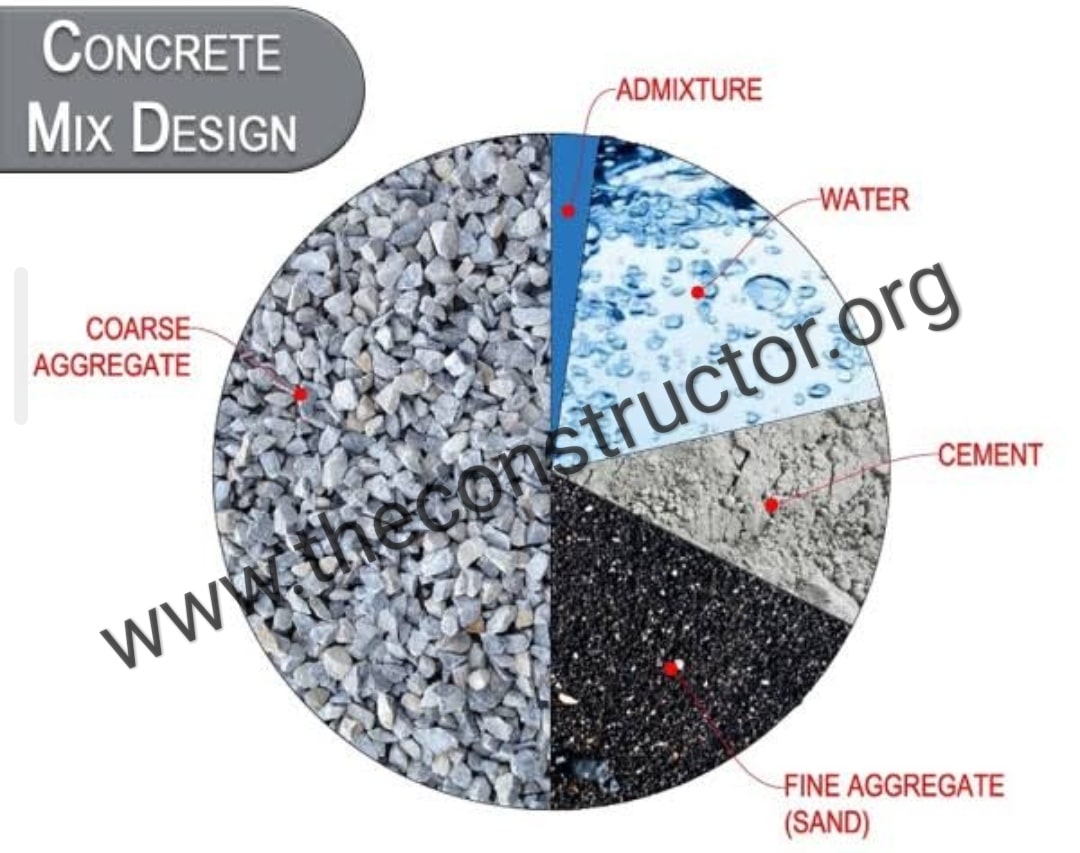
Explain the step by step process for Concrete Mix Design?

[Deleted User]
[Deleted User]

Explain the step by step process for concrete mix design?

  1. AdityaBhandakkar

    AdityaBhandakkar

    • 12 Questions
    • 250 Answers
    • 2 Best Answers
    • 0 Points
    View Profile
    AdityaBhandakkar User
    Added an answer on September 18, 2020 at 6:35 pm
    Explain the step by step process for Concrete Mix Design?

    Hi Kamesh Varan, For a step-by-step process of the mix, design refer IS 10262:2009. Also refer ACI 211.1, for details of mix design and the calculation of quantity. You may also refer IS 456: 2000 for curing and other properties of it also gives the idea of durability and strength of structures.

    Hi Kamesh Varan,

    For a step-by-step process of the mix, design refer IS 10262:2009.

    Also refer ACI 211.1, for details of mix design and the calculation of quantity.

    You may also refer IS 456: 2000 for curing and other properties of it also gives the idea of durability and strength of structures.

    See less
    • 45
    • Share
      Share
      • Share on Facebook
      • Share on Twitter
      • Share on LinkedIn
      • Share on WhatsApp
  • 0
  • 4 4 Answers
  • 7,293 Views
  • 0 Followers
Asked: July 20, 2020In: Concrete

Why strength of white cement is less than OPC cement?

Vivek Patel
Vivek Patel

Vivek Patel

  • 39 Questions
  • 80 Answers
  • 1 Best Answer
  • 6 Points
View Profile
Vivek Patel User

Why strength of white cement is less than OPC cement?

  1. nikeetasharma

    nikeetasharma

    • 23 Questions
    • 303 Answers
    • 0 Best Answers
    • 2,680 Points
    View Profile
    nikeetasharma Guru
    Added an answer on December 18, 2020 at 2:21 pm

    Production of white concrete with a compressive strength between 25 and 50 Mpa is possible by using white cement. It was also found out in study that white concrete had higher compressive strength than normal gray concrete. The strength in opc cement comes from calcium aluminate present in it. In anRead more

    Production of white concrete with a compressive strength between 25 and 50 Mpa is possible by using white cement. It was also found out in study that white concrete had higher compressive strength than normal gray concrete. The strength in opc cement comes from calcium aluminate present in it. In another hand, for achieving white color in white cement limestone, chalk, and clay are mixed due to which it gets expand and leads to lower strength.

    See less
    • 0
    • Share
      Share
      • Share on Facebook
      • Share on Twitter
      • Share on LinkedIn
      • Share on WhatsApp
  • 0
  • 3 3 Answers
  • 7,241 Views
  • 0 Followers
Asked: June 11, 2020In: Concrete

What is grade of PCC used at site?

Namita Ghosh
Namita Ghosh

Namita Ghosh

  • 1 Question
  • 0 Answers
  • 0 Best Answers
  • 0 Points
View Profile
Namita Ghosh User

What is grade of PCC used at site?

  1. Abbas Khan Civil Engineer

    Abbas Khan Civil Engineer

    • 11 Questions
    • 29 Answers
    • 1 Best Answer
    • 925 Points
    View Profile
    Abbas Khan Civil Engineer Learner
    Added an answer on June 12, 2020 at 1:01 pm

    The Grade of the PCC used is M15 grade. IN M15 Grade, The mix ratio is 1:2:4. (1 cement,2 sand , 4 aggregates). Applications:  M15 grade plain concrete cement is used for levelling courses,bedding for footing, beams and columns e.tc.

    The Grade of the PCC used is M15 grade.

    IN M15 Grade, The mix ratio is 1:2:4. (1 cement,2 sand , 4 aggregates).

    Applications:  M15 grade plain concrete cement is used for levelling courses,bedding for footing, beams and columns e.tc.

    See less
    • 4
    • Share
      Share
      • Share on Facebook
      • Share on Twitter
      • Share on LinkedIn
      • Share on WhatsApp
  • 0
  • 1 1 Answer
  • 7,138 Views
  • 0 Followers
Asked: September 22, 2020In: Concrete

Sugar is act as an accelerator or retarder in concrete?

Komal Bhandakkar
Komal Bhandakkar

Komal Bhandakkar

  • 49 Questions
  • 255 Answers
  • 0 Best Answers
  • 2,050 Points
View Profile
Komal Bhandakkar AUTHOR

Sugar is act as an accelerator or retarder in concrete?

  1. Preet Chovatiya

    Preet Chovatiya

    • 11 Questions
    • 81 Answers
    • 5 Best Answers
    • 858 Points
    View Profile
    Preet Chovatiya Learner
    Added an answer on November 26, 2020 at 10:20 pm

    Sugar meddles with the concrete restricting cycle in the solid. Note that solid and concrete are not equivalent. Concrete is made by consolidating concrete, water and a filler material called a "total," like rock or sand. Most concrete is produced using limestone and dirt. It responds with water toRead more

    Sugar meddles with the concrete restricting cycle in the solid. Note that solid and concrete are not equivalent. Concrete is made by consolidating concrete, water and a filler material called a “total,” like rock or sand. Most concrete is produced using limestone and dirt. It responds with water to frame a solidifying glue that ties the total together to create hard concrete. This solidifying cycle is called hydration.

    One hypothesis recommends that when the solid combination contains sugar, the sugar particles connect themselves to the hydrating solidify and repress the synthetic responses associated with hardening the material.

    sugar builds the centralizations of calcium, aluminum, and iron in concrete. The sugar particles consolidate with these metals to frame insoluble compound buildings that coat the concrete grains. A few key synthetic cycles that solidify the solid are then hindered. Hydration hinders the cycle and the solid takes more time to set. Thus, sugar is known as a retarder. Retarders increment the setting season of cement.

    Refined white sugar is extraordinary compared to other retarders. Lactose, the sugar found in milk, is a moderate retarder. Trehalose, a sugar created by different parasites, is non-hindering and doesn’t influence setting time.

    See less
    • 0
    • Share
      Share
      • Share on Facebook
      • Share on Twitter
      • Share on LinkedIn
      • Share on WhatsApp
  • 32
  • 4 4 Answers
  • 6,496 Views
  • 0 Followers
Asked: May 31, 2020In: Concrete

What is the difference between Segregation and Honeycomb in Concrete? 

saifalnahwy
saifalnahwy

saifalnahwy

  • 2 Questions
  • 0 Answers
  • 0 Best Answers
  • 10 Points
View Profile
saifalnahwy User

What is the difference between segregation and honeycomb in concrete?

  1. aviratdhodare

    aviratdhodare

    • 37 Questions
    • 252 Answers
    • 0 Best Answers
    • 480 Points
    View Profile
    aviratdhodare
    Added an answer on August 13, 2020 at 1:05 pm

    Segregation is the “Separation of constituent materials in concrete.” In concrete technology, segregation is of three types:- 1. Separation of Coarse aggregate from the concrete mixture, 2. Separation of Cement paste from the concrete during its plastic stage. 3. Separation of water from the concretRead more

    Segregation is the “Separation of constituent materials in concrete.” In concrete technology, segregation is of three types:-

    1. Separation of Coarse aggregate from the concrete mixture,

    2. Separation of Cement paste from the concrete during its plastic stage.

    3. Separation of water from the concrete mix (Bleeding in concrete)

    Concrete is a mixture of cement, fine and coarse aggregates. Good concrete is one in which all the constituents are properly categorized to form a homogeneous mixture. The primary cause of Segregation in concrete is the differences in specific gravities of the constituents, Specific gravity of Cement is in between 3.1-3.6g/cc, and for aggregate it lies between 2.6-2.7g/cc due to these differences, the aggregate separates from the matrix and causes segregation in concrete.

    Some other factors causing segregation in concrete:-

    • Transporting concrete mixes for long distances.
    • Poorly proportioned mix, where sufficient matrix is not there to bind the aggregates
    • Dropping concrete from more than 1m.
    • Vibrating concrete for a long time.

    How to minimize segregation in concrete:-

    1. Segregation can be controlled by maintaining proper proportioning the mix.

    2. By peculiar handling, placing, transporting, compacting and finishing,

    3. By using air-entraining agents, admixtures and pozzolanic materials in the mix segregation controlled to some extent.

    In case of segregation, the heavy aggregate particles settle down leaving a sand cement mix on top affecting the quality adversely. Fine aggregate could be used to overcome the problems. However; the design mix must be such that the required strength could be achieved. Similarly, water ratio may be catered for in design mix to avoid bleeding keeping in view the local material specifications

    .Honeycombs are hollow spaces and cavities left in concrete mass on the surface or inside the concrete mass where concrete could not reach. These look like honey bees nest.

    Honeycombs which are on sides are visible to naked eyes and can be detected easily as soon shuttering is removed. Honeycombs which are inside the mass of concrete can only be detected by advanced techniques like ultrasonic testing etc.

    Honeycomb is due to non-reaching of concrete to all places due to to which cavities and hallow pockets are created,

    main reasons are:

    Honeycombs are hollow spaces and cavities left in concrete mass on the surface or inside the concrete mass where concrete could not reach. These look like honey bees nest.

    Honeycombs which are on sides are visible to naked eyes and can be detected easily as soon shuttering is removed. Honeycombs which are inside the mass of concrete can only be detected by advanced techniques like ultrasonic testing etc.

    Honeycomb is due to non-reaching of concrete to all places due to which cavities and hallow pockets are created, main reasons are:

    1) Improper vibration during concrete.

    2) Less cover to reinforcement bars

    3) Use of very stiff concrete (this can be avoided by controlling water as per slump test).

    4) Places like the junction of the beam to beam to column and to one or more beams are the typical spots where honeycombs are observed. This is due to jumbling of reinforcement of beams and column rods at one place; special attention is required at such place during concreting and vibrating.

    5) Presence of more percentage of the bigger size of aggregate in concrete also prevents concrete to fill narrow spaces between the reinforcement rods.

    See less
    • 33
    • Share
      Share
      • Share on Facebook
      • Share on Twitter
      • Share on LinkedIn
      • Share on WhatsApp
  • 0
  • 4 4 Answers
  • 6,232 Views
  • 0 Followers
Asked: July 13, 2020In: Concrete

What is difference between Waffle slab and Grid slab?

vivek gami
vivek gami

vivek gami

  • 54 Questions
  • 16 Answers
  • 5 Best Answers
  • 93 Points
View Profile
vivek gami User

What is difference between Waffle slab and Grid slab?

  1. Preet Chovatiya

    Preet Chovatiya

    • 11 Questions
    • 81 Answers
    • 5 Best Answers
    • 858 Points
    View Profile
    Preet Chovatiya Learner
    Added an answer on July 15, 2020 at 12:03 pm

    There is no difference in grid slab and waffle slab because both are the same, but names are different. Grid slab or waffle slab are define as a slab which have two-directional reinforcement outside of the material and giving a shape of pocket on a waffle. Features:- Slab thickness is 85-100 mm BeamRead more

    There is no difference in grid slab and waffle slab because both are the same, but names are different.

    Grid slab or waffle slab are define as a slab which have two-directional reinforcement outside of the material and giving a shape of pocket on a waffle.

    Grid or Waffle slab

    Features:-

    1. Slab thickness is 85-100 mm
    2. Beams are 100-200 mm wide
    3. Slab panel in 1 m grid type
    See less
    • 0
    • Share
      Share
      • Share on Facebook
      • Share on Twitter
      • Share on LinkedIn
      • Share on WhatsApp
  • 1
  • 1 1 Answer
  • 6,108 Views
  • 0 Followers
Asked: June 2, 2020In: Concrete

How to determination of Consistency of Cement as per IS Code?

[Deleted User]
[Deleted User]

How to determination of Consistency of Cement as per IS Code? Is there any reference for taking 400gm of cement for the consistency test?  

  1. Abbas Khan Civil Engineer

    Abbas Khan Civil Engineer

    • 11 Questions
    • 29 Answers
    • 1 Best Answer
    • 925 Points
    View Profile
    Abbas Khan Civil Engineer Learner
    Added an answer on June 6, 2020 at 12:00 am

    As Per IS Code 4031: The standard Consistency of a cement is defined as " A consistency which allow the Vicat Plunger to penetrate to a point 5 mm to 7 mm from the bottom of the mould". Procedure To Determine The Consistency Of the Cement: 1- Prepare the cement paste weighed 300 grams with  potableRead more

    As Per IS Code 4031:

    The standard Consistency of a cement is defined as ” A consistency which allow the Vicat Plunger to penetrate to a point 5 mm to 7 mm from the bottom of the mould”.

    Procedure To Determine The Consistency Of the Cement:

    1- Prepare the cement paste weighed 300 grams with  potable water  of known quantity.

    2-Taking utmost care that preparation time is between 3 mins to 5 mints and do not exceed the time.

    3-Fill the vicat mould with cement paste.

    4-Smooth the top layer of the cement paste.

    5-Trowel should be use for all the above process to determine the normal consistency of cement.

    6- Place the sample under the rod  bearing the plunger.

    7- Lower the plunger slowly to touch the surface of the test block and quickly release it, allowing it to penetrate in the paste.

    8- Write the record depth of the penetration.

    9- Try it on others samples with different amount of water, test it as the above procedure.

    FOEMULA’S USED ;

    Standard Consistency (%) = Weight of water added /Weight of cement *100

    Answer to 2nd Question:

    There is no refrence of taking 400gms of cement for consistency test,as per IS CODE 4031.

    See less
    • 1
    • Share
      Share
      • Share on Facebook
      • Share on Twitter
      • Share on LinkedIn
      • Share on WhatsApp
  • 2
  • 1 1 Answer
  • 6,063 Views
  • 0 Followers
Load More Questions

Sidebar

Explore

  • Questions
  • Ask Questions
  • Write for us
  • Artificial Intelligence
  • Sustainability
  • Building
    • Brick Masonry
    • Building Materials
    • Building Tips
    • Formwork/Shuttering
  • Concrete
    • Concrete Admixtures
    • Cement
    • Concrete Cracks
    • Concrete Properties
  • Construction
    • Construction Equipments
    • Construction Management
    • Construction Project
    • Estimating & Costing
  • How To Guide
    • Material Estimation
    • Repair/Protection Guide
    • Material Testing Guide
    • Mix Design Guide
    • Rate Analysis
  • Geotechnical
    • Foundation Engineering
    • Ground Improvement
  • Structural Engineering
    • Strengthening of Structure
    • Structual Inspection
    • Structural Detailing
  • Surveying
  • Tips

Footer

  • Ask Questions
  • Write for us
  • Popular Questions
  • Facebook
  • Instagram
  • Twitter
  • Telegram

© 2009-2021 The Constructor. All Rights Reserved.