

What is disturbed and undisturbed soil sample?


Thank you everyone.
Thank you everyone.
See lessJoin TheConstructor to ask questions, answer questions, write articles, and connect with other people. When you join you get additional benefits.
Log in to TheConstructor to ask questions, answer people’s questions, write articles & connect with other people. When you join you get additional benefits.
Lost your password? Please enter your email address. You will receive a link and will create a new password via email.
What is disturbed and undisturbed soil sample?
What are the methods for ground improvement technique and which one is the best among them?
Thank you everyone.
Thank you everyone.
See lesswhat are the difference between drained and undrained shear strength? under what condition drained or undrained shear strength should be used
One very imp decision on the selection of soil strength for design is whether the soil is behaving under drained or undrained loading conditions. Why, bcoz each gives diff strength values and the selection of the wrong trength could lead to disaster. Any soil can experience either condition dependinRead more
One very imp decision on the selection of soil strength for design is whether the soil is behaving under drained or undrained loading conditions. Why, bcoz each gives diff strength values and the selection of the wrong trength could lead to disaster. Any soil can experience either condition depending on the rate of loading and the permeability of the soil.
In general, we normally treat coarse-grained soils such as sands and gravels as drained materials bcoz their permeability is high and therefore water can flow freely through the large and continuous void spaces. Fine-grained soils such as silts and clay’s however have much smaller void spaces and often these aren’t continuous so there is no direct route for water to flow freely. You can consider water flow in fine-grained soils is a little like a game of snakes and ladders whether water advances to a certain pt but then as to backtrack as the void spaces come to an abrupt end.
Thus, the porous nature of soil has a direct influence on soil strength. We can illustrate this by again calling on Mohr circle for 2D stress as many practical problems can be treated by analysis in 2D. Imagine we have a submerged coarse grain material, this means the soil void space is saturated and that we’re going to construct a raft foundation at ground level. Consider a representative element within the bulb of soil influenced by the rafts floating. Before the raft is constructed, the soil element will experience the following vertical & horizontal normal stresses. The Mohr circle for these stresses looks like so,

Diag not exact, only for reference
notice that the circle is well away from the failure line and this is known as the K0 are at rest condition
K0 = σ3 / σ1
If the raft is now constructed, we see that the Mohr circle shifts to the right & increases in diameter. This is bcoz the raft loading increases both the horizontal and vertical normal stresses.
These increases take place in unison as the load is transferred directly into greater intergranular stresses. Any tendency for the pore water pressure to increase doesn’t materialize as the permeability of the soil permits the water to flow rapidly out of the void space. So the grain settled into a denser & stronger configuration & this is ∴ referred to as the drained or eff stress condition. The eff vertical stress on the soil element changes from the at-rest condn to the follow’g
σ1 = γsat . z – γw . z
σ1‘= (γsat . z + ∆σ) – γw . z
Note again that the Mohr circle at the end of construction remains well away from the line defining failure. Its dist away being a measure of the foundations FOS.
Now let’s take the exact same scenario but this time for a fine-grained soil. The K0 or in-situ stresses remain essentially the same as before. This time however that the foundation load is applied, the Mohr circle will again shift to the right but its dia remains constant. This occurs bcoz water is incompressible & it takes the additional load from the raft as the low permeability soil prevents the water in the void space from escaping quickly enough. Hence the soil grains are prevented from reconfiguring into a denser stronger structure. The consequence of such behavior can be seen if we test three specimens that are fully saturated have the same moisture content & a similar soil structure. Then the application of an increasing confining pressure in each test will simply mean that the pore water pressure in each specimen is increased by the same amount. No change in eff stress occurs as the pore water carries the additional load & the shear strength measured Cu will be the same irrespective of the confining pressure this gives a ϕu = 0° failure line. Also note that the characteristics of all three specimens in terms of eff stress is represented by the same circle. This is a consequence of the pore water pressure and failure then -‘ed from the initial confining stress for each test.
This is an imp concept to understand. It’s not that the soil has changed in any way but rather, the loading conditions are such that in the short term. The soil is not free draining & hence its strength is limited by its initial eff stress. In the long term of course, the elevated pore water pressures will dissipate & the stress once carried by the pore water will be transferred into the soil skeleton.
The lesson here is under undrained loading, saturated fine-grained soils will have a strength limited by their eff stress prior to loading. But in time, assuming the soil has not failed under the loading its strength will increase with transfer of load from the pore water to the soil grains.
In temperate climates throughout the world. Soils are essentially saturated at foundation level so engineers practicing in such regions would do well to remember this jekyll-and-hyde behavior of fine grained soils. Finally we mentioned earlier that as soil is loaded the strength increases as its grains move into a denser tighter configuration. The price we pay for this closing of void space is settlement or the movement of foundations.
See lessWhat are the properties and significance of Fire Clay?
Fire clay :- Fire clay is a range of refractory clays used in the manufacture of ceramics, especially fire brick. The United States Environmental Protection Agency defines fire clay very generally as a "mineral aggregate composed of hydrous silicates of aluminium (Al2O3·2SiO2·2H2O) with or without fRead more
Fire clay :-
Fire clay is a range of refractory clays used in the manufacture of ceramics, especially fire brick. The United States Environmental Protection Agency defines fire clay very generally as a “mineral aggregate composed of hydrous silicates of aluminium (Al2O3·2SiO2·2H2O) with or without free silica.”
Properties of fire clay :-
Fire clay is resistant to high temperatures, having fusion points higher than 1,600 °C (2,910 °F); therefore it is suitable for lining furnaces, as fire brick, and for manufacture of utensils used in the metalworking industries, such as crucibles, saggars, retorts and glassware. Because of its stability during firing in the kiln, it can be used to make complex items of pottery such as pipes and sanitary ware.
See lessIn which type of soil ‘Floating foundation’ can be used?
Floating foundation can be used in on high moisture soils.
Floating foundation can be used in on high moisture soils.
See lessWhat are the method for finding Bearing capacity of soil?
The different methods for finding bearing capacity of soil are as follows :- 1. Presumptive analysis 2. Analytical method 3. Plate bearing test 4. Penetration test 5. Modern testing method 6. Centrifuge test
The different methods for finding bearing capacity of soil are as follows :-
1. Presumptive analysis
2. Analytical method
3. Plate bearing test
4. Penetration test
5. Modern testing method
6. Centrifuge test
What is adsorbed water, and how does it affect the permeability of soil?
Adsorbed water The term 'Adsorbed water' as it applies to the area of reclamation can be defined as ' Water in a soil or rock mass, held by physico-chemical forces, having physical properties substantially different from absorbed water or chemically combined water, at the same temperature and pressuRead more
Adsorbed water
The term ‘Adsorbed water’ as it applies to the area of reclamation can be defined as ‘ Water in a soil or rock mass, held by physico-chemical forces, having physical properties substantially different from absorbed water or chemically combined water, at the same temperature and pressure’.
How affects the permeability :
Fine particles of clay are surrounded by films of adsorbed water. Forces of adsorption and development of diffuse ion-layer around the clay particles create immobilized hydrodynamic layers of water, thereby reducing the effective pore space available for seepage.
See less
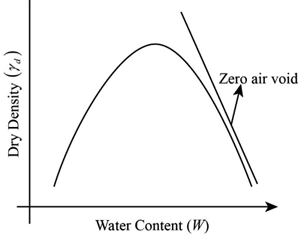
What is zero air void line in soil?
The zero Air Void line is obtained when there is no presence of the air in the pores of a soil mass and totally filled with the water and soil mass get saturated. It is determined by the compaction test of a soil. Draw the graph between Dry Density VS water content, calculate the dry density from thRead more
The zero Air Void line is obtained when there is no presence of the air in the pores of a soil mass and totally filled with the water and soil mass get saturated. It is determined by the compaction test of a soil. Draw the graph between Dry Density VS water content, calculate the dry density from the compaction test results, and Zero Air void line is drawn on the graph.




nikeetasharma
Disturbed soil sample is one in which the structure of the soil has been changed sufficiently that tests of the structural properties of the soil will not be representatives of in-situ conditions, and only properties of soil grains can be accurately determined. Undisturbed soil sample is one where tRead more
Disturbed soil sample is one in which the structure of the soil has been changed sufficiently that tests of the structural properties of the soil will not be representatives of in-situ conditions, and only properties of soil grains can be accurately determined.
Undisturbed soil sample is one where the condition of the soil in the sample is close enough to the conditions of the soil in in-situ to allow tests of structural properties of the soil to be used to approximate the properties of the soil in-situ.
See less