Sign Up

Join TheConstructor to ask questions, answer questions, write articles, and connect with other people. When you join you get additional benefits.

Have an account? Sign In


Have an account? Sign In Now

Sign In

Log in to TheConstructor to ask questions, answer people’s questions, write articles & connect with other people. When you join you get additional benefits.

Sign Up Here

Join for free or log in to continue reading...


Forgot Password?

Don't have account, Sign Up Here

Forgot Password

Lost your password? Please enter your email address. You will receive a link and will create a new password via email.

Have an account? Sign In Now

Sorry, you do not have a permission to ask a question, You must login to ask question. Get the paid membership

Join for free or log in to continue reading...


Forgot Password?

Don't have account, Sign Up Here
Get the paid membership
theconstructor.org Logo theconstructor.org Logo
Log inJoin

theconstructor.org

theconstructor.org Navigation

  • Articles
    • Recent Articles
    • Popular Articles
    • Write for us
  • Community
  • Categories
    • How To Guide
      • Material Testing Guide
    • Concrete
    • Building
      • Brick Masonry
      • Building Materials
      • Building Tips
    • Construction
      • Equipments
      • Management
    • Digital Construction
    • Geotechnical
      • Foundation
  • Case Studies
Search
Ask A Question

Mobile menu

Close
Ask a Question
  • Questions
  • Ask Questions
  • Write for us
  • Artificial Intelligence
  • Sustainability
  • Building
    • Brick Masonry
    • Building Materials
    • Building Tips
    • Formwork/Shuttering
  • Concrete
    • Concrete Admixtures
    • Cement
    • Concrete Cracks
    • Concrete Properties
  • Construction
    • Construction Equipments
    • Construction Management
    • Construction Project
    • Estimating & Costing
  • How To Guide
    • Material Estimation
    • Repair/Protection Guide
    • Material Testing Guide
    • Mix Design Guide
    • Rate Analysis
  • Geotechnical
    • Foundation Engineering
    • Ground Improvement
  • Structural Engineering
    • Strengthening of Structure
    • Structual Inspection
    • Structural Detailing
  • Surveying
  • Tips

Geotechnical Engineering

Home/Geotechnical Engineering/Page 3

Do you need to remove the ads? Get the paid membership

  • Recent Questions
  • Most Answered
  • Answers
  • No Answers
  • Most Visited
  • Most Voted
  • Random

Discy Latest Questions

Asked: September 19, 2020In: Geotechnical Engineering

What is adsorbed water, and how does it affect the permeability of soil?

aviratdhodare
aviratdhodare

aviratdhodare

  • 37 Questions
  • 252 Answers
  • 0 Best Answers
  • 480 Points
View Profile
aviratdhodare

What is adsorbed water, and how does it affect the permeability of soil?

  1. sanjaypakad

    sanjaypakad

    • 0 Questions
    • 9 Answers
    • 0 Best Answers
    • 232 Points
    View Profile
    sanjaypakad Beginner
    Added an answer on October 8, 2020 at 5:36 pm

    Adsorbed water The term 'Adsorbed water' as it applies to the area of reclamation can be defined as ' Water in a soil or rock mass, held by physico-chemical forces, having physical properties substantially different from absorbed water or chemically combined water, at the same temperature and pressuRead more

    Adsorbed water

    The term ‘Adsorbed water’ as it applies to the area of reclamation can be defined as ‘ Water in a soil or rock mass, held by physico-chemical forces, having physical properties substantially different from absorbed water or chemically combined water, at the same temperature and pressure’.

    How affects the permeability :

    Fine particles of clay are surrounded by films of adsorbed water. Forces of adsorption and development of diffuse ion-layer around the clay particles create immobilized hydrodynamic layers of water, thereby reducing the effective pore space available for seepage.


    See less
    • 2
    • Share
      Share
      • Share on Facebook
      • Share on Twitter
      • Share on LinkedIn
      • Share on WhatsApp
  • 31
  • 4 4 Answers
  • 6,247 Views
  • 0 Followers
Asked: July 24, 2020In: Geotechnical Engineering

What is zero air void line in soil?

Vivek Patel
Vivek Patel

Vivek Patel

  • 39 Questions
  • 80 Answers
  • 1 Best Answer
  • 6 Points
View Profile
Vivek Patel User

What is zero air void line in soil?

  1. Abbas Khan Civil Engineer

    Abbas Khan Civil Engineer

    • 11 Questions
    • 29 Answers
    • 1 Best Answer
    • 925 Points
    View Profile
    Abbas Khan Civil Engineer Learner
    Added an answer on July 27, 2020 at 3:17 pm

    The zero Air Void line is obtained when there is no presence of the air in the pores of a soil mass and totally filled with the water and soil mass get saturated. It is determined by the compaction test of a soil. Draw the graph between Dry Density VS water content, calculate the dry density from thRead more

    The zero Air Void line is obtained when there is no presence of the air in the pores of a soil mass and totally filled with the water and soil mass get saturated. It is determined by the compaction test of a soil. Draw the graph between Dry Density VS water content, calculate the dry density from the compaction test results, and Zero Air void line is drawn on the graph.
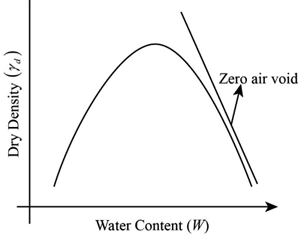
     

    Graph A

    See less
    • 19
    • Share
      Share
      • Share on Facebook
      • Share on Twitter
      • Share on LinkedIn
      • Share on WhatsApp
  • 3
  • 4 4 Answers
  • 38,641 Views
  • 0 Followers
Asked: June 24, 2020In: Geotechnical Engineering

What is Submerged Density and Degree of Shrinkage?

Manas Ranjan Patra
Manas Ranjan Patra

Manas Ranjan Patra

  • 1 Question
  • 0 Answers
  • 0 Best Answers
  • 5 Points
View Profile
Manas Ranjan Patra User

  What is the submerged density and degree of shrinkage?

  1. Kuldeep Singh

    Kuldeep Singh

    • 1 Question
    • 110 Answers
    • 10 Best Answers
    • 652 Points
    View Profile
    Best Answer
    Kuldeep Singh Learner
    Added an answer on June 28, 2020 at 10:30 pm

    Submerged density or bouyant density is the density of a mass of soil as observed under water in a saturated condition of course. Suppose you are calculating the density when the soil mass and you yourself are submerged. It is calculated as the difference of the soil density in air and the density oRead more

    Submerged density or bouyant density is the density of a mass of soil as observed under water in a saturated condition of course. Suppose you are calculating the density when the soil mass and you yourself are submerged. It is calculated as the difference of the soil density in air and the density of water, divided by the density of water.

    SD = (density of soil – density of water) / density of water

    or

    SD = density of soil in air – 1

    It is also defined as the mass of soil minus the mass of water displaced by it upon submergence, divided by the volume.

    This concept is particularly useful in determining the bouyancy of submerged soils and is crucial in equations of sediment transport in rivers. If the bouyant density equals 1, the soil just floats. If it gets negative, soil will rise in water.

    Degree of shrinkage is another concept. It is the amount of water content reduction needed to bring the soil to its shrinkage limit, expressed as percent of the original water content.

    See less
    • 4
    • Share
      Share
      • Share on Facebook
      • Share on Twitter
      • Share on LinkedIn
      • Share on WhatsApp
  • 3
  • 4 4 Answers
  • 9,034 Views
  • 0 Followers
Asked: June 29, 2020In: Geotechnical Engineering

What is Tacheometry?

RaghavArora
RaghavArora

RaghavArora

  • 4 Questions
  • 5 Answers
  • 1 Best Answer
  • 847 Points
View Profile
RaghavArora Learner

What is a tachometry? What is it’s used in civil engineering projects?

  1. Soumyadeep Halder

    Soumyadeep Halder

    • 0 Questions
    • 29 Answers
    • 2 Best Answers
    • 57 Points
    View Profile
    Best Answer
    Soumyadeep Halder User
    Added an answer on June 30, 2020 at 6:46 pm

    ans- defination Tacheometric is a branch of surveying in which horizontal and vertical distances are determined by taking angular observation with an instrument known as a tachometer. Tacheometric surveying is adopted in rough in rough and difficult terrain where direct levelling and chaining are eiRead more

    ans- defination

    Tacheometric is a branch of surveying in which horizontal and vertical distances are
    determined by taking angular observation with an instrument known as a tachometer.
    Tacheometric surveying is adopted in rough in rough and difficult terrain where direct levelling
    and chaining are either not possible or very tedious.
    Tacheometric survey also can be used for Railways, Roadways, and reservoirs etc.
    Tacheometric surveying is very rapid, and a reasonable contour map can be prepared for
    investigation works within a short time on the basis of such survey.
    An ordinary transits theodolite fitted with a stadia diaphragm is generally used for tacheometric
    surveying.

    Uses of Tachometry in civil engineering
    Tachometry is used for preparation of topographic map where both horizontal and vertical
    distances are required to be measured; survey work in difficult terrain where direct methods of
    measurements are inconvenient; reconnaissance survey for highways and railways etc.;
    Establishment of secondary control points.

    See less
    • 4
    • Share
      Share
      • Share on Facebook
      • Share on Twitter
      • Share on LinkedIn
      • Share on WhatsApp
  • 2
  • 3 3 Answers
  • 5,425 Views
  • 1 Follower
Asked: July 19, 2020In: Geotechnical Engineering

Why abutment in bridge is designed as earth pressure and rest condition?

Himanshu joshi
Himanshu joshi

Himanshu joshi

  • 11 Questions
  • 27 Answers
  • 0 Best Answers
  • 767 Points
View Profile
Himanshu joshi Learner

Why abutment in bridge is designed as earth pressure and rest condition?

  1. nikeetasharma

    nikeetasharma

    • 23 Questions
    • 303 Answers
    • 0 Best Answers
    • 2,680 Points
    View Profile
    nikeetasharma Guru
    Added an answer on December 17, 2020 at 12:03 pm

    Abutment in bridge is designed as earth pressure and rest condition because abutments support the ends of the bridge and transfer the loads from the superstructure in to the ground. The abutments also support the bearing devices and the backwalls Moreover, bridge abutments connect the deck, or surfaRead more

    Abutment in bridge is designed as earth pressure and rest condition because abutments support the ends of the bridge and transfer the loads from the superstructure in to the ground. The abutments also support the bearing devices and the backwalls Moreover, bridge abutments connect the deck, or surface of the bridge, to the ground and help support its weight both horizontally and vertically. On short bridges, one abutment is placed at either end of the bridge and connected to the embankment, sometimes including a retaining wall.

    See less
    • 0
    • Share
      Share
      • Share on Facebook
      • Share on Twitter
      • Share on LinkedIn
      • Share on WhatsApp
  • 1
  • 3 3 Answers
  • 2,231 Views
  • 0 Followers
Asked: July 15, 2020In: Geotechnical Engineering

What is Supersaturated in Soil?

vivek gami
vivek gami

vivek gami

  • 54 Questions
  • 16 Answers
  • 5 Best Answers
  • 93 Points
View Profile
vivek gami User

What is Supersaturated in Soil?

  1. Vivek Patel

    Vivek Patel

    • 39 Questions
    • 80 Answers
    • 1 Best Answer
    • 6 Points
    View Profile
    Vivek Patel User
    Added an answer on July 22, 2020 at 12:06 am

    Basically in soil there is 3 part Solids partical Air Water When water added to soil, at that time soil become saturated. And when air contain replace by water and soil become fully saturated at that time soil have two part one is water and one is solid partical.   If we add more water than fulRead more

    Basically in soil there is 3 part

    1. Solids partical
    2. Air
    3. Water

    When water added to soil, at that time soil become saturated. And when air contain replace by water and soil become fully saturated at that time soil have two part one is water and one is solid partical.


    If we add more water than fully saturation, hence saturation of soil is 100% or more than that, is called the supersaturated stage.

    Water content more than shrinkage limit called supersaturated stage

    See less
    • 1
    • Share
      Share
      • Share on Facebook
      • Share on Twitter
      • Share on LinkedIn
      • Share on WhatsApp
  • 1
  • 3 3 Answers
  • 3,316 Views
  • 0 Followers
Asked: September 22, 2020In: Geotechnical Engineering

How can we differentiate clay and silt apart from its sizes?

Komal Bhandakkar
Komal Bhandakkar

Komal Bhandakkar

  • 49 Questions
  • 255 Answers
  • 0 Best Answers
  • 2,050 Points
View Profile
Komal Bhandakkar AUTHOR

How can we differentiate clay and silt apart from its sizes?

  1. nikeetasharma

    nikeetasharma

    • 23 Questions
    • 303 Answers
    • 0 Best Answers
    • 2,680 Points
    View Profile
    nikeetasharma Guru
    Added an answer on October 9, 2020 at 9:45 am

    Here, from a geotechnical perspective you can’t differentiate silt and clay on the basis of grain size because it can be irrelevant to material behaviour. Silt and clay are both the result of the physical and chemical breakdown of the minerals in rocks. They main difference is in chemical compositioRead more

    Here, from a geotechnical perspective you can’t differentiate silt and clay on the basis of grain size because it can be irrelevant to material behaviour.

    Silt and clay are both the result of the physical and chemical breakdown of the minerals in rocks. They main difference is in chemical composition and particle size.

    Silt is composed of silicate minerals, or those containing silicon and oxygen.

    Clay is composed of metal silicates, or silicates with metals like magnesium or aluminum associated with it.

    But in terms of handling the two as part of an experiment, the main discernible difference is particle size. Sand particles are larger than silt particles which are in turn larger than clay particles. Silt particles are about 0.05 to 0.002 millimeters in size. Clay particles are smaller than micrometer in size. So silt particles are too small to really be felt with your fingers like grains of sand. But wet silt will feel very smooth like finely ground baking flour. Clay particles are so small that they will simply feel sticky. You won’t be able to move them around your fingers like silt particles. This stickiness will be the main difference between the two in terms of touch.

    See less
    • 36
    • Share
      Share
      • Share on Facebook
      • Share on Twitter
      • Share on LinkedIn
      • Share on WhatsApp
  • 31
  • 3 3 Answers
  • 13,677 Views
  • 0 Followers
Asked: June 24, 2020In: Geotechnical Engineering

What is Braced Excavation?

Rohan Chaugule
Rohan Chaugule

Rohan Chaugule

  • 12 Questions
  • 11 Answers
  • 1 Best Answer
  • 1,045 Points
View Profile
Rohan Chaugule Expert

What is Braced Excavation?

  1. Kuldeep Singh

    Kuldeep Singh

    • 1 Question
    • 110 Answers
    • 10 Best Answers
    • 652 Points
    View Profile
    Kuldeep Singh Learner
    Added an answer on June 28, 2020 at 10:30 pm
    What is Braced Excavation?

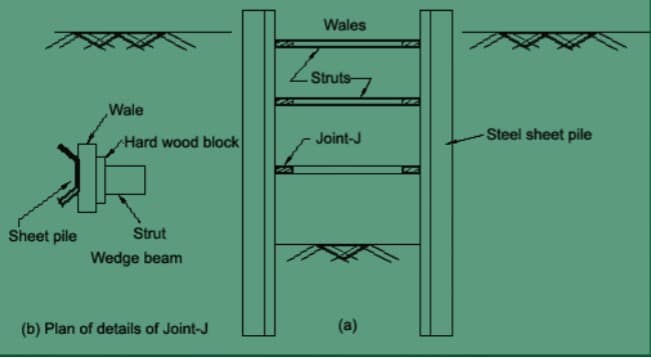
    Braced excavation is a method where deep excavations with straight vertical faces are laterally supported by a sheeting and bracing system until the structure is built. In deep excavations creating a safe slope on the excavation face just for safety is generally not feasible due to high cost, inabunRead more

    Braced excavation is a method where deep excavations with straight vertical faces are laterally supported by a sheeting and bracing system until the structure is built.

    In deep excavations creating a safe slope on the excavation face just for safety is generally not feasible due to high cost, inabundance of space and other structures present nearby. So, the excavation is temperorly supported by sheets/walls and struts, which are removed individually when their requirements cease. Relatively flexible sheets/walls are placed against excavation walls and supported by horizontal struts which in turn resist the earth pressure in compression.

    Some methods are vertical timber sheeting, shoring, steel sheet piling, soldier beams and also tiebacks.

    These structures might not be removed later but they may or may structurallynot be structurally important apart from offering temperorly lateral support. For example, tie backs support excavations and also replace permanent retaining walls.

    See less
    • 2
    • Share
      Share
      • Share on Facebook
      • Share on Twitter
      • Share on LinkedIn
      • Share on WhatsApp
  • 0
  • 3 3 Answers
  • 11,602 Views
  • 0 Followers
Load More Questions

Sidebar

Explore

  • Questions
  • Ask Questions
  • Write for us
  • Artificial Intelligence
  • Sustainability
  • Building
    • Brick Masonry
    • Building Materials
    • Building Tips
    • Formwork/Shuttering
  • Concrete
    • Concrete Admixtures
    • Cement
    • Concrete Cracks
    • Concrete Properties
  • Construction
    • Construction Equipments
    • Construction Management
    • Construction Project
    • Estimating & Costing
  • How To Guide
    • Material Estimation
    • Repair/Protection Guide
    • Material Testing Guide
    • Mix Design Guide
    • Rate Analysis
  • Geotechnical
    • Foundation Engineering
    • Ground Improvement
  • Structural Engineering
    • Strengthening of Structure
    • Structual Inspection
    • Structural Detailing
  • Surveying
  • Tips

Footer

  • Ask Questions
  • Write for us
  • Popular Questions
  • Facebook
  • Instagram
  • Twitter
  • Telegram

© 2009-2021 The Constructor. All Rights Reserved.