
Foundation
Home/Foundation/Page 2Do you need to remove the ads? Get the paid membership
Join TheConstructor to ask questions, answer questions, write articles, and connect with other people. When you join you get additional benefits.
Log in to TheConstructor to ask questions, answer people’s questions, write articles & connect with other people. When you join you get additional benefits.
Lost your password? Please enter your email address. You will receive a link and will create a new password via email.
Which type of foundation is best for black cotton soil?
Ajinkya Morey
Under reamed pile is the best type of foundation for black cotton soil as it's The reamed pipe is placed with the moistured surface, and the ball present in it will allow the equal distribution of the load of the structure
On what basis is the pile foundation recommended?
Preet Chovatiya
As per my knowledge and experience pile foundation is recommended for the below situations. 1. When building loads are very heavy and concentrate or UDL loading. 2. In High rise structures 3. In Bridges and water tank 4. When the soil layer is very weak and doesn't able to resist the building load tRead more
As per my knowledge and experience pile foundation is recommended for the below situations.
1. When building loads are very heavy and concentrate or UDL loading.
2. In High rise structures
3. In Bridges and water tank
4. When the soil layer is very weak and doesn’t able to resist the building load then we have to use a pile foundation.
See lessWhat is punching shear failure of foundation?
CB Sowmya
Punching shear failure of foundation occurs when there is a localized force acting on the structure. It is mostly found in foundations but also common in flat slabs. In punching failure of foundations, the column breaks through the foundation mat. In flat slabs, the failure occurs at the column headRead more
Punching shear failure of foundation occurs when there is a localized force acting on the structure. It is mostly found in foundations but also common in flat slabs.
In punching failure of foundations, the column breaks through the foundation mat. In flat slabs, the failure occurs at the column head. This type of failure is sudden and does not show any warning. Therefore it is crucial to check for punching shear and to provide sufficient reinforcement to take care of it. Reinforcements should be provided in addition to the main reinforcements. This punching shear must not be neglected though it is less critical than the beam shear.
To know more about punching shear,
https://theconstructor.org/structural-engg/punching-shear-slabs-foundations/17716/
See lessWhat is Pedestal in Column?
Vivek Patel
See the figure Pedestal is a compression member who has the length to least lateral dimension ratio is less than 3. It is used at where column load is very high, and we required more depth of footing around column edge to transfer the load and prevent failure of footing, at the time, we provide a peRead more
See the figure
Pedestal is a compression member who has the length to least lateral dimension ratio is less than 3.
It is used at where column load is very high, and we required more depth of footing around column edge to transfer the load and prevent failure of footing, at the time, we provide a pedestal to transfer load safely from column to footing.
Pedestal is usually used in steel structure where the column load is very high.
See lessWhich type of foundation are used for G+5 building?
DevilAVRT
The decision of establishment to a great extent relies upon the soil where it is being proposed to be laid and also on what are you going to build, I.e., by implication, the load itself. Essentially a mix of isolated and combined footing for buildings up to G+4, pile foundations for G+5 and above. SRead more
The decision of establishment to a great extent relies upon the soil where it is being proposed to be laid and also on what are you going to build, I.e., by implication, the load itself.
See lessEssentially a mix of isolated and combined footing for buildings up to G+4, pile foundations for G+5 and above. Strip, mat if the soil is not suitable
One thing must be remembered that it is the soil which conveys the load, foundations distribute it.
Which type of foundation is used in sea link project bridge?
DevilAVRT
Most commonly, they use reinforced pile. For e.g., Bandra Worli sea link. The foundations for the BWSL's cable-stayed bridges consist of 120 reinforced concrete piles of 2,000 mm (6.6 ft) diameter. Those for the viaducts consist of 484 piles of 1,500 mm (4.9 ft). These 604 piles were driven betweenRead more
Most commonly, they use reinforced pile.
For e.g., Bandra Worli sea link. The foundations for the BWSL’s cable-stayed bridges consist of 120 reinforced concrete piles of 2,000 mm (6.6 ft) diameter. Those for the viaducts consist of 484 piles of 1,500 mm (4.9 ft). These 604 piles were driven between 6m and 34m into the substrata in geotechnical conditions that varied from highly weathered volcanic material to massive high strength rocks.
See lessWhat is diffrent between strap footing and wall footing?
Preet Chovatiya
Strip Footing (Wall Footing) :- Strip Footing is one type of shallow foundation, and it is used to transfer load-bearing structure weight to the ground evenly. It is used only when soil bearing capacity is good. The width of footing generally kept as twice of the wall width. Strap Footing:- Strap FoRead more
Strip Footing (Wall Footing) :-
Strip Footing is one type of shallow foundation, and it is used to transfer load-bearing structure weight to the ground evenly. It is used only when soil bearing capacity is good. The width of footing generally kept as twice of the wall width.
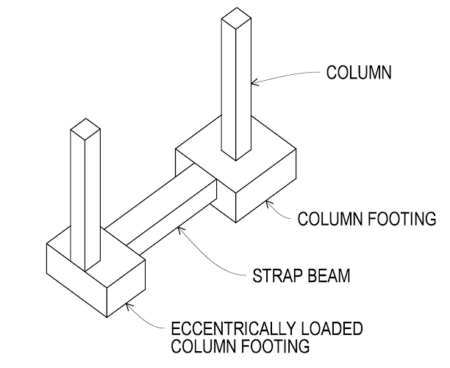
Strap Footing:-
Strap Footing is generally used when the column footing width is restricted due to limitations of the boundary. It is also called as cantilever footing and is one type of combined footing.
See lessWhat is Universal Foundation?
vivek gami
universal foundation is pile foundation. it is used at all location, so we call it universal foundation in simple way basically pile foundation use at where bearing capacity of soil is low where chances of differential settlement of foundation where structural load is very high like bridge or skyskiRead more
universal foundation is pile foundation.
it is used at all location, so we call it universal foundation in simple way
basically pile foundation use at
- where bearing capacity of soil is low
- where chances of differential settlement of foundation
- where structural load is very high like bridge or skyskiper building
- where black cotton soil is present
- where bearing strata depth is very high
- where structure need to resist excessive vibration (wind mill)
- pile foundation we can use every where.
See less