
Sign Up

Join TheConstructor to ask questions, answer questions, write articles, and connect with other people. When you join you get additional benefits.

Have an account? Sign In


Have an account? Sign In Now

Sign In

Log in to TheConstructor to ask questions, answer people’s questions, write articles & connect with other people. When you join you get additional benefits.

Sign Up Here

Join for free or log in to continue reading...


Forgot Password?

Don't have account, Sign Up Here

Forgot Password

Lost your password? Please enter your email address. You will receive a link and will create a new password via email.

Have an account? Sign In Now

Sorry, you do not have a permission to ask a question, You must login to ask question. Get the paid membership

Join for free or log in to continue reading...


Forgot Password?

Don't have account, Sign Up Here
Get the paid membership
theconstructor.org Logo theconstructor.org Logo
Log inJoin

theconstructor.org

theconstructor.org Navigation

  • Articles
    • Recent Articles
    • Popular Articles
    • Write for us
  • Community
  • Categories
    • How To Guide
      • Material Testing Guide
    • Concrete
    • Building
      • Brick Masonry
      • Building Materials
      • Building Tips
    • Construction
      • Equipments
      • Management
    • Digital Construction
    • Geotechnical
      • Foundation
  • Case Studies
Search
Ask A Question

Mobile menu

Close
Ask a Question
  • Questions
  • Ask Questions
  • Write for us
  • Artificial Intelligence
  • Sustainability
  • Building
    • Brick Masonry
    • Building Materials
    • Building Tips
    • Formwork/Shuttering
  • Concrete
    • Concrete Admixtures
    • Cement
    • Concrete Cracks
    • Concrete Properties
  • Construction
    • Construction Equipments
    • Construction Management
    • Construction Project
    • Estimating & Costing
  • How To Guide
    • Material Estimation
    • Repair/Protection Guide
    • Material Testing Guide
    • Mix Design Guide
    • Rate Analysis
  • Geotechnical
    • Foundation Engineering
    • Ground Improvement
  • Structural Engineering
    • Strengthening of Structure
    • Structual Inspection
    • Structural Detailing
  • Surveying
  • Tips

Miscellaneous

Home/Miscellaneous/Page 3

Do you need to remove the ads? Get the paid membership

  • Recent Questions
  • Most Answered
  • Answers
  • No Answers
  • Most Visited
  • Most Voted
  • Random

Discy Latest Questions

Asked: July 7, 2020In: Miscellaneous

Which software used for taking out estimation of building or any structure?

Preet Chovatiya
Preet Chovatiya

Preet Chovatiya

  • 11 Questions
  • 81 Answers
  • 5 Best Answers
  • 858 Points
View Profile
Preet Chovatiya Learner

Which software used for taking out estimation of building or any structure?

  1. nikeetasharma

    nikeetasharma

    • 23 Questions
    • 303 Answers
    • 0 Best Answers
    • 2,680 Points
    View Profile
    nikeetasharma Guru
    Added an answer on November 24, 2020 at 6:24 pm

    The softwares used for taking out estimation of building are as follows :- 1. ProEst Estimating Software 2. Stack Software 3. Clear Estimates Software 4. Sage Estimating Software

    The softwares used for taking out estimation of building are as follows :-
    1. ProEst Estimating Software
    2. Stack Software
    3. Clear Estimates Software
    4. Sage Estimating Software

    See less
    • 0
    • Share
      Share
      • Share on Facebook
      • Share on Twitter
      • Share on LinkedIn
      • Share on WhatsApp
  • 0
  • 2 2 Answers
  • 477 Views
  • 0 Followers
Asked: November 28, 2020In: Miscellaneous

What is the percentage of carbon in wrought iron?

Komal Bhandakkar
Komal Bhandakkar

Komal Bhandakkar

  • 49 Questions
  • 255 Answers
  • 0 Best Answers
  • 2,050 Points
View Profile
Komal Bhandakkar AUTHOR

What is the percentage of carbon in wrought iron?

  1. aviratdhodare

    aviratdhodare

    • 37 Questions
    • 252 Answers
    • 0 Best Answers
    • 480 Points
    View Profile
    aviratdhodare
    Added an answer on January 5, 2021 at 1:53 pm

    Wrought iron is a form of commercial iron containing less than 0.10% of carbon, less than 0.25% of impurities total of sulfur, phosphorus, silicon and manganese, and less than 2% slag by weight. Wrought iron is redshort or hot short if it contains sulfur in excess quantity.

    Wrought iron is a form of commercial iron containing less than 0.10% of carbon, less than 0.25% of impurities total of sulfur, phosphorus, silicon and manganese, and less than 2% slag by weight. Wrought iron is redshort or hot short if it contains sulfur in excess quantity.

    See less
    • 1
    • Share
      Share
      • Share on Facebook
      • Share on Twitter
      • Share on LinkedIn
      • Share on WhatsApp
  • 2
  • 2 2 Answers
  • 2,669 Views
  • 1 Follower
Asked: August 17, 2020In: Miscellaneous

What is Gunia in Building Construction?

aviratdhodare
aviratdhodare

aviratdhodare

  • 37 Questions
  • 252 Answers
  • 0 Best Answers
  • 480 Points
View Profile
aviratdhodare

What is Gunia in Building Construction?

  1. nikeetasharma

    nikeetasharma

    • 23 Questions
    • 303 Answers
    • 0 Best Answers
    • 2,680 Points
    View Profile
    nikeetasharma Guru
    Added an answer on December 17, 2020 at 9:06 pm

    Gunia means simply a diagonal checking of the rectangular area.

    Gunia means simply a diagonal checking of the rectangular area.

    See less
    • 0
    • Share
      Share
      • Share on Facebook
      • Share on Twitter
      • Share on LinkedIn
      • Share on WhatsApp
  • 32
  • 4 4 Answers
  • 10,272 Views
  • 0 Followers
Asked: July 17, 2020In: Miscellaneous

What is the meaning of fluxes in hydrology?

fathima
fathima

fathima

  • 26 Questions
  • 10 Answers
  • 0 Best Answers
  • 377 Points
View Profile
fathima Beginner

What is the meaning of fluxes in hydrology?

  1. Vivek Patel

    Vivek Patel

    • 39 Questions
    • 80 Answers
    • 1 Best Answer
    • 6 Points
    View Profile
    Vivek Patel User
    Added an answer on July 24, 2020 at 7:42 pm

    Fluxes mean inflow- outflow water relationship. Basically fluxes term use in groundwater study. In order to define the water balance or water budget of an aquifer system of soil strata, the individual processes that bring water into or the liftoff of the system must be quantified. Groundwater InflowRead more

    Fluxes mean inflow- outflow water relationship.

    Basically fluxes term use in groundwater study. In order to define the water balance or water budget of an aquifer system of soil strata, the individual processes that bring water into or the liftoff of the system must be quantified.

    Groundwater Inflow due to

    • Infiltration of rain water
    • Ground water flow
    • Surrounding seepage

    GroundwaterOutflow due to

    • Due to irrigation pumping
    • Due to evaporation and transpiration
    • Groundwater meet to sea water
    • Groundwater passed to string and it lost.
    See less
    • 2
    • Share
      Share
      • Share on Facebook
      • Share on Twitter
      • Share on LinkedIn
      • Share on WhatsApp
  • 1
  • 1 1 Answer
  • 2,140 Views
  • 0 Followers
Asked: October 5, 2020In: Miscellaneous

What is the difference between Declination and Dip?

Komal Bhandakkar
Komal Bhandakkar

Komal Bhandakkar

  • 49 Questions
  • 255 Answers
  • 0 Best Answers
  • 2,050 Points
View Profile
Komal Bhandakkar AUTHOR

What is the difference between declination and dip?

  1. Komal Bhandakkar

    Komal Bhandakkar

    • 49 Questions
    • 255 Answers
    • 0 Best Answers
    • 2,050 Points
    View Profile
    Komal Bhandakkar AUTHOR
    Added an answer on October 9, 2020 at 9:25 pm
    This answer was edited.
    What is the difference between Declination and Dip?

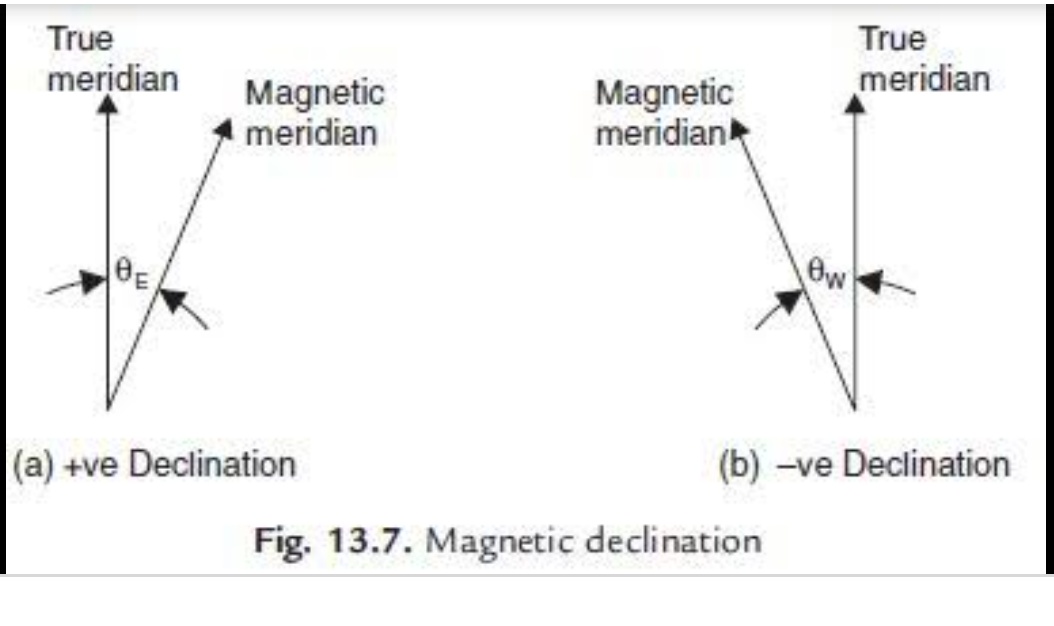
    Declination: I am providing more additional information about the declination, have a look. Here, I Attached a diagram of declination, through that we can clearly understand positive as well as negative declination. Whenever declination is towards the Eastwood direction then that declination is callRead more

    Declination:

    I am providing more additional information about the declination, have a look.

    Here, I Attached a diagram of declination, through that we can clearly understand positive as well as negative declination.


    1. Whenever declination is towards the Eastwood direction then that declination is called positive declination.

    2. When a declination is going towards west word direction then it is called negative declination.

    True bearing is the sum of magnetic bearing plus declination.


    Thank you.

    See less
    • 33
    • Share
      Share
      • Share on Facebook
      • Share on Twitter
      • Share on LinkedIn
      • Share on WhatsApp
  • 25
  • 5 5 Answers
  • 15,136 Views
  • 0 Followers
Asked: July 6, 2020In: Miscellaneous

How can we measure the infiltration rate in the filed?

Ancy Joby
Ancy Joby

Ancy Joby

  • 20 Questions
  • 11 Answers
  • 1 Best Answer
  • 580 Points
View Profile
Ancy Joby Learner

How can we measure the infiltration rate in the filed? Mention the apparatus used for the measurement.

  1. Preet Chovatiya

    Preet Chovatiya

    • 11 Questions
    • 81 Answers
    • 5 Best Answers
    • 858 Points
    View Profile
    Preet Chovatiya Learner
    Added an answer on July 6, 2020 at 2:38 pm

    Generally, for measurement of infiltration on the field we use the Cylindrical Infiltrometer of diameter 30 cm and 60 cm. Basic infiltration rate for a different type of soil are as below: If the infiltration rate is 1-5 mm/hour that it is Clay. If the infiltration rate is 5-10 mm/hour that it is ClRead more

    Generally, for measurement of infiltration on the field we use the Cylindrical Infiltrometer of diameter 30 cm and 60 cm. Basic infiltration rate for a different type of soil are as below:

    1. If the infiltration rate is 1-5 mm/hour that it is Clay.
    2. If the infiltration rate is 5-10 mm/hour that it is Clay Loam.
    3. If the infiltration rate is 10-20 mm/hour that it is Loam.
    4. If the infiltration rate is 20-30 mm/hour that it is Sandy Loam.
    5. If the infiltration rate is greater than 30 mm/hour that it is Sand.
    See less
    • 0
    • Share
      Share
      • Share on Facebook
      • Share on Twitter
      • Share on LinkedIn
      • Share on WhatsApp
  • 0
  • 1 1 Answer
  • 796 Views
  • 0 Followers
Asked: September 19, 2020In: Miscellaneous

What is the difference between the modulus of rupture and flexural strength?

aviratdhodare
aviratdhodare

aviratdhodare

  • 37 Questions
  • 252 Answers
  • 0 Best Answers
  • 480 Points
View Profile
aviratdhodare

What is the difference between the modulus of rupture and flexural strength?

  1. nikeetasharma

    nikeetasharma

    • 23 Questions
    • 303 Answers
    • 0 Best Answers
    • 2,680 Points
    View Profile
    nikeetasharma Guru
    Added an answer on November 27, 2020 at 3:25 pm

    Flexural strength is the maximum strength (stress) either yield or up to fracture that a structure or element or a member could bear. It could be measures in terms of modulus of rupture at yield also. Where in modulus of rupture is just showing the present stress condition within the member or elemeRead more

    Flexural strength is the maximum strength (stress) either yield or up to fracture that a structure or element or a member could bear. It could be measures in terms of modulus of rupture at yield also.

    Where in modulus of rupture is just showing the present stress condition within the member or element itself. If the member is on the verge of failure i.e on the verge of fracture than the modulus of rupture will give Flexural strength.

    See less
    • 0
    • Share
      Share
      • Share on Facebook
      • Share on Twitter
      • Share on LinkedIn
      • Share on WhatsApp
  • 32
  • 3 3 Answers
  • 12,256 Views
  • 0 Followers
Asked: September 2, 2020In: Miscellaneous

Why water tanks are still designed by the working stress method?

aviratdhodare
aviratdhodare

aviratdhodare

  • 37 Questions
  • 252 Answers
  • 0 Best Answers
  • 480 Points
View Profile
aviratdhodare

Why water tanks are still designed by the working stress method?

  1. nikeetasharma

    nikeetasharma

    • 23 Questions
    • 303 Answers
    • 0 Best Answers
    • 2,680 Points
    View Profile
    nikeetasharma Guru
    Added an answer on October 15, 2020 at 10:00 am

    Here, because water tanks are more vulnerable structures and plus the tank is sometime overfilled and sometime empty, the pressure inside is so varying, It needs more safety precautions and as we all know working stress method assumes more safety factor than limit state design, which is an economicaRead more

    Here, because water tanks are more vulnerable structures and plus the tank is sometime overfilled and sometime empty, the pressure inside is so varying,

    It needs more safety precautions and as we all know working stress method assumes more safety factor than limit state design, which is an economical design, we prefer to use working stress method…

    See less
    • 30
    • Share
      Share
      • Share on Facebook
      • Share on Twitter
      • Share on LinkedIn
      • Share on WhatsApp
  • 34
  • 5 5 Answers
  • 9,129 Views
  • 0 Followers
Load More Questions

Sidebar

Explore

  • Questions
  • Ask Questions
  • Write for us
  • Artificial Intelligence
  • Sustainability
  • Building
    • Brick Masonry
    • Building Materials
    • Building Tips
    • Formwork/Shuttering
  • Concrete
    • Concrete Admixtures
    • Cement
    • Concrete Cracks
    • Concrete Properties
  • Construction
    • Construction Equipments
    • Construction Management
    • Construction Project
    • Estimating & Costing
  • How To Guide
    • Material Estimation
    • Repair/Protection Guide
    • Material Testing Guide
    • Mix Design Guide
    • Rate Analysis
  • Geotechnical
    • Foundation Engineering
    • Ground Improvement
  • Structural Engineering
    • Strengthening of Structure
    • Structual Inspection
    • Structural Detailing
  • Surveying
  • Tips

Footer

  • Ask Questions
  • Write for us
  • Popular Questions
  • Facebook
  • Instagram
  • Twitter
  • Telegram

© 2009-2021 The Constructor. All Rights Reserved.