Sign Up

Join TheConstructor to ask questions, answer questions, write articles, and connect with other people. When you join you get additional benefits.

Have an account? Sign In


Have an account? Sign In Now

Sign In

Log in to TheConstructor to ask questions, answer people’s questions, write articles & connect with other people. When you join you get additional benefits.

Sign Up Here

Join for free or log in to continue reading...


Forgot Password?

Don't have account, Sign Up Here

Forgot Password

Lost your password? Please enter your email address. You will receive a link and will create a new password via email.

Have an account? Sign In Now

Sorry, you do not have a permission to ask a question, You must login to ask question. Get the paid membership

Join for free or log in to continue reading...


Forgot Password?

Don't have account, Sign Up Here
Get the paid membership
theconstructor.org Logo theconstructor.org Logo
Log inJoin

theconstructor.org

theconstructor.org Navigation

  • Articles
    • Recent Articles
    • Popular Articles
    • Write for us
  • Community
  • Categories
    • How To Guide
      • Material Testing Guide
    • Concrete
    • Building
      • Brick Masonry
      • Building Materials
      • Building Tips
    • Construction
      • Equipments
      • Management
    • Digital Construction
    • Geotechnical
      • Foundation
  • Case Studies
Search
Ask A Question

Mobile menu

Close
Ask a Question
  • Questions
  • Ask Questions
  • Write for us
  • Artificial Intelligence
  • Sustainability
  • Building
    • Brick Masonry
    • Building Materials
    • Building Tips
    • Formwork/Shuttering
  • Concrete
    • Concrete Admixtures
    • Cement
    • Concrete Cracks
    • Concrete Properties
  • Construction
    • Construction Equipments
    • Construction Management
    • Construction Project
    • Estimating & Costing
  • How To Guide
    • Material Estimation
    • Repair/Protection Guide
    • Material Testing Guide
    • Mix Design Guide
    • Rate Analysis
  • Geotechnical
    • Foundation Engineering
    • Ground Improvement
  • Structural Engineering
    • Strengthening of Structure
    • Structual Inspection
    • Structural Detailing
  • Surveying
  • Tips

Structural Engineering

Home/Structural Engineering/Page 5

Do you need to remove the ads? Get the paid membership

  • Recent Questions
  • Most Answered
  • Answers
  • No Answers
  • Most Visited
  • Most Voted
  • Random

Discy Latest Questions

Asked: October 5, 2020In: Structural Engineering

How to detect/identify reinforcement bars inside the hardened concrete?

Getu B.
Getu B.

Getu B.

  • 1 Question
  • 2 Answers
  • 0 Best Answers
  • 60 Points
View Profile
Getu B. User

How to detect/identify reinforcement bars inside the hardened concrete, such as footings and columns without destructing the built concrete?

  1. AdityaBhandakkar

    AdityaBhandakkar

    • 12 Questions
    • 250 Answers
    • 2 Best Answers
    • 0 Points
    View Profile
    AdityaBhandakkar User
    Added an answer on October 6, 2020 at 8:10 am
    This answer was edited.

    Hi, Following are some process to identify the defects and done inspection of Steel bars in reinforcement concrete Eddy current Technique, Single frequency method, Microwave heating of numerical modelling, Refer this methods in ACI for details practical use.

    Hi, Following are some process to identify the defects and done inspection of Steel bars in reinforcement concrete

    1. Eddy current Technique,
    2. Single frequency method,
    3. Microwave heating of numerical modelling,

    Refer this methods in ACI for details practical use.

    See less
    • 36
    • Share
      Share
      • Share on Facebook
      • Share on Twitter
      • Share on LinkedIn
      • Share on WhatsApp
  • 0
  • 2 2 Answers
  • 734 Views
  • 0 Followers
Asked: September 19, 2020In: Structural Engineering

What happens when the thrust line coincides with the bottom Vern axis of beam? (Prestressed concrete)

aviratdhodare
aviratdhodare

aviratdhodare

  • 37 Questions
  • 252 Answers
  • 0 Best Answers
  • 480 Points
View Profile
aviratdhodare

What happens when the thrust line coincides with the bottom Vern axis of beam? (Prestressed concrete)

  1. nikeetasharma

    nikeetasharma

    • 23 Questions
    • 303 Answers
    • 0 Best Answers
    • 2,680 Points
    View Profile
    nikeetasharma Guru
    Added an answer on November 26, 2020 at 1:24 pm
    This answer was edited.

    Basically, shear force is the combination of flexural compression which result as C and tends to form an inclined thrust line known as arch. For example consider a simple strut and tie model. Here it may be technically expected that the shear force is supported by the longitudinal resultant.   NαVcoRead more

    Basically, shear force is the combination of flexural compression which result as C and tends to form an inclined thrust line known as arch. For example consider a simple strut and tie model. Here it may be technically expected that the shear force is supported by the longitudinal resultant.  

    NαVcotθNa=αVcotθ

    Shear force is the product of shear stress and area. Thrust line can also affect the stability. 

    See less

    • 0
    • Share
      Share
      • Share on Facebook
      • Share on Twitter
      • Share on LinkedIn
      • Share on WhatsApp
  • 30
  • 3 3 Answers
  • 1,006 Views
  • 0 Followers
Asked: July 20, 2020In: Structural Engineering

What is the compressive strength of Fe500 rebars?

CB Sowmya
CB Sowmya

CB Sowmya

  • 3 Questions
  • 53 Answers
  • 4 Best Answers
  • 5 Points
View Profile
CB Sowmya User

What is the compressive strength of Fe500 rebars?

  1. Kuldeep Singh

    Kuldeep Singh

    • 1 Question
    • 110 Answers
    • 10 Best Answers
    • 652 Points
    View Profile
    Best Answer
    Kuldeep Singh Learner
    Added an answer on July 21, 2020 at 10:30 pm

    It is generally assumed to be 250 MPa.

    It is generally assumed to be 250 MPa.

    See less
    • 2
    • Share
      Share
      • Share on Facebook
      • Share on Twitter
      • Share on LinkedIn
      • Share on WhatsApp
  • 3
  • 3 3 Answers
  • 3,417 Views
  • 0 Followers
Asked: April 24, 2021In: Structural Engineering

Is it safe not to build a colunm at an intersection of two beams?

Yousuf arian
Yousuf arian

Yousuf arian

  • 1 Question
  • 0 Answers
  • 0 Best Answers
  • 25 Points
View Profile
Yousuf arian User

Is it safe not to build a column at an intersection of two beams?

  1. Fasi Ur Rahman

    Fasi Ur Rahman

    • 4 Questions
    • 36 Answers
    • 1 Best Answer
    • 1,323 Points
    View Profile
    Fasi Ur Rahman
    Added an answer on April 24, 2021 at 7:51 pm

    Yes, it is safe not to build a column at an intersection of two beams subjected that all the loads are considered, calculated, and transferred via columns placed at the end of the beams.

    Yes, it is safe not to build a column at an intersection of two beams subjected that all the loads are considered, calculated, and transferred via columns placed at the end of the beams.

    See less
    • 1
    • Share
      Share
      • Share on Facebook
      • Share on Twitter
      • Share on LinkedIn
      • Share on WhatsApp
  • 0
  • 1 1 Answer
  • 1,369 Views
  • 0 Followers
Asked: July 22, 2020In: Structural Engineering

What is the benefit of smaller dia steel instead of larger dia steel in slab and beam?

vivek gami
vivek gami

vivek gami

  • 54 Questions
  • 16 Answers
  • 5 Best Answers
  • 93 Points
View Profile
vivek gami User

What is the benefit of smaller dia steel instead of larger dia steel in slab and beam?

  1. nikeetasharma

    nikeetasharma

    • 23 Questions
    • 303 Answers
    • 0 Best Answers
    • 2,680 Points
    View Profile
    nikeetasharma Guru
    Added an answer on December 18, 2020 at 6:40 pm

    Having smaller diameter rebar distributed throughout the structure also distributes the load from the concrete to the steel more effectively as there is a greater area of contact for adhesion between the two.

    Having smaller diameter rebar distributed throughout the structure also distributes the load from the concrete to the steel more effectively as there is a greater area of contact for adhesion between the two.

    See less
    • 1
    • Share
      Share
      • Share on Facebook
      • Share on Twitter
      • Share on LinkedIn
      • Share on WhatsApp
  • 4
  • 5 5 Answers
  • 2,702 Views
  • 0 Followers
Asked: June 29, 2020In: Structural Engineering

What are the Different Types of Steel Stacks?

Maulik vavaliya
Maulik vavaliya

Maulik vavaliya

  • 3 Questions
  • 1 Answer
  • 0 Best Answers
  • 43 Points
View Profile
Maulik vavaliya User

What are the different types of steel stacks?

  1. Preet Chovatiya

    Preet Chovatiya

    • 11 Questions
    • 81 Answers
    • 5 Best Answers
    • 858 Points
    View Profile
    Best Answer
    Preet Chovatiya Learner
    Added an answer on June 30, 2020 at 6:46 pm

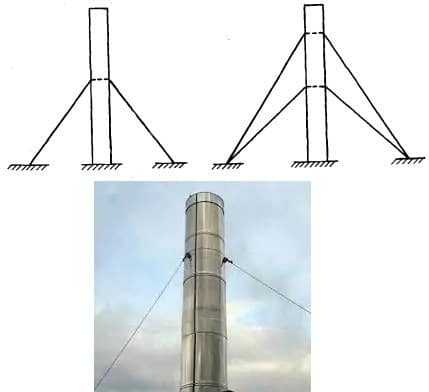
    There are four types of steel stack that generally used in steel stack are as below: Freestanding (Self-supported) steel stack (fig.1) The base support and guyed steel stack (fig.2) The base support and braced steel stack Multi flue stack (fig.3) [caption id="attachment_45199" align="alignnone" widtRead more

    There are four types of steel stack that generally used in steel stack are as below:

    1. Freestanding (Self-supported) steel stack (fig.1)
    2. The base support and guyed steel stack (fig.2)
    3. The base support and braced steel stack
    4. Multi flue stack (fig.3)

    fig.1

    fig.2

    fig.3

    See less
    • 1
    • Share
      Share
      • Share on Facebook
      • Share on Twitter
      • Share on LinkedIn
      • Share on WhatsApp
  • 2
  • 1 1 Answer
  • 4,405 Views
  • 1 Follower
Asked: May 18, 2020In: Structural Engineering

Which Type of Cement is used for Pile Foundation?

poojan
poojan

poojan

  • 5 Questions
  • 14 Answers
  • 1 Best Answer
  • 604 Points
View Profile
poojan Learner

Which type of cement is used in the construction of a pile foundation? Kindly mention the references from codes or guides for the answer.

  1. Madeh Izat Hamakareem

    Madeh Izat Hamakareem

    • 0 Questions
    • 40 Answers
    • 3 Best Answers
    • 1,229 Points
    View Profile
    Best Answer
    Madeh Izat Hamakareem
    Added an answer on May 18, 2020 at 11:35 pm

    Any type of cement can be used as long as the design and durability requirements of the concrete used to construct the pile are met. For instance, if the sulfate attack is expected, it is desirable to select sulfate resistance cement because it produces concrete that withstand sulfate attack. As a rRead more

    Any type of cement can be used as long as the design and durability requirements of the concrete used to construct the pile are met. For instance, if the sulfate attack is expected, it is desirable to select sulfate resistance cement because it produces concrete that withstand sulfate attack. As a result, the produced concrete would durable.

    You can visit the following link to read more about Applications of Different Types of Cement for Concrete Construction:

    https://theconstructor.org/building/applications-cement-types-concrete/7686/

    The ACI code 318-18 provides the design and durability requirements of concrete.

    Design Requirements of Concrete Based on ACI 318-19

    https://theconstructor.org/concrete/design-requirements-concrete/39004/

    Concrete Durability Requirements Based on ACI-318-19

    https://theconstructor.org/concrete/concrete-durability-requirements/39036/

    See less
    • 2
    • Share
      Share
      • Share on Facebook
      • Share on Twitter
      • Share on LinkedIn
      • Share on WhatsApp
  • 1
  • 2 2 Answers
  • 5,806 Views
  • 0 Followers
Asked: August 2, 2020In: Structural Engineering

Where is the T beam used in concrete structure?

Vivek Patel
Vivek Patel

Vivek Patel

  • 39 Questions
  • 80 Answers
  • 1 Best Answer
  • 6 Points
View Profile
Vivek Patel User

Where is the T beam used in concrete structure?

  1. nikeetasharma

    nikeetasharma

    • 23 Questions
    • 303 Answers
    • 0 Best Answers
    • 2,680 Points
    View Profile
    nikeetasharma Guru
    Added an answer on November 23, 2020 at 11:20 am

    Here, the designers gets a natural advantage of using T or L beams in any structure with slab beam construction. It is mainly used in frame type structure. A T-beam or Tee-beam is used in a construction process which is a load bearing structure of a reinforced concrete, wood or metal having T-shapedRead more

    Here, the designers gets a natural advantage of using T or L beams in any structure with slab beam construction. It is mainly used in frame type structure. A T-beam or Tee-beam is used in a construction process which is a load bearing structure of a reinforced concrete, wood or metal having T-shaped cross-section. The vertical section (web) of the beam below the compression flange serves to resist shear stress and to provide greater separation for the coupled forces of bending.
    Therefore, in any situation of beam-slab we can use T-beam.

    See less
    • 0
    • Share
      Share
      • Share on Facebook
      • Share on Twitter
      • Share on LinkedIn
      • Share on WhatsApp
  • 1
  • 4 4 Answers
  • 6,689 Views
  • 0 Followers
Load More Questions

Sidebar

Explore

  • Questions
  • Ask Questions
  • Write for us
  • Artificial Intelligence
  • Sustainability
  • Building
    • Brick Masonry
    • Building Materials
    • Building Tips
    • Formwork/Shuttering
  • Concrete
    • Concrete Admixtures
    • Cement
    • Concrete Cracks
    • Concrete Properties
  • Construction
    • Construction Equipments
    • Construction Management
    • Construction Project
    • Estimating & Costing
  • How To Guide
    • Material Estimation
    • Repair/Protection Guide
    • Material Testing Guide
    • Mix Design Guide
    • Rate Analysis
  • Geotechnical
    • Foundation Engineering
    • Ground Improvement
  • Structural Engineering
    • Strengthening of Structure
    • Structual Inspection
    • Structural Detailing
  • Surveying
  • Tips

Footer

  • Ask Questions
  • Write for us
  • Popular Questions
  • Facebook
  • Instagram
  • Twitter
  • Telegram

© 2009-2021 The Constructor. All Rights Reserved.